
Quick Summary
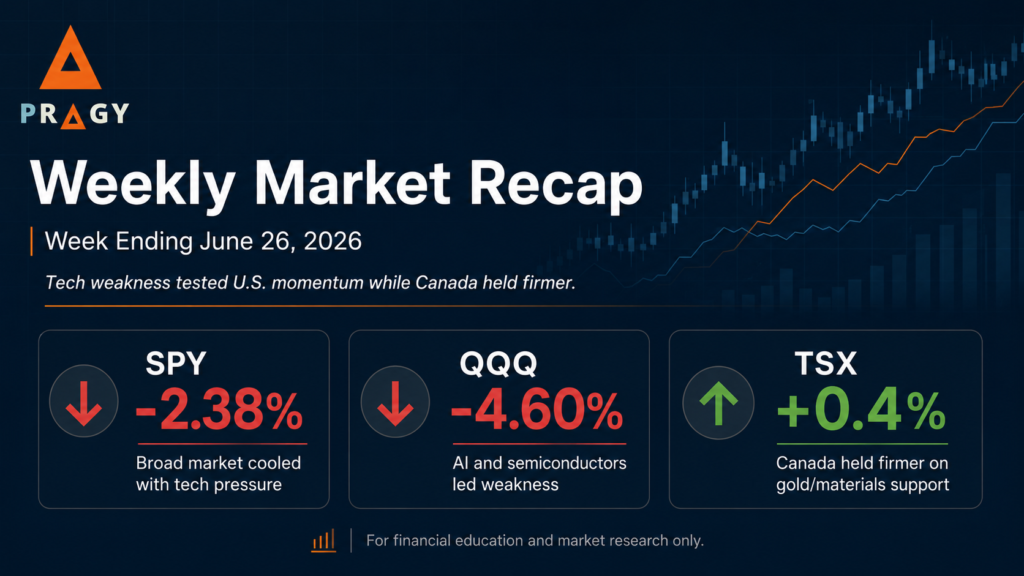
The week ending June 26, 2026, brought a clear shift in market tone. U.S. markets lost momentum as AI-linked and semiconductor names came under pressure, with SPY finishing the week down about 2.38% and QQQ down about 4.60%. The move did not look like a broad collapse, but it did show that crowded leadership areas can cool quickly when expectations become stretched.
Canada held up better on a relative basis. The S&P/TSX Composite finished the week up about 0.4%, helped by strength in gold and materials even as commodity sensitivity remained an important risk. The main takeaway: U.S. technology leadership is still important, but the market is now asking for more confirmation before rewarding high-growth and AI-related themes.
Market Tone
The tone was mixed, selective, and more risk-aware than the prior stretch of trading. In the U.S., the broader market was still near elevated levels, but the weakness in AI, semiconductors, and several mega-cap technology names created a more cautious backdrop.
This was not a full risk-off week across every area. Some defensive, healthcare, and select value-oriented groups held up better, and small-cap performance was not uniformly weak. Still, the market showed that leadership was narrowing in the highest-expectation parts of technology.
For Pragy watchlist work, the key message is to separate healthy pullbacks from failed breakouts. Strong charts can reset, but they need confirmation, volume support, and clear invalidation levels before being treated as constructive again.
SPY / QQQ Context
SPY moved lower for the week as the S&P 500 gave back recent strength. The pullback was driven by pressure in technology-heavy leadership groups, along with weakness in parts of industrials and materials. Broad market structure remains important because SPY is still the cleaner read on whether the selloff is contained or spreading into wider risk reduction.
QQQ was the weaker major U.S. index ETF in focus. The Nasdaq-100 proxy was hit by pressure in AI-linked hardware and semiconductor names, showing how quickly high-momentum leadership can reverse when sentiment turns. The weekly loss in QQQ was larger than SPY, which points to a leadership reset rather than a uniform market decline.
The most constructive scenario for next week would be stabilization in QQQ, improving breadth, and a move back above short-term resistance with participation from more than one technology group. The more cautious scenario would be continued weakness in semiconductors, failed rebounds in mega-cap technology, and SPY losing support as selling broadens.
TSX / Canadian Market Context
The Canadian market held firmer than the U.S. technology-heavy indexes. The S&P/TSX Composite finished the week with a modest gain, supported by strength in gold-related materials shares. That helped offset pressure from earlier commodity weakness and broader global risk caution.
Canada’s market remains more sensitive to commodities, financials, materials, and energy than the U.S. mega-cap technology complex. That difference helped the TSX show relative resilience this week, but it also means next week’s tone may depend on whether gold, oil, and the Canadian dollar remain stable.
For Canadian watchlists, materials and gold miners remain under observation after the late-week rebound. Energy names need a more selective read because softer oil prices can pressure sentiment, even when individual setups remain technically constructive.
Strong Sectors
Gold and materials: Gold-linked materials helped support the TSX into the end of the week. This group remains worth tracking for follow-through, but strength should be judged against commodity-price confirmation and volume quality.
Healthcare and biotech: Healthcare showed pockets of relative strength in the U.S. market. This kind of rotation can be useful when high-growth technology cools, but individual names still need clean setups and clear risk levels.
Selective software and quality growth: Not all technology acted the same. Software and higher-quality growth areas that avoided the worst of the semiconductor pressure may remain candidates for watchlist review if the broader market stabilizes.
Small-cap and non-mega-cap breadth: Some smaller-cap areas held up better than the headline technology weakness suggested. This is important to watch because durable broadening would improve the quality of the market backdrop.
Weak Sectors
Semiconductors and AI hardware: This was the clearest weak area of the week. The group remains a major leadership gauge, and continued weakness would likely weigh on QQQ and broader risk appetite.
Mega-cap technology: Several large technology names faced selling pressure as investors reassessed AI spending, margins, and valuation expectations. A rebound attempt should be treated as a test, not automatic confirmation.
U.S. industrials and materials: Parts of these groups also weakened late in the week, which matters because broader participation outside technology is needed for a healthier market tone.
Energy-sensitive areas: Energy remains under observation after oil-price weakness. Canadian energy watchlists should be approached with extra attention to crude-price direction and sector breadth.
Notable Watchlist Themes
AI leadership reset: AI remains a major long-term market theme, but this week showed that leadership can pause or reverse when expectations become crowded. Watch for whether AI-linked names reclaim support or continue to distribute.
Semiconductor confirmation: Semis remain one of the most important risk gauges for QQQ. A strong bounce with breadth would be constructive; a weak bounce followed by another lower low would keep caution elevated.
Gold and materials follow-through: The TSX benefited from materials strength into Friday. Next week should show whether this was only a short-term rebound or the start of stronger relative leadership.
Quality over momentum: In a choppier tape, clean balance sheets, steady earnings quality, and controlled pullbacks may matter more than aggressive breakout chasing.
Canada versus U.S. divergence: The TSX held up better than QQQ this week. If that divergence continues, Canadian watchlists may offer different opportunities than U.S. mega-cap technology setups.
Risk Notes
Markets are still vulnerable to fast sentiment shifts around inflation, interest rates, commodity prices, AI spending expectations, and geopolitical headlines. A leadership pullback can remain orderly, but it can also become more serious if selling broadens across sectors.
Strong areas can become extended, while weak areas can rebound quickly. For that reason, confirmation matters. Watchlist setups should be evaluated with risk/reward, support levels, volume quality, and invalidation points instead of relying on prediction.
For Pragy market notes, the focus remains on observation, scenario planning, and education. The goal is to understand market context, not to force trades or make certainty-based calls.
What to Watch Next Week
Next week, the market will need to prove whether this was a short-term reset or the start of a deeper rotation. Key items to monitor include:
- Whether QQQ can stabilize after the technology-led decline.
- Whether SPY holds short-term support and avoids broader sector weakness.
- Semiconductor follow-through after the sharp weekly pullback.
- Gold, oil, and materials behavior for TSX direction.
- Breadth across healthcare, software, small caps, and defensive groups.
- Inflation, rates, central-bank commentary, and any new macro headlines.
- Whether Canada’s relative strength continues or fades if commodities weaken.
A constructive start to the week would include calmer semiconductor trading, broader sector participation, and steady TSX leadership from materials or financials. A cautious start would include another failed rebound in QQQ, renewed oil weakness, or a breakdown in SPY breadth.
Source Notes
Market levels and weekly context were reviewed using public market data and market-close reporting available after the June 26, 2026 close. SPY and QQQ weekly changes were calculated from historical closing prices using the June 26 close versus the prior available U.S. market close. TSX weekly context was reviewed from market-close reporting for the S&P/TSX Composite.
Author Disclosure
Disclosure: The author may hold positions in securities, ETFs, leveraged ETFs, options, or related instruments discussed.
Disclaimer
This content is for financial education and market research only. It is not investment advice, financial planning, portfolio management, tax advice, legal advice, or a recommendation to buy, sell, or hold any security. Trading and investing involve risk, including possible loss of capital. Readers are responsible for their own decisions and should consult a qualified financial professional before making financial decisions.