
Quick Summary
SPY has bounced back into a former resistance zone, but the index is entering the week with several important tests. Technology has pulled back from recent leadership, financials have shown stronger relative tone, and renewed U.S.–Iran hostilities are keeping oil prices and inflation expectations in focus.
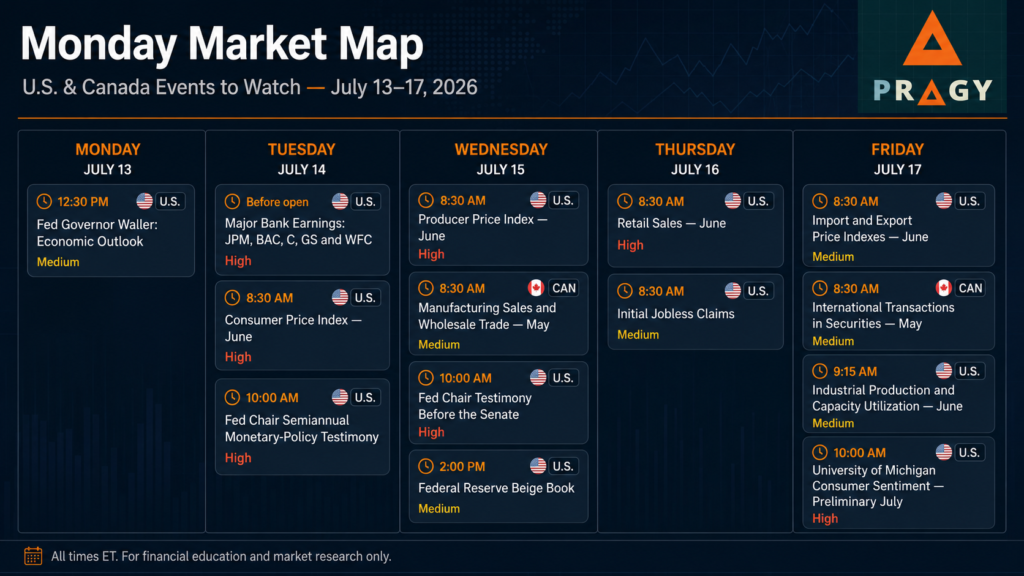
The market may remain selective rather than broadly risk-on. Tuesday's U.S. CPI report, a heavy slate of major-bank earnings, Federal Reserve testimony, and later-week retail-sales and industrial-production data could determine whether the rebound develops into broader participation or loses momentum near resistance.
Market Tone
The tone is mixed, event-driven, and selective.
SPY's rebound is constructive, but the move is occurring near an area where sellers previously appeared. A clean continuation would be more convincing if market breadth improves and leadership expands beyond financials and energy. Failure to hold the rebound could leave the market vulnerable to another rotation toward defensive positioning.
Oil remains a major cross-asset variable. Renewed conflict risk around Iran and the Strait of Hormuz can lift energy prices, support parts of the energy sector, and simultaneously pressure transportation, consumer-sensitive industries, and inflation expectations. That combination makes this week's CPI and PPI releases especially important.
SPY / QQQ Context
SPY: The broad-market ETF has recovered into a former resistance zone. The key question is whether that area can convert into support. Confirmation would include steady closes above the reclaimed zone, improving participation, and less dependence on a narrow group of leaders. Rejection from the area would keep the index in a choppy range and raise the risk of another pullback.
QQQ: Technology and high-duration growth stocks have cooled after leading much of the prior advance. The pullback does not automatically end the broader trend, but it increases the importance of relative-strength confirmation. Semiconductors, mega-cap software, and AI-linked names should be watched for stabilization rather than assumed to resume leadership immediately.
A softer inflation reading could help rate-sensitive growth stocks, while a hotter report or another oil spike could pressure valuations and reinforce the rotation toward financials, energy, and shorter-duration cash-flow profiles.
TSX / Canadian Market Context
The TSX remains highly sensitive to financials, energy, and materials. Financials are the index's largest sector weight, so continued strength in Canadian banks and insurers can provide meaningful support. Energy may also act as a relative-strength pocket while oil remains elevated, although geopolitical headlines can create sharp two-way moves.
Canadian equities could therefore hold up better than U.S. growth benchmarks during a technology pullback, but that resilience is not guaranteed. A broad risk-off move, weaker commodity pricing, or a reversal in financials could quickly narrow TSX leadership.
Canada's most relevant releases this week are May manufacturing sales and wholesale trade on Wednesday, followed by international securities transactions on Friday. Canada's June CPI is scheduled for the following Monday, July 20, rather than during this week's window.
Sector Map
Stronger or Improving
Financials: Relative strength is the clearest positive theme. Major U.S. banks report Tuesday, making earnings quality, credit trends, trading revenue, loan growth, and management outlooks important confirmation points.
Energy: Supported by renewed oil-supply concerns and geopolitical risk. The group may remain firm while crude holds elevated levels, but headline sensitivity is unusually high.
Select Industrials: Companies with durable backlogs, pricing power, or energy and infrastructure exposure may benefit from rotation away from crowded growth leadership.
Weaker or More Selective
Technology: The sector has pulled back and needs stabilization. Mega-cap software and semiconductors remain important, but confirmation matters more than chasing early rebounds.
Healthcare: The group remains selective. Defensive characteristics may attract interest during volatility, but sector-wide momentum has been uneven.
High-Beta and Speculative Growth: Quantum-computing and other emerging-technology names can move sharply in both directions. These setups require tighter risk framing, liquidity awareness, and volume confirmation.
Watchlist Themes
Technology Reset
The technology pullback creates a test of trend quality. The preferred observation is whether leading names form orderly bases, defend prior breakout areas, and regain relative strength as CPI and yields settle.
Financial Earnings Confirmation
Financials enter earnings season with stronger momentum. The sector's next move may depend less on headline earnings beats and more on credit quality, net interest income, capital-return plans, and forward guidance.
Healthcare Stabilization
Healthcare remains a possible defensive rotation theme, but confirmation should come from improving breadth and sustained relative strength rather than isolated one-day moves.
Quantum Volatility
Quantum names remain a high-beta watchlist theme. Strong percentage moves can reverse quickly, so any setup should be treated as speculative and monitored for liquidity, volume, and support confirmation.
Energy and Oil Sensitivity
Energy can benefit from higher crude prices, while airlines, transports, chemicals, and consumer-facing businesses may face margin pressure. Watch whether oil strength broadens into sustained energy leadership or fades after headline-driven spikes.
Risk Notes
- CPI, PPI, retail sales, and Federal Reserve testimony can quickly change rate expectations and index direction.
- Renewed U.S.–Iran hostilities may produce overnight gaps in oil, equity futures, and energy-sensitive sectors.
- SPY is testing a former resistance area; a rebound near resistance is not the same as a confirmed breakout.
- Financials may be extended into earnings and can sell off even after apparently strong results if guidance disappoints.
- Technology weakness can deepen if Treasury yields rise or inflation expectations reaccelerate.
- Quantum and other speculative-growth names can experience wide spreads, sharp gaps, and fast reversals.
- Strong sectors can become crowded, while weak sectors can stage violent countertrend rebounds.
- Position size, predefined invalidation levels, and confirmation remain more important than prediction.
What to Watch This Week
MSFT: Watch whether Microsoft can stabilize after the technology pullback, hold its short-term structure, and regain relative strength versus QQQ. A constructive setup would require confirmation rather than an automatic assumption that prior leadership will resume.
NVDA: NVIDIA remains a key read on semiconductor and AI leadership. Monitor sector breadth, reaction to inflation data, and whether strength is supported by the wider semiconductor group rather than by one stock alone.
QBTS: D-Wave Quantum remains a speculative quantum-computing name under observation. Volume quality, liquidity, gap risk, and support confirmation are especially important because high-beta moves can reverse quickly.
Also monitor:
- SPY's response at the former resistance zone
- QQQ and semiconductor breadth after the pullback
- Major-bank earnings and financial-sector follow-through
- Oil prices and Strait of Hormuz headlines
- Treasury yields and inflation expectations after CPI and PPI
- TSX leadership in financials and energy
- Consumer-sensitive sectors after U.S. retail sales
- Market breadth into Friday's industrial-production and sentiment data
Weekly Calendar
All times are Eastern Time unless noted otherwise.
| Date | Time | Country | Event | Importance | Why It Matters |
|---|---|---|---|---|---|
| Mon, Jul. 13 | 12:30 PM | U.S. | Fed Governor Waller: Economic Outlook | Medium | May shape rate expectations before CPI. |
| Tue, Jul. 14 | Before open | U.S. | Major bank earnings: JPM, BAC, C, GS and WFC | High | Tests recent financial-sector strength and credit outlooks. |
| Tue, Jul. 14 | 8:30 AM | U.S. | Consumer Price Index, June | High | Main inflation catalyst for rates, growth stocks and the dollar. |
| Tue, Jul. 14 | 10:00 AM | U.S. | Fed Chair semiannual monetary-policy testimony | High | Offers updated policy and economic guidance. |
| Wed, Jul. 15 | 8:30 AM | U.S. | Producer Price Index, June | High | Adds information on pipeline inflation after CPI. |
| Wed, Jul. 15 | 8:30 AM | Canada | Manufacturing sales and wholesale trade, May | Medium | Provides a read on Canadian industrial and distribution activity. |
| Wed, Jul. 15 | 10:00 AM | U.S. | Fed Chair testimony before the Senate | High | Second day of congressional monetary-policy testimony. |
| Wed, Jul. 15 | 2:00 PM | U.S. | Federal Reserve Beige Book | Medium | Regional evidence on growth, prices, labour and credit conditions. |
| Thu, Jul. 16 | 8:30 AM | U.S. | Retail sales, June | High | Key test of consumer demand and economic resilience. |
| Thu, Jul. 16 | 8:30 AM | U.S. | Initial jobless claims | Medium | Weekly signal on labour-market conditions. |
| Fri, Jul. 17 | 8:30 AM | U.S. | Import and export price indexes, June | Medium | Additional inflation and trade-price context. |
| Fri, Jul. 17 | 8:30 AM | Canada | International transactions in securities, May | Medium | Tracks cross-border investment flows. |
| Fri, Jul. 17 | 9:15 AM | U.S. | Industrial production and capacity utilization, June | Medium | Measures factory, mining and utilities output. |
| Fri, Jul. 17 | 10:00 AM | U.S. | University of Michigan consumer sentiment, preliminary July | High | Provides a timely read on confidence and inflation expectations. |
Source Notes
Market structure incorporates user-provided observations and public market information available on July 13, 2026.
Calendar dates and times were checked against official or primary sources:
- U.S. Bureau of Labor Statistics — July 2026 release schedule
- Federal Reserve Board — July 2026 calendar
- U.S. Census Bureau — Economic Indicator Release Schedule
- Statistics Canada — Upcoming release schedule
- Federal Reserve — Industrial Production release schedule
- University of Michigan — Surveys of Consumers
- Company investor-relations pages for JPMorgan Chase, Bank of America, Citigroup, Goldman Sachs, and Wells Fargo
- International Energy Agency — Oil Market Report, July 2026
- Toronto Stock Exchange daily market reports for Canadian sector context
Event schedules can change. Readers should confirm timing with the issuing organization before acting on time-sensitive information.
Author Disclosure
Disclosure: The author may hold positions in securities, ETFs, leveraged ETFs, options, or related instruments discussed.
Disclaimer
This content is for financial education and market research only. It is not investment advice, financial planning, portfolio management, tax advice, legal advice, or a recommendation to buy, sell, or hold any security. Trading and investing involve risk, including possible loss of capital. Readers are responsible for their own decisions and should consult a qualified financial professional before making financial decisions.