
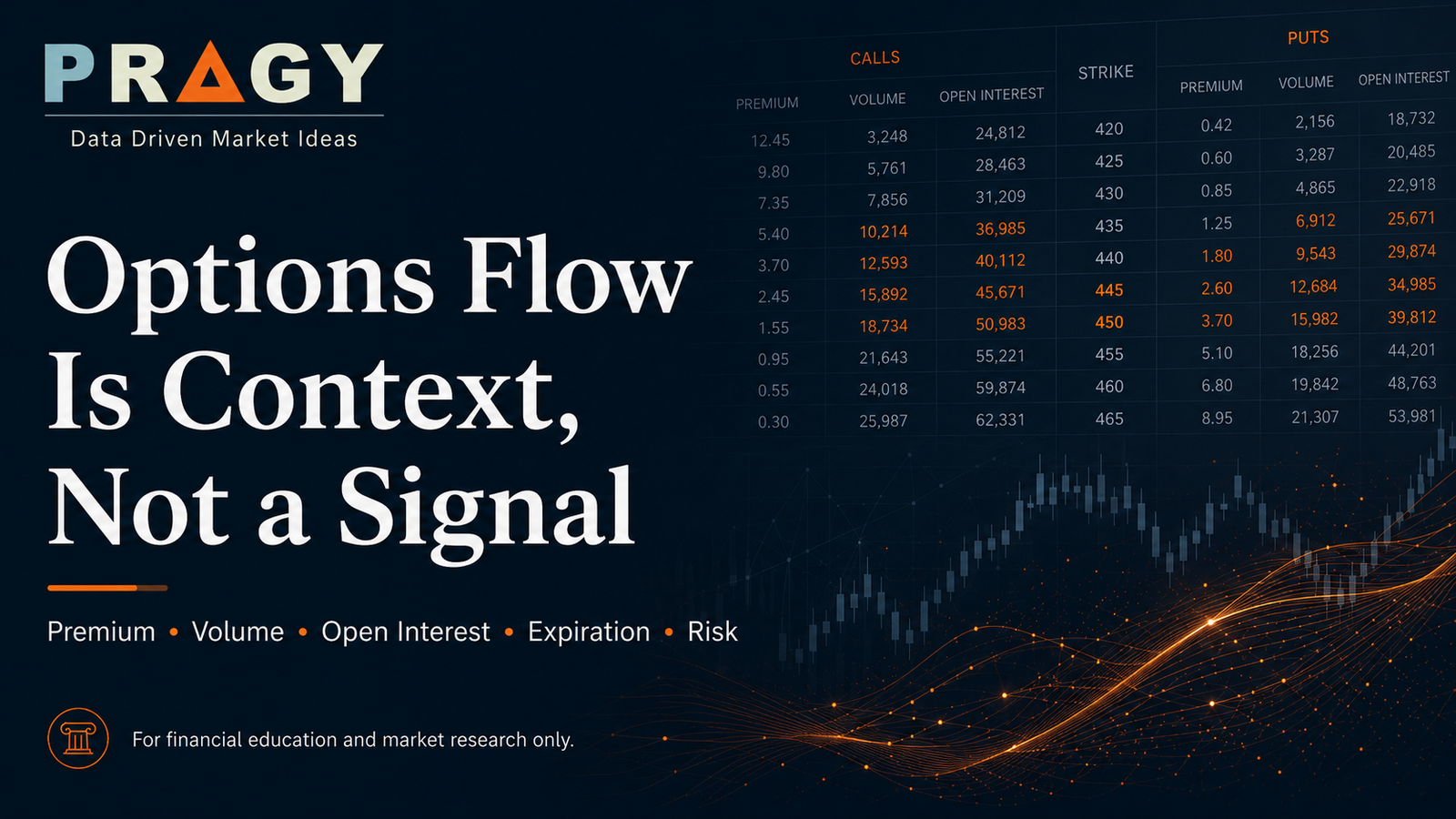
Options flow gets attention because it looks like someone knows something.
Large premium. Short expiration. Aggressive sweep. Unusual volume.
It can feel exciting.
But excitement is not a research process.
Options flow can be useful, but only when it is read in context. A large call or put order does not automatically mean a stock is going up or down. Flow can reflect speculation, hedging, volatility positioning, spread activity, closing trades, or institutional risk management.
The goal is not to copy the trade.
The goal is to ask better questions.
Use this guide alongside the Options Flow Tracker and the Options Basics library when reviewing options activity as market context.
Quick Summary
Options flow is the observation of notable options activity in the market.
It can include unusual volume, large premium, aggressive order flow, short-dated contracts, LEAPS activity, or contracts trading above normal activity.
But options flow is not automatically bullish or bearish.
A call trade is not always bullish.
A put trade is not always bearish.
Large premium is not always conviction.
Short-dated activity is not always informed institutional activity.
Options flow should be treated as market context, not a command.
What Options Flow Can Tell You
Options flow can help identify where market participants are paying attention.
It may suggest that traders are positioning around:
- Earnings
- Product announcements
- Macro events
- Sector rotation
- Breakouts or breakdowns
- Volatility expansion
- Hedging needs
- Institutional positioning
- Short-term speculation
That does not mean the trade is correct.
It only means the activity is worth studying.
The Core Fields to Review
Before giving any options flow weight, the contract details matter.
A cleaner options-flow review should look at:
- Ticker
- Date
- Contract type
- Expiration
- Strike
- Premium
- Volume
- Open interest
- Stock price at the time of the trade
- Bid/ask location
- Time until expiration
- Event risk
- Chart location
- Broader market tone
Without those details, options flow becomes noise.
Premium Matters, But It Is Not Enough
Premium shows how much capital is involved in the trade.
A $2 million order usually deserves more attention than a $20,000 order.
But premium alone does not prove conviction.
A large premium trade can be:
- Directional speculation
- A hedge
- Part of a spread
- A closing trade
- Volatility positioning
- Portfolio protection
- Market maker activity
That is why premium should be reviewed with volume, open interest, contract structure, and price action.
Volume Versus Open Interest
Volume and open interest are two of the most important fields in options-flow analysis.
Volume shows how many contracts traded during the session.
Open interest shows how many contracts remained open from previous sessions.
When volume is much higher than open interest, the activity may be new positioning.
When open interest is already high, the flow may be adding to an existing area of interest.
But even then, the interpretation is not guaranteed.
A high-volume contract can still be part of a spread, hedge, or closing transaction.
Expiration Changes the Meaning
Expiration matters a lot.
Short-dated options can move quickly, but they also decay quickly.
A weekly option with only a few days left may reflect short-term speculation, event positioning, or a very tactical trade.
Longer-dated options, such as LEAPS, may suggest a broader thesis or hedge.
Neither is automatically better.
The question is:
Does the expiration match the possible catalyst?
A short-dated contract without a clear catalyst can be noisy.
A longer-dated contract near a major technical or fundamental inflection point may deserve closer research.
Strike Selection Matters
The strike price can also change the interpretation.
In-the-money options behave differently from far out-of-the-money options.
Near-the-money contracts often have more direct sensitivity to the stock price.
Far out-of-the-money contracts can be cheaper, more speculative, and more dependent on a sharp move.
A far out-of-the-money weekly call with unusual volume may look exciting, but it can also expire worthless very quickly.
That is why strike selection should be reviewed with risk, timeframe, and catalyst context.
Chart Context Still Matters
Options flow should not be studied in isolation.
A large call order near resistance is different from a large call order after a clean retest.
A large put order near support is different from a large put order after a confirmed breakdown.
The chart helps answer:
- Is the stock extended?
- Is it near support?
- Is it near resistance?
- Is volume confirming the move?
- Is the broader sector helping or hurting?
- Is the trade fighting the trend?
- Is there a clear invalidation level?
Flow without chart context is incomplete.
Possible Interpretations
Options flow can fall into several broad categories.
1. Noise
This is flow that looks interesting but lacks enough context.
Examples may include tiny premium, very short expiration, unclear catalyst, weak chart setup, or poor volume confirmation.
2. Watchlist Candidate
This is flow worth tracking, but not enough to form a strong view.
The contract may have notable premium or unusual volume, but confirmation is still missing.
3. Real Flow Candidate
This is stronger activity.
It may show unusual premium, volume above open interest, relevant expiration, logical strike selection, supportive chart context, and a possible catalyst.
4. High Conviction Candidate
This is rare.
A high-conviction candidate usually needs multiple pieces of evidence, not just one big trade.
It may include meaningful premium, clean contract structure, supportive price action, relevant catalyst, sector alignment, and improving technical structure.
Even then, it is still not a guarantee.
It is only a research candidate.
This framework is designed to slow the process down.
That is the point.
Fast reactions are easy.
Disciplined research is harder.
What Would Make Flow Less Reliable?
Options flow becomes lower quality when:
- The contract is very short-dated
- The strike is far out-of-the-money
- Premium is small
- Open interest is unclear
- The trade may be part of a spread
- The chart is extended
- The sector is weak
- There is no catalyst
- The market is risk-off
- The stock lacks volume confirmation
This does not mean the flow is useless.
It means it should be treated with caution.
What Would Make Flow More Interesting?
Options flow becomes more useful when:
- Premium is meaningful
- Volume is much higher than open interest
- The expiration matches a catalyst
- The strike selection makes sense
- The stock is near an important technical level
- Price action confirms the direction
- Sector strength supports the move
- The broader market is aligned
- Follow-through appears after the flow
The key word is context.
No single data point should carry the entire thesis.
Use the Dashboards area with options-flow context when you want to compare tools, calculators, and research workflow in one place.
Education Notes
Options flow is best used as a research filter.
It can help answer:
- What stocks are attracting attention?
- What expirations are active?
- Where is premium concentrated?
- Is the activity unusual?
- Does the chart support the idea?
- Is the flow likely directional, speculative, hedging, or volatility-related?
It should not answer:
- Which exact position should I take?
- Which contract should someone duplicate?
- What will happen next?
That is not the purpose.
The purpose is to improve the research process.
Final Takeaway
Options flow can be valuable, but it is not magic.
It is one layer of market research.
A disciplined options-flow review should combine contract details, premium, volume, open interest, expiration, strike selection, catalyst context, chart structure, and risk notes.
The best use of options flow is not copying.
The best use is filtering.
Find what is worth studying.
Then build the thesis separately.
Disclaimer
Pragy Investments provides financial education and market research only. This article is not investment advice, tax advice, legal advice, and is not a recommendation to buy, sell, or hold any security. Options trading involves risk and may not be suitable for all investors. Options can expire worthless and may result in the loss of capital. Readers are responsible for their own decisions and should consult a qualified financial professional before making financial decisions.