
Quick Summary
The market setup for the week of June 22 to June 26 looks weak-to-mixed. Technology remains the key leadership group, especially AI-linked and software-related areas, but the broader market tone is more cautious than fully risk-on. This is a week where leadership quality, breadth, and macro reaction may matter more than headline index movement.
For Pragy readers, the cleaner approach is to treat this week as a confirmation week rather than a chase week. Strong sectors can keep working, but extended charts need discipline. Weak sectors can bounce, but they still need follow-through before they become higher-quality setups.
Market Tone
The tone is mixed, cautious, and somewhat defensive.
Technology leadership is still present, but it is not enough by itself to call the whole market healthy. Energy is weaker and more volatile, commodity-linked areas remain sensitive to oil and metals, and macro data can quickly shift rate expectations. This kind of environment usually rewards selectivity: stronger charts, better relative strength, and cleaner risk levels matter more than broad exposure.
The key message for the week is simple: do not assume that index strength automatically means broad participation. Watch whether gains are concentrated in a small group of mega-cap and AI-linked names, or whether breadth improves across financials, industrials, materials, and consumer groups.
SPY / QQQ Context
SPY remains the main broad-market risk gauge. A constructive SPY setup would require stabilization in breadth, steady participation beyond technology, and limited damage from macro data. If SPY holds its near-term structure while rate-sensitive and cyclical groups stop weakening, the market can remain in a controlled consolidation phase.
The risk for SPY is that narrow leadership masks underlying weakness. If technology cools at the same time that financials, consumer, industrials, or energy fail to participate, the index can look better than the average stock. For this week, SPY should be viewed through the lens of breadth confirmation, macro reaction, and whether pullbacks are bought with conviction.
QQQ remains the stronger relative vehicle because technology and growth leadership are still central to the market. However, the same strength also creates the main risk: QQQ can become vulnerable when semiconductor or AI-linked names get crowded, extended, or sensitive to rate moves.
For QQQ, the cleanest setup is continued leadership with controlled volatility. A less constructive setup would be a sharp reversal in semiconductors, weak closes after strong opens, or a move where only a few mega-cap names hold the index up. The focus should be on confirmation, not prediction.
TSX / Canadian Market Context
The TSX setup remains tied to commodities, financials, materials, and Canadian macro data. Canada inflation is a major focus this week because it can influence expectations around the Bank of Canada and the Canadian dollar. If inflation pressure looks concentrated and temporary, the TSX may be able to look through some of the data. If inflation looks broader or more persistent, rate-sensitive groups could stay under pressure.
Materials and precious-metals-linked names remain important support areas for the Canadian market. Financials are a key confirmation group because they reflect rate expectations, credit conditions, and domestic economic confidence. Energy remains more difficult because oil-price volatility can move the sector quickly in both directions.
For Canadian equities, the better setup is a selective one: strong materials, stable financials, and improving breadth. The weaker setup is one where energy remains under pressure and financials do not confirm.
Sector Map
| Sector / Group | Tone | Notes |
|---|---|---|
| Technology | Strong / Mixed | Still the main leadership area, but leadership needs healthy breadth and controlled pullbacks. Avoid assuming every tech chart has the same quality. |
| Semiconductors | Strong / Mixed | AI-linked leadership remains important, but semis are high-beta and can reverse quickly if positioning gets crowded or rates move higher. |
| Energy | Weak / Mixed | Oil and geopolitical headlines can create fast moves, but the group needs more stable commodity confirmation before the tone improves. |
| Financials | Mixed | Watch banks, brokers, and Canadian financials for confirmation. Higher-rate fears can help margins in some cases but also raise credit and demand concerns. |
| Materials | Mixed / Strong | Metals and gold-linked names can support the TSX if commodity strength holds. Volatility remains high, so confirmation matters. |
| Industrials | Mixed | A useful breadth check. Improving industrials would support a broader market advance; weakness would keep the tone selective. |
| Consumer | Weak / Mixed | Consumer groups remain sensitive to inflation, rates, and spending data. Quality and pricing power matter more than broad exposure. |
| Utilities | Mixed / Defensive | Can attract defensive flows when risk appetite fades, but still sensitive to interest-rate moves. Useful as a risk-off signal group. |
Watchlist Themes
AI and technology leadership under observation. The strongest watchlist theme remains technology leadership, but this is not a blanket green light for chasing. Focus on names showing relative strength, controlled pullbacks, and strong closes rather than extended one-way moves.
Semiconductor follow-through versus fatigue. Semiconductors remain an important market signal. Continued strength would support QQQ and AI-linked risk appetite. Weakness or sharp reversals would raise the risk of broader technology cooling.
TSX materials and gold-linked strength. Materials can help the Canadian market if metals and gold-linked names continue to attract flows. The better setups are those with clear trend structure and volume confirmation.
Energy repair setups only after confirmation. Energy is weak-to-mixed and should be treated as a repair theme, not a clean leadership theme. Watch for stabilization in crude, improved relative strength, and stronger closes before assuming the group has turned.
Defensive rotation and breadth checks. Utilities, staples, and lower-beta areas may become more relevant if macro data pressures growth stocks. Breadth is important: the market is healthier if leadership expands rather than narrows.
Risk Notes
Macro data can change the tone quickly this week. Inflation, housing, GDP, consumer spending, and central-bank communication all have the potential to move rates, the U.S. dollar, USD/CAD, commodities, and equity leadership.
Technology and semiconductors remain strong but can become extended. Strong sectors can pull back sharply when positioning is crowded. Weak sectors can rebound quickly but still fail to create durable trend changes. For that reason, this week’s setups should be viewed through confirmation, risk levels, and position sizing rather than confidence alone.
For Canadian markets, the main risks are inflation sensitivity, oil-price volatility, currency movement, and whether financials confirm or diverge from the broader TSX. For U.S. markets, the main risks are narrow leadership, rate repricing, and weak breadth beneath the index surface.
What to Watch This Week
Watch how SPY reacts to macro data and whether pullbacks are bought. A constructive week would show stable breadth, steady closes, and participation from more than just mega-cap technology.
Watch QQQ and semiconductors for signs of leadership holding or fading. If QQQ remains strong while semis hold their structure, growth leadership can remain intact. If semis weaken and mega-cap technology narrows, the risk backdrop becomes more fragile.
Watch the TSX through materials, financials, energy, and Canadian inflation data. Materials strength can support the index, but energy weakness and rate-sensitive financial reactions may determine whether the TSX tone is broad or selective.
Watch rates, USD/CAD, oil, gold, and breadth. These cross-market signals can help confirm whether the week is moving toward risk-on continuation, defensive rotation, or a choppy consolidation.
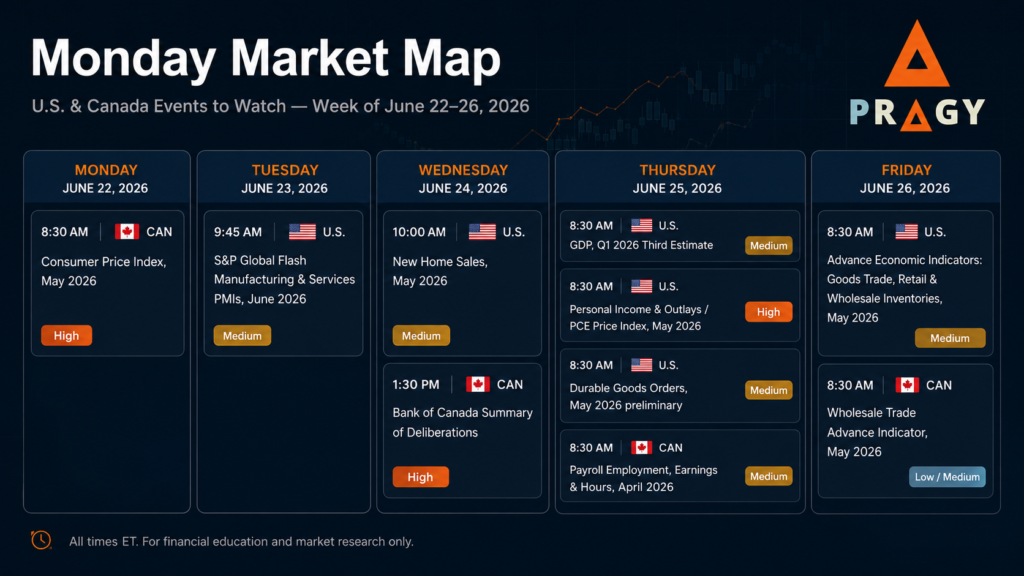
Weekly Calendar
All times ET unless stated otherwise.
| Date | Day | Time | Country | Event | Importance | Why it matters |
|---|---|---|---|---|---|---|
| 2026-06-22 | Monday | 8:30 AM | Canada | Consumer Price Index, May 2026 | High | Key inflation input for Bank of Canada expectations, CAD, rates, and rate-sensitive Canadian equities. |
| 2026-06-23 | Tuesday | 9:45 AM | U.S. | S&P Global Flash Manufacturing & Services PMIs, June 2026 | Medium | Early read on business momentum, pricing pressure, and demand conditions. |
| 2026-06-24 | Wednesday | 10:00 AM | U.S. | New Home Sales, May 2026 | Medium | Important housing and rate-sensitivity signal. |
| 2026-06-24 | Wednesday | 1:30 PM | Canada | Bank of Canada Summary of Deliberations | High | Helps frame how the BoC is weighing inflation, growth, and policy flexibility after the June rate decision. |
| 2026-06-25 | Thursday | 8:30 AM | U.S. | GDP, Q1 2026 Third Estimate | Medium | Updates the growth backdrop and demand mix. |
| 2026-06-25 | Thursday | 8:30 AM | U.S. | Personal Income & Outlays / PCE Price Index, May 2026 | High | Key U.S. inflation and consumer-spending data for Federal Reserve expectations. |
| 2026-06-25 | Thursday | 8:30 AM | U.S. | Durable Goods Orders, May 2026 preliminary | Medium | Useful read on manufacturing, capital spending, and cyclical demand. |
| 2026-06-25 | Thursday | 8:30 AM | Canada | Payroll Employment, Earnings & Hours, April 2026 | Medium | Canadian labor and wage context for domestic demand and inflation. |
| 2026-06-26 | Friday | 8:30 AM | U.S. | Advance Economic Indicators: Goods Trade, Retail & Wholesale Inventories, May 2026 | Medium | Helps frame trade, inventory, and growth expectations. |
| 2026-06-26 | Friday | 8:30 AM | Canada | Wholesale Trade Advance Indicator, May 2026 | Low / Medium | Early signal for Canadian goods-sector activity. |
Source Notes
Market context and calendar items were prepared using user-provided notes and public source checks from official or primary sources including Statistics Canada, the Bank of Canada, the U.S. Bureau of Economic Analysis, and the U.S. Census Bureau / HUD, along with public market data references for index and sector context. Event timing should be verified against official sources before publishing when precision matters.
Author Disclosure
Disclosure: The author may hold positions in securities, ETFs, leveraged ETFs, options, or related instruments discussed.
Disclaimer
This content is for financial education and market research only. It is not investment advice, financial planning, portfolio management, tax advice, legal advice, or a recommendation to buy, sell, or hold any security. Trading and investing involve risk, including possible loss of capital. Readers are responsible for their own decisions and should consult a qualified financial professional before making financial decisions.