
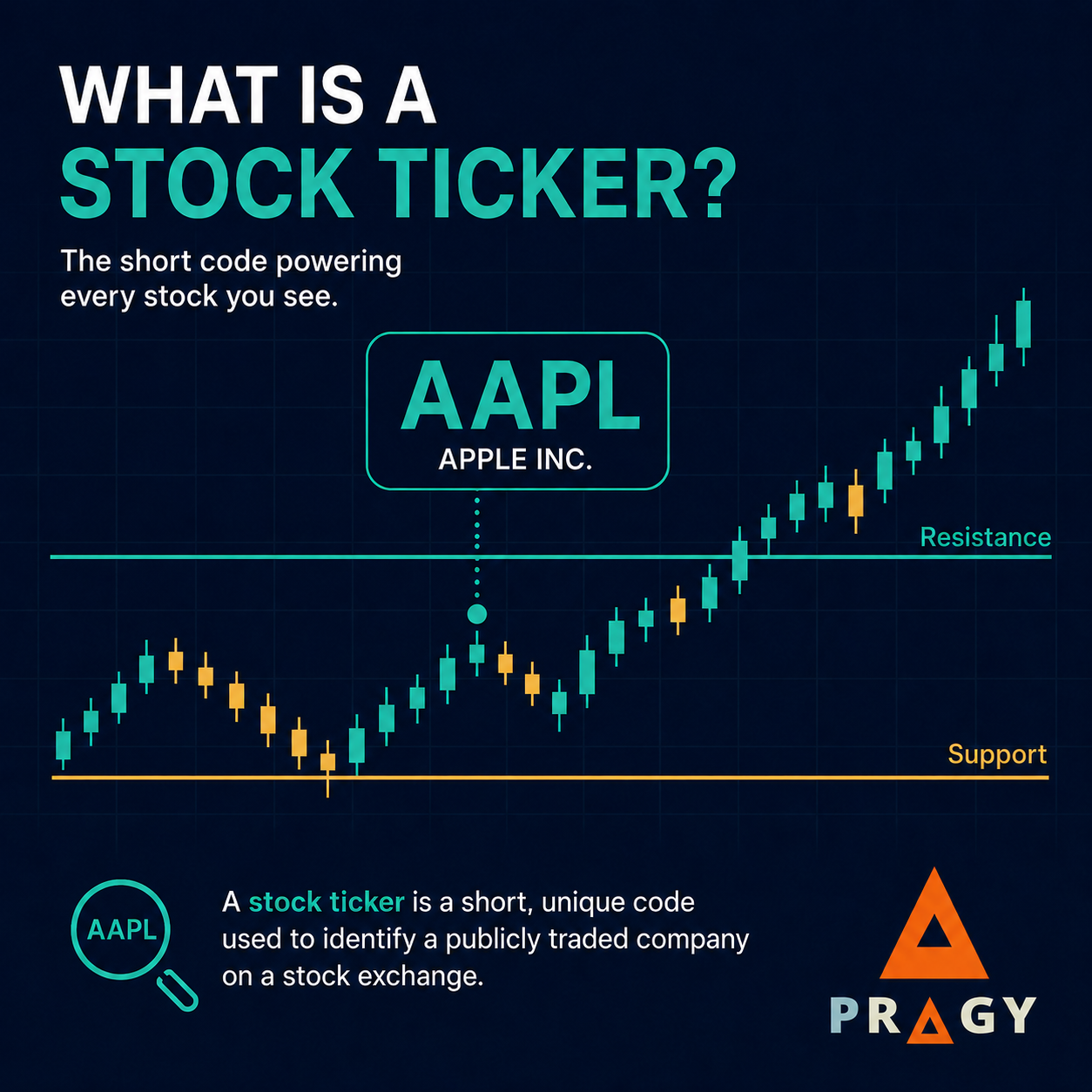
A stock ticker is tiny.
Usually just a few letters.
And somehow, that tiny code can decide whether you are looking at the right company, the wrong fund, the wrong exchange, or a completely different asset.
Here’s the deal: beginners often treat stock tickers like casual labels. They are not. A ticker is the market’s shortcut for identifying a traded security. Get the shortcut wrong, and your research can go sideways before you even read the first chart.
Let’s clean it up.
Here’s the simple version
A stock ticker, also called a ticker symbol, is a short code used to identify a stock or another traded security on an exchange.
A security is a tradable financial asset, such as a stock, exchange-traded fund, or bond. A stock represents ownership in a company. An exchange is the marketplace where securities are listed and traded.
Think of a ticker like a market license plate.
The company name is the full identity. The ticker is the fast code traders, investors, platforms, brokers, news sites, and exchanges use to find it quickly.
A fictional example:
- Company name: BrightPath Robotics Inc.
- Stock ticker: BPR
- Exchange: Example Exchange
When someone types “BPR” into a brokerage platform, charting tool, or financial website, the system uses that symbol to pull up the quote, chart, company data, and trading information.
Clean. Fast. Useful.
But only when you know what you are looking at.
Why stock tickers exist
Imagine trying to trade using full company names every time.
That would be a mess.
Company names can be long. Some are similar. Some change over time. Some have different share classes. Some companies operate in multiple countries. Some funds sound almost identical.
Stock tickers make the market easier to organize.
They help with:
1. Speed
Typing a short code is faster than typing a full company name.
Traders, investors, market data providers, and financial news platforms need speed. A ticker gives everyone a compact reference point.
2. Precision
The clean version: tickers reduce confusion.
A company name may sound similar to another company. A ticker helps identify the specific listed security.
But do not get lazy. A ticker alone is not always enough. The exchange, currency, and asset type can matter too.
3. Market data
A stock quote is the current market information for a security, usually including price, daily change, bid, ask, volume, and other data.
The ticker is what allows platforms to pull that quote quickly.
Without the symbol, your charting tool does not know what to display.
What a ticker does not tell you
This is where people mess up.
A ticker does not tell you whether something is a good investment.
It does not tell you if the business is strong.
It does not tell you if the chart is clean.
It does not tell you if the risk makes sense.
It is just an identifier.
A ticker helps you find the thing. It does not tell you what to do with the thing.
Red flag: someone treats a ticker like a complete thesis.
Green flag: someone uses the ticker as the starting point for research, not the final answer.
Stock ticker vs. company name
The company name is the business identity.
The ticker is the trading symbol.
For beginners, this difference matters because your brokerage platform may show several results when you search a name. You might see:
- The main stock
- A different share class
- An ETF with a similar name
- A company listed on another exchange
- A bond or preferred share
- An old or inactive result
An ETF, or exchange-traded fund, is a basket of securities that trades on an exchange like a stock.
The trap is assuming the first result is always the right result.
Do not overcomplicate it. Before researching or trading anything, confirm the ticker, exchange, currency, and security type.
Why some tickers are short and others are longer
Ticker formats vary by exchange and market.
Some tickers use one to four letters. Others use more. Some include dots, dashes, or suffixes depending on the platform and country.
Those extra marks can point to things like:
- Different share classes
- Preferred shares
- Foreign listings
- Exchange-specific formats
- Special security types
A share class is a category of stock issued by the same company, often with different voting rights or ownership features.
That means two tickers can connect to the same company, but not necessarily the same exact security.
Beginner translation: similar ticker, different instrument.
That difference matters.
Why tickers can change
A ticker is not permanent.
Companies can change ticker symbols after events like:
- Rebrands
- Mergers
- Acquisitions
- Exchange moves
- Corporate restructurings
A ticker change does not automatically mean the company got better or worse. It just means the market identifier changed.
The important move is to verify whether you are looking at current information. Old articles, screenshots, videos, and social media posts may refer to outdated tickers.
That is especially common when beginners learn from old content.
Practical example: the 4-check ticker test
Before you research a stock, use this simple framework.
1. Confirm the ticker
Make sure the symbol matches the company or fund you meant to search.
Not “close enough.”
Exact.
2. Confirm the exchange
The same or similar ticker can appear in different markets.
The exchange tells you where it trades. This affects market hours, currency, liquidity, and sometimes available order types.
Liquidity means how easily something can be bought or sold without a big price impact. Higher liquidity usually means tighter spreads and smoother execution.
3. Confirm the security type
Is it a common stock, ETF, preferred share, option, bond, or something else?
An option is a contract linked to an underlying asset. It is not the same thing as owning the stock.
This matters because different securities behave differently and carry different risks.
4. Confirm the quote details
Look at the price, currency, volume, and recent activity.
Volume means how many shares or contracts traded during a period. Low volume can make entries and exits harder because there may not be enough market participation.
The goal is not to become paranoid. The goal is to avoid obvious mistakes.
How ticker symbols show up on charts
When you open a chart, the ticker tells the platform which security to display.
A chart shows price movement over time. A candlestick is a chart style where each candle shows the open, high, low, and close for a selected period.
If you are studying a stock, you might use the ticker to pull up:
- A daily chart
- A 1-hour chart
- Historical price data
- Volume bars
- Moving averages
- News linked to the security
A moving average is a line that smooths price data over a selected number of periods, helping traders see the broader direction without staring at every tiny move.
The ticker gets you to the chart. The chart helps you study behavior.
Those are different jobs.
Common mistakes beginners make with stock tickers
Mistake 1: Searching the company name and clicking the first result
Fast is nice.
Wrong is not.
Always check the full listing details before assuming the first result is correct.
Mistake 2: Ignoring the exchange
A ticker without exchange context can be incomplete.
Two securities can look similar but trade in different places. That can affect price display, trading hours, currency, and available data.
Mistake 3: Confusing a stock with an ETF
Some ETFs have names that sound like companies or themes.
An ETF is not one company. It is a fund that usually holds multiple assets.
That does not make it good or bad. It makes it different.
Mistake 4: Treating a ticker mention like a recommendation
Someone mentioning a ticker is not analysis.
It is not a strategy.
It is not a risk plan.
It is not a reason to enter a trade.
A real decision needs context: business quality, valuation, chart structure, market conditions, risk management, and your own plan.
Mistake 5: Not checking if the ticker changed
Old educational content can still be useful, but ticker references may become outdated.
When something looks odd, verify the current symbol before going deeper.
Action checklist
Before you study or trade any ticker, run this checklist:
- Do I have the exact ticker symbol?
- Does it match the company, fund, or security I intended?
- Which exchange is it listed on?
- What currency is the quote shown in?
- Is it a stock, ETF, option, preferred share, or something else?
- Is the quote active and current?
- Is there enough volume for clean analysis?
- Am I treating this as research, not as a blind trade idea?
Simple checklist. Big mistake filter.
Final takeaway
A stock ticker is the market’s shorthand code for a traded security.
It helps you find quotes, charts, data, and news quickly. But it is not analysis. It is not a signal. It is not a reason to buy, sell, or hold.
The clean version: use the ticker to identify the asset, then do the actual work.
That is how you avoid confusing a symbol with a strategy.
Disclaimer
Educational content only. Not personalized financial advice. Trading and investing involve risk, and loss of capital is possible.