
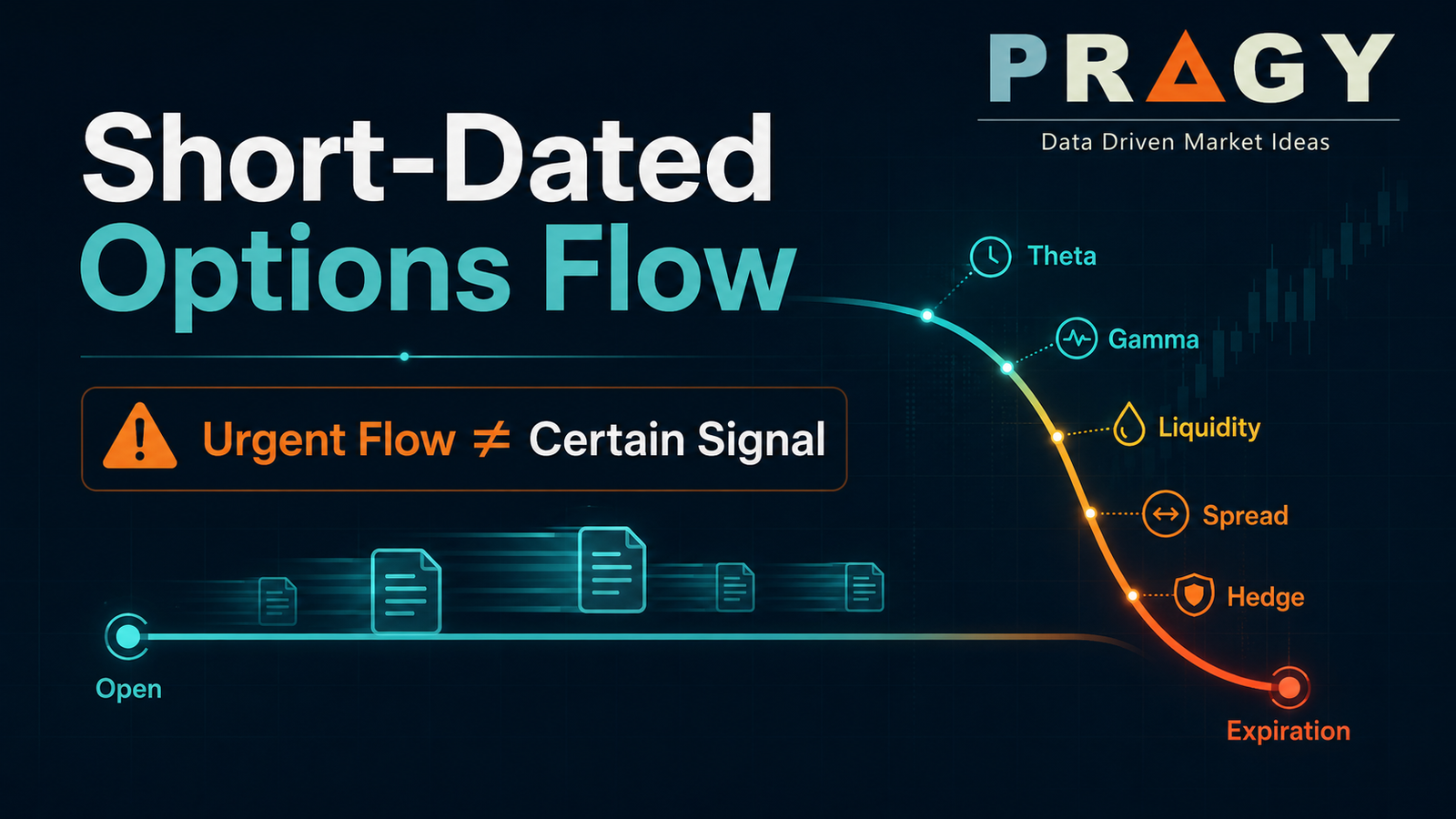
Short-dated options flow is addictive because it feels urgent.
A call sweep expires this Friday. A put block expires today. Premium moves fast. The chart twitches. The scanner screams.
That urgency can be useful. It can also be a trap.
Short-dated options are not just “normal options with less time.” Less time changes the entire risk profile. Price movement matters more. Time decay matters more. Execution matters more. A small mistake can become expensive before a trader has time to think clearly.
And when short-dated flow hits a scanner, it is easy to mistake speed for signal.
Here’s the simple version
Short-dated options flow can be meaningful, but it is also noisy, fragile, and easy to misread.
Short-dated contracts include weekly options, contracts expiring within a few trading sessions, and 0DTE options, which are options that expire the same trading day.
These contracts can react sharply because:
- there is little time left for the trade to work
- theta decay can accelerate near expiration
- gamma can make delta change quickly
- bid-ask spreads and liquidity matter more
- small underlying moves can create large percentage swings
- flow may reflect hedging, spreads, or intraday risk management
- closing activity can look like fresh positioning
The clean takeaway:
Short-dated flow tells you someone is acting on a compressed timeline. It does not prove they are right.
What counts as short-dated options flow?
There is no single universal cutoff, but in practical flow reading, “short-dated” usually means options with very little time until expiration.
Common buckets:
| Bucket | Typical meaning | Main risk |
|---|---|---|
| 0DTE | Expires today | Extremely compressed time and rapid sensitivity to price movement |
| 1–3 DTE | Expires within a few sessions | Fast time decay and catalyst sensitivity |
| Weekly options | Expires this week or next | Short timeline with less room for error |
| Near-term monthlies | Front-month expiration | Still short-term, but usually less extreme than 0DTE |
DTE means “days to expiration.” A 0DTE option has zero days left after the current trading day.
That does not automatically make it bad. It simply means the clock is loud.
Why short-dated flow gets so much attention
Short-dated options are visually dramatic.
A contract can move 30%, 80%, or 200% in a short window because the option has little time left and the underlying stock or index moves near the strike.
That creates scanner fireworks.
But the same feature that creates large percentage moves also creates fast losses. The option can lose most or all of its value if the move does not happen quickly enough.
This is where beginners often confuse potential movement with quality of setup.
A contract can be explosive and still be a poor research signal.
The main risk: time is almost gone
Options have time value. The less time remaining, the less room the contract has for the underlying to move favorably.
Theta is the Greek that estimates how much an option’s theoretical value changes as time passes, all else equal.
Theta is not perfectly smooth. It often accelerates as expiration approaches. That matters because short-dated options are already close to the steepest part of the time-decay curve.
Plain-English version
With a longer-dated option, the market can say:
“Not yet, but maybe later.”
With a short-dated option, the market says:
“Now or never.”
That is why short-dated flow can be so unforgiving.
Buyer risk: the premium can disappear quickly
Buying a short-dated call or put may have defined risk: the premium paid.
But “defined risk” does not mean “small risk.” If someone pays $2.00 for an option, they can lose the full $2.00 per share, or $200 per standard contract.
With short-dated options, that loss can happen quickly.
A buyer needs the underlying to move:
- in the right direction
- by enough
- soon enough
- while implied volatility does not hurt the position too much
- with execution costs under control
That is a lot to ask in a small time window.
Seller risk: small premium can hide large exposure
Selling short-dated options can look attractive because time decay is fast.
That is the pitch people like.
The problem is the risk side. A seller receives premium, but takes on the obligation attached to the option. If the underlying moves sharply, the position can change fast.
For naked short options, losses can be substantial. For spreads, risk may be defined, but that does not mean it is trivial. A defined-risk spread can still reach its maximum loss quickly if the underlying moves against it near expiration.
Short-dated option selling is not “picking up pennies.” It is accepting event and movement risk on a compressed clock.
Gamma risk: delta can change fast
Delta estimates how much an option price may change for a $1 move in the underlying, all else equal.
Gamma estimates how quickly delta changes.
Near expiration, options near the strike can become highly sensitive to small price changes. A contract that looked low-delta can become high-delta quickly if the underlying moves toward the strike.
That creates two important realities:
- Short-dated options can react violently near key price levels.
- Flow can look powerful after the move has already started.
This matters for interpretation.
A late-day sweep in a contract that suddenly moved near the strike may not mean someone calmly built a high-conviction thesis. It may reflect rapid hedging, market-maker adjustments, closing activity, or a trader chasing movement.
Implied volatility can distort the signal
Implied volatility (IV) is the market’s estimate of expected movement.
Short-dated options can be heavily affected by event volatility:
- earnings
- Federal Reserve announcements
- inflation reports
- jobs data
- company news
- index rebalancing
- major technical breakouts or breakdowns
A high-premium short-dated trade may simply reflect the fact that the market is pricing a large near-term move.
That does not mean the trader has special information. It may mean uncertainty is expensive.
And after an event, IV can fall quickly. That can hurt long-option buyers even if the underlying moves somewhat in the expected direction.
Flow interpretation risk: urgent does not mean informed
Short-dated options flow can look cleaner than it is.
A scanner may show:
- unusual volume
- aggressive execution
- large percentage change
- a nearby expiration
- a strike close to the current price
That can be worth investigating.
But the print may still be:
- a hedge
- a spread leg
- a closing trade
- a roll
- market-maker inventory management
- a volatility trade
- a momentum chase
- a small trade that looks large in percentage terms
The trade happened fast. That does not mean the interpretation should happen fast.
Why 0DTE flow is a special case
0DTE options expire the same trading day. That makes them the most compressed version of short-dated options.
A 0DTE contract can be used for speculation, hedging, income strategies, or intraday risk management. The key point is that the time horizon is brutally short.
For buyers, the contract can lose the full premium paid if the expected move does not happen by the end of the session.
For sellers, a sharp underlying move can create losses in a very short period.
For flow readers, the problem is interpretation. 0DTE activity may say more about intraday positioning than long-term conviction.
A 0DTE put sweep on an index does not automatically mean someone is bearish for the next month. It may mean someone is hedging the next hour.
The “same flow, different meaning” problem
Imagine a fictional stock called Northstar Robotics trading at $100.
A scanner shows:
- Contract: $102 call
- Expiration: today
- Option price: $0.80
- Size: 1,000 contracts
- Headline premium: $80,000
- Stock is moving toward intraday resistance
- Volume is far above open interest
That looks interesting.
But what could it mean?
Possible interpretation 1: Short-term speculation
A trader may be betting on a quick breakout before the close.
Possible interpretation 2: Hedge adjustment
A trader short stock or short calls may be using calls to reduce risk.
Possible interpretation 3: Spread leg
The $102 calls may be one side of a vertical spread, not a naked directional bet.
Possible interpretation 4: Momentum chase
The trade may be chasing a move already underway.
Possible interpretation 5: Closing activity
The print may be closing an old short position rather than opening new bullish exposure.
The scanner shows the print. It does not show the motive.
What makes short-dated flow more useful?
Short-dated flow becomes more research-worthy when it lines up with multiple pieces of context.
| Context check | Better question | Why it matters |
|---|---|---|
| Expiration | How much time is left? | Less time means less room for the idea to work. |
| Strike location | Is the strike near the current price? | Near-the-money contracts can be highly sensitive near expiration. |
| Volume vs. open interest | Is today’s activity unusual? | Helps separate fresh activity from existing positioning. |
| Spread check | Did related strikes trade at the same time? | One leg can mislead the entire interpretation. |
| Execution | Was it near bid, ask, or mid? | Useful clue, but not proof of buyer or seller intent. |
| Catalyst | Is there news, earnings, or macro data? | Event risk can dominate short-dated pricing. |
| IV context | Is implied volatility elevated? | Expensive volatility can make premium misleading. |
| Chart context | Is price near a meaningful level? | Flow matters more when the underlying context supports attention. |
| Repeat activity | Is this isolated or repeated? | One flashy print is weaker than repeated, coherent activity. |
| Risk profile | What can go wrong before expiration? | Short-dated contracts leave little time to adjust. |
Common mistakes beginners make
Mistake 1: Treating short-dated flow as a signal to copy
Flow is not an instruction. It is a clue. You do not know the trader’s account, hedge, time horizon, or full position.
Mistake 2: Ignoring theta
With short-dated options, time decay can matter almost immediately. Being “kind of right” may not be enough.
Mistake 3: Underestimating gamma
Near expiration, small moves can change the option’s behavior quickly. That can help or hurt depending on position structure.
Mistake 4: Forgetting spreads exist
A single call buy may be part of a call spread. A single put buy may be part of a hedge. The visible leg is not always the whole trade.
Mistake 5: Overreacting to premium
Short-dated premium may look large because the trade size is large, the event risk is high, or the contract is near the money. Premium is not proof of conviction.
Mistake 6: Ignoring liquidity
Short-dated contracts can have active volume, but liquidity can still dry up or spreads can widen during fast markets. Getting in is one problem. Getting out cleanly is another.
Mistake 7: Reading intraday flow as a long-term thesis
A same-day option trade may be about the next 30 minutes. Do not stretch it into a three-month narrative without evidence.
A cleaner way to classify short-dated flow
Instead of calling every short-dated print “bullish” or “bearish,” use a simple classification.
| Label | Meaning | Example |
|---|---|---|
| Noise | Not enough context to matter | Small isolated print with no unusual volume |
| Intraday watch | Worth monitoring during the session | Repeated same-day contracts near a key level |
| Event-risk flow | Likely tied to a known catalyst | Flow before earnings, CPI, Fed, or major news |
| Hedge candidate | May be protection or risk adjustment | Puts bought against long exposure |
| Spread/structure candidate | Needs multi-leg review | Multiple strikes or expirations trade together |
| Research candidate | Flow plus chart/context support further review | Unusual volume, repeated activity, catalyst, and clean underlying context |
That classification keeps the language honest.
It also prevents the worst habit in flow reading: turning every print into a story.
Practical checklist before trusting short-dated flow
Run this before giving short-dated options flow too much weight:
- What is the expiration date?
- Is it 0DTE, weekly, or front-month?
- Is the strike in the money, at the money, or out of the money?
- How much premium traded?
- Is today’s volume unusual relative to open interest?
- Did nearby strikes or expirations trade at the same time?
- Is there a known catalyst today or tomorrow?
- Is implied volatility elevated?
- Is the underlying near a meaningful technical level?
- Could the trade be a hedge, spread, roll, or closing order?
- What would make the simple interpretation wrong?
If the answer to most questions is “not sure,” the flow is not a conclusion yet.
It is a starting point.
Final takeaway
Short-dated options flow is exciting because the clock is almost out.
That is also why it is dangerous to overread.
Fast contracts can produce fast moves, fast losses, and fast misunderstandings. A 0DTE sweep or weekly block may be speculation, hedging, closing activity, or one piece of a larger structure. The expiration date makes the flow urgent, but urgency is not the same as conviction.
The clean rule:
Short-dated flow deserves context before confidence.
Start there, and you will avoid a lot of expensive storytelling.
Sources
Sources checked June 29, 2026.
- Options Industry Council (OIC), Theta: https://www.optionseducation.org/advancedconcepts/theta
- Options Industry Council (OIC), 0DTE Options Primer: What Investors Should Know About Expiration Day Positions: https://www.optionseducation.org/news/0dte-options-primer-what-investors-should-know-about-expiration-day-positions
- FINRA, Zeroing In on an Options Trading Strategy: 0DTE: https://www.finra.org/investors/insights/zeroing-in-options-trading-strategy
- FINRA, Options investor education overview: https://www.finra.org/investors/investing/investment-products/options
- Investor.gov, Investor Bulletin: An Introduction to Options: https://www.investor.gov/introduction-investing/general-resources/news-alerts/alerts-bulletins/investor-bulletins-63
- OCC, Characteristics and Risks of Standardized Options: https://www.theocc.com/company-information/documents-and-archives/options-disclosure-document
Disclaimer
Pragy Investments provides financial education and market research only. This content is not investment advice, financial planning, portfolio management, tax advice, legal advice, or a recommendation to buy, sell, or hold any security. Examples and scenarios are for educational purposes only. Investing and trading involve risk, including possible loss of capital. Readers are responsible for their own decisions and should consult an appropriately qualified professional where needed. Options involve additional risks and may not be suitable for all investors. Options activity can reflect speculation, hedging, multi-leg strategies, volatility positioning, or other motives and does not by itself establish directional conviction.