
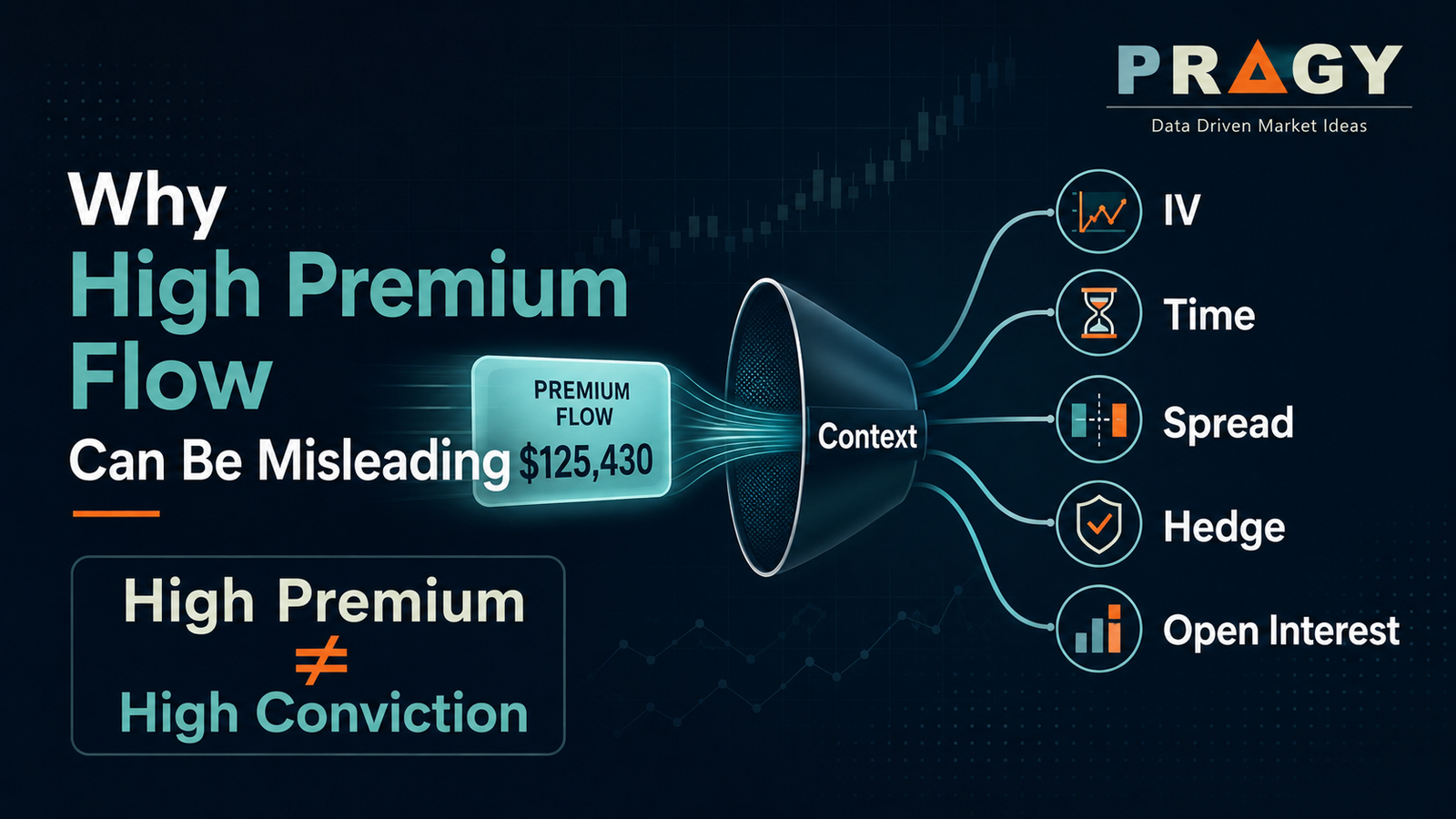
A giant options print hits the tape. The premium is six figures. FinTwit loses its mind. Someone says, “That has to be smart money.”
Slow down.
A large premium number can be interesting, but by itself it tells you almost nothing about conviction. In options flow, premium is just the dollar amount paid or received for the contract position. It is not a built-in truth detector.
That is the trap.
Here’s the simple version
High premium does not automatically mean high conviction.
A trade can show huge premium because:
- the underlying stock is expensive
- the contract has a lot of time remaining
- implied volatility is elevated
- the order is part of a multi-leg spread
- the trade is a hedge, not a directional bet
- the print is opening, closing, or rolling an existing position
- the trade size looks big in dollars but small relative to normal activity
In other words, premium is a data point, not a conclusion.
What “premium” actually measures
An option’s premium is its price.
The quick formula is:
Total premium = option price × 100 × number of contracts
That “× 100” matters because one standard equity option contract usually controls 100 shares.
So if a contract trades at $8.00 and 200 contracts print, the headline premium is:
$8.00 × 100 × 200 = $160,000
That sounds dramatic. It may be dramatic. But it may also be completely ordinary depending on the stock, expiration, and structure.
Why this matters
Premium tells you the notional dollars involved in the option transaction, but it does not tell you:
- whether the trader is bullish or bearish with confidence
- whether the order opened a new position
- whether the order closed an old position
- whether it was a hedge
- whether it was one leg of a larger spread
- whether it is meaningful relative to the usual flow in that name
That missing context is where people get hurt.
Why high premium can look more important than it really is
Humans love big numbers. Options scanners know this. A $500,000 print looks more exciting than a $45,000 print.
But “bigger” is not always “better information.”
Here are the main reasons.
1) Expensive stocks naturally create bigger premium numbers
A trade in a $700 stock will often print much larger dollar premium than a similar-looking trade in a $35 stock.
That does not mean the trader in the $700 stock is more confident. It may just mean the options cost more.
Quick example
- Stock A trades at $40
- Stock B trades at $600
A one-month at-the-money option in Stock B will usually cost far more than a comparable option in Stock A. The same number of contracts can create a wildly larger premium figure, even if the informational value is not higher.
Translation: premium size can be a function of the stock price, not conviction.
2) More time to expiration inflates premium
Options with more time remaining usually cost more because they contain more extrinsic value, which is the part of the premium tied to time and uncertainty.
A 180-day option will often show much more premium than a 7-day option, even if the shorter-dated trade is the more aggressive speculative bet.
That means a big premium print in a long-dated contract might reflect patience, structure, or hedging—not urgency or extreme conviction.
3) High implied volatility can make ordinary trades look huge
Implied volatility (IV) is the market’s estimate of how much the stock could move over time. When IV is high, options usually become more expensive.
This often happens:
- before earnings
- during biotech or regulatory events
- during market stress
- when takeover rumors or major news are circulating
If IV is elevated, the same number of contracts can create an eye-catching premium figure without representing unusual conviction.
Premium can expand because fear or uncertainty is expensive, not because someone knows the future.
4) A large print may be a hedge, not a bet
This is one of the biggest misunderstandings in options flow.
A trader can buy puts with big premium to hedge a long stock position. A fund can sell calls as part of a covered position. A portfolio manager can buy calls as a stock replacement or buy puts as insurance.
The print may be large and real. But its meaning may be defensive, not directional.
Common hedge-related possibilities
- protective puts on a long stock position
- covered call overwriting
- collars
- stock replacement using deep-in-the-money calls
- volatility hedges around an event
If you see premium and instantly assume “bullish whale” or “bearish whale,” you are skipping the hard part.
5) One print may be just one leg of a spread
A lot of impressive-looking flow is actually part of a multi-leg strategy. A spread means the trader is combining two or more options together.
Examples include:
- vertical spreads
- calendar spreads
- diagonals
- straddles and strangles
- collars
- ratio spreads
If your scanner highlights only one leg, the premium can look directional when the full trade is actually defined-risk, hedged, or volatility-driven.
This is where people mess up.
A large call purchase might look wildly bullish until you realize the trader also sold a higher-strike call at the same time. That turns the position into a call spread, which changes the risk, cost, and expected payoff.
6) Opening activity and closing activity are not the same thing
A big print is more informative when it appears to be opening a new position rather than closing an old one.
That is why traders often compare:
- volume, which is how many contracts traded today
- open interest, which is how many contracts were already open before today
If volume is much larger than open interest, it may suggest new positioning. If open interest is already large, today’s print may be a close, a roll, or routine activity.
Important word: may.
You often do not know for sure in real time. Open interest updates with a delay, and trade classification is not perfect.
7) Bid/ask execution does not tell the whole story
Many flow watchers look at whether the trade hit the ask, the bid, or somewhere in between.
That can be useful, but it is not gospel.
A trade near the ask might suggest aggressive buying. A trade near the bid might suggest aggressive selling. But in practice:
- the order may be part of a spread
- market makers may work the fill in pieces
- routing can distort the print
- the displayed quote may have moved during execution
Treat bid/ask clues as supporting evidence, not final proof.
8) Large premium can still be small relative to normal activity
A $250,000 print sounds huge in isolation. But if the name regularly trades millions of dollars of options premium every day, that print may be background noise.
This is why relative size matters more than raw size.
Ask better questions:
- Is today’s volume unusual for this contract?
- Is it unusual for this stock’s options overall?
- Is the print large relative to average daily options volume?
- Is the order concentrated in one strike and expiration, or scattered everywhere?
Big number. Small signal. It happens all the time.
A better way to read high premium flow
Here is a cleaner framework.
| Check | What to ask | Why it matters |
|---|---|---|
| Premium size | How large is the dollar premium? | Useful starting point, but never enough on its own. |
| Relative size | Is it big versus the contract’s normal activity? | A smaller print in a quiet name can matter more than a larger print in a busy name. |
| Volume vs. open interest | Does today’s volume exceed prior open interest? | Can hint at new positioning, though not with certainty. |
| Expiration | Is the contract weekly, monthly, or far-dated? | Longer-dated options naturally carry more premium. |
| Implied volatility | Is IV elevated? | High IV can inflate premium without implying stronger conviction. |
| Trade structure | Is it a single-leg order or part of a spread? | One leg alone can create a false narrative. |
| Execution | Near bid, ask, or mid? | Helpful clue, but not definitive. |
| Stock context | Is there earnings, news, or a macro event? | Event-driven flow is often more complex than simple directional bets. |
| Chart context | Is the stock near a major level or in the middle of chop? | Flow means more when the broader setup makes sense. |
| Repeat activity | Are similar prints appearing over time? | Repetition can be more informative than one isolated block. |
Practical example: same premium headline, very different meaning
Let’s compare two fictional examples.
Example A: The dramatic-looking print
- Underlying stock: $520
- Contract: 6-month $500 call
- Option price: $22.00
- Size: 75 contracts
- Headline premium: $165,000
That is a large premium print.
But what could it be?
- a stock replacement position
- part of a call spread
- a roll from one strike to another
- a hedge against a short position
- a directional bet, yes, but not necessarily
The premium number alone does not tell you which one.
Example B: The less flashy but possibly more useful print
- Underlying stock: $28
- Contract: 30-day $30 call
- Option price: $1.10
- Size: 900 contracts
- Headline premium: $99,000
- Prior open interest: 40 contracts
- Normal daily volume in that line: very low
- Same-strike sweeps appear repeatedly during the session
This second trade shows less headline premium, but it may actually be more informative because the size is unusual relative to normal activity and may point to fresh interest.
The lesson
Premium helps you notice a trade. Context helps you understand it.
Common mistakes people make
Mistake 1: Treating premium as conviction
Big premium is not the same thing as “someone knows something.”
Mistake 2: Ignoring implied volatility
High IV can make premium explode even when the trade is not especially unusual.
Mistake 3: Ignoring time to expiration
Far-dated contracts naturally carry bigger dollar values.
Mistake 4: Reading a spread as a single-leg bet
If you miss the other leg, you may misread the entire trade.
Mistake 5: Forgetting hedging exists
Institutions use options for protection, yield enhancement, and structure—not just speculation.
Mistake 6: Ignoring the stock itself
If the stock is nowhere near a meaningful level, has no catalyst, and the flow is isolated, the signal may be weaker than it looks.
A fast checklist before you call flow “important”
Before you label a high premium print as meaningful, run through this:
- What is the total premium?
- What is the stock price?
- How much time is left until expiration?
- Is implied volatility elevated?
- Is volume unusual relative to normal activity?
- How does volume compare with open interest?
- Could this be a hedge?
- Could this be one leg of a spread?
- Was there a catalyst like earnings or news?
- Are there repeated prints supporting the same idea?
If you cannot answer most of those questions, you do not have a conclusion yet. You have a headline.
Final takeaway
Here’s the clean version: high premium flow is worth noticing, but not worth worshipping.
Premium can be inflated by stock price, time value, implied volatility, and trade structure. It can reflect hedging, closing activity, or a multi-leg spread just as easily as speculative conviction.
So the next time you see a giant flow print, do not ask only, “How big is it?”
Ask the better question:
“What does it actually mean in context?”
That is where real research begins.
Sources
- Options Industry Council (OIC), educational resources on options basics, open interest, and strategy interpretation: https://www.optionseducation.org/
- FINRA, Options investor education overview: https://www.finra.org/investors/investing/investment-products/options
- Investor.gov, Options and investor-risk education: https://www.investor.gov/introduction-investing/general-resources/news-alerts/alerts-bulletins/investor-bulletins-91
Disclaimer
Pragy Investments provides financial education and market research only. This content is not investment advice, tax advice, legal advice, or a recommendation to buy, sell, or hold any security. Options involve additional risks and may not be suitable for all investors.