
Most beginners hear the word “stock” and assume every share works the same way.
Not quite.
A share is a slice of ownership in a company, but not every slice comes with the same rights, risks, or rewards. Common shares and preferred shares can both belong to the same company, yet they can behave like very different instruments.
Here’s the deal: before you compare prices, dividends, or charts, you need to know what type of share you are actually looking at.
Here’s the simple version
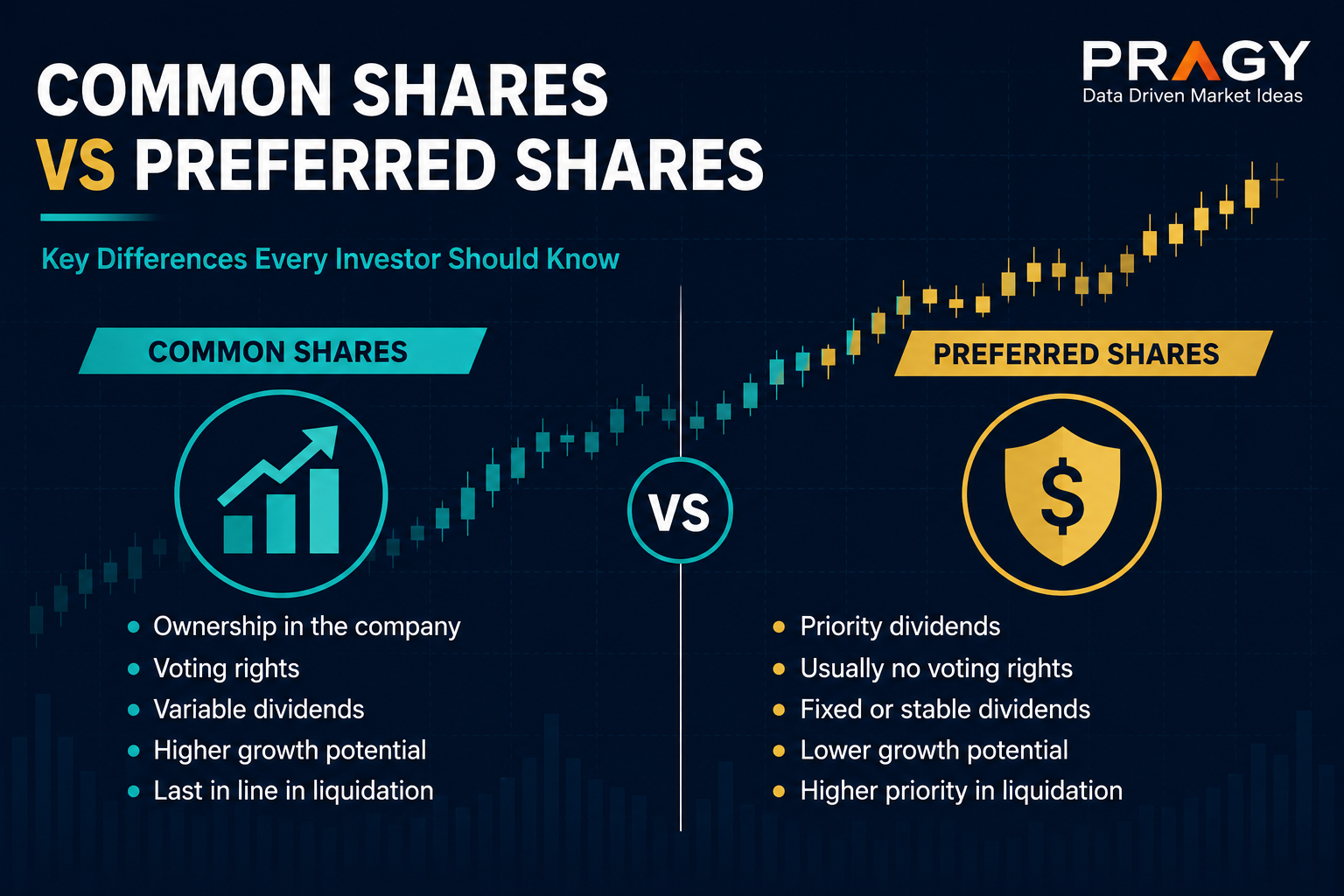
Common shares usually give investors voting rights and the most direct exposure to the company’s upside. If the business grows, common shareholders may benefit from price appreciation. But they also sit lower in the priority line if the company runs into serious trouble.
Preferred shares usually focus more on income and priority. They often pay a fixed or structured dividend and rank ahead of common shareholders for dividend payments and claims on assets. But they typically have less upside and may come with limited or no voting rights.
The clean version:
| Feature | Common Shares | Preferred Shares |
|---|---|---|
| Ownership | Yes | Yes |
| Voting rights | Usually yes | Usually limited or none |
| Dividend | Variable, not guaranteed | Often fixed or structured |
| Upside potential | Higher | Usually capped or more limited |
| Priority if company liquidates | Lower | Higher than common shares |
| Price behavior | More tied to business growth | Often more tied to income, rates, and credit risk |
Don’t overcomplicate it: common shares are usually the growth-and-voting class. Preferred shares are usually the income-and-priority class.
What are common shares?
Common shares are the standard ownership shares most people mean when they talk about stocks.
When you own common shares, you typically own a piece of the business and may get a vote on certain corporate matters. Voting rights can include board elections, major corporate changes, and shareholder proposals.
A voting right means shareholders may have a say in certain company decisions. It does not mean they run the company day to day. Management still manages. Shareholders vote on selected items.
Common shares are usually where the biggest long-term upside sits. If a company grows revenue, improves profits, gains market share, or becomes more valuable, common shares may reflect that improvement through a higher share price.
But there is a trade-off.
Common shareholders are last in line during liquidation. Liquidation means a company is shutting down and its assets are being sold to repay creditors and owners. Bondholders and lenders usually come first. Preferred shareholders usually come before common shareholders. Common shareholders get what is left, if anything.
That is why common shares can be powerful, but also risky.
What are preferred shares?
Preferred shares are a special class of shares that usually sit between common stock and debt in the capital structure.
The capital structure is the company’s funding stack: debt, preferred shares, and common equity. It shows who gets paid first and who takes more risk.
Preferred shares often pay a regular dividend. A dividend is a cash payment a company may distribute to shareholders. Preferred dividends are often fixed, meaning the payment is based on a set rate or formula.
That sounds clean, but beginners need to slow down.
Preferred dividends are not the same as bond interest. A company may be able to suspend or defer preferred dividends depending on the share terms. The exact rules matter.
Preferred shares may also be:
Cumulative preferred shares
If dividends are missed, they accumulate and must usually be paid before common shareholders receive dividends.
Non-cumulative preferred shares
If dividends are missed, they do not necessarily have to be repaid later.
Callable preferred shares
The company may have the right to redeem the shares at a set price after a certain date. Callable means the issuer can take the shares back under the stated terms.
Convertible preferred shares
The preferred shares may be convertible into common shares under certain conditions. Convertible means the holder may have a path to exchange one security for another.
This is where people mess up: they see a preferred share with a high dividend and assume it is automatically better. A high yield can also signal higher risk, weaker demand, or concern about the issuer’s financial health.
The biggest difference: upside vs priority
Common shares and preferred shares usually answer different investor questions.
Common shares ask:
“How much could this company grow?”
Preferred shares ask:
“How reliable is the income stream, and how strong is the company’s ability to support it?”
Common shares usually give more upside because they participate directly in business growth. If the company performs exceptionally well, common shareholders can benefit more.
Preferred shares usually have more priority, but less upside. Their price may not rise dramatically just because the company is doing well, especially if the dividend is fixed and the redemption terms limit price appreciation.
Think of it like seats in the same stadium.
Common shareholders may get the best view if the game becomes exciting, but they are also more exposed to the crowd. Preferred shareholders may have a more protected seat, but the view may be less dramatic.
Voting rights: control is not the same as income
Common shares often come with voting rights. Preferred shares often do not.
That matters because voting rights can influence corporate governance. Corporate governance is the system of rules and decisions that guides how a company is directed and controlled.
For many beginners, voting rights are not the main reason they choose a share class. But voting rights still matter because they affect control.
Preferred shareholders often give up voting influence in exchange for income priority. That does not make preferred shares bad. It just means the instrument has a different purpose.
Green flag: you understand what rights come with the share class.
Red flag: you assume every ticker with the same company name gives the same rights.
Dividends: common dividends are flexible, preferred dividends are structured
Common dividends are usually flexible. A company can raise, reduce, pause, or cancel them depending on profits, cash flow, board decisions, and business priorities.
Preferred dividends are usually more structured. That can make them appealing for income-focused research, but “structured” does not mean “guaranteed.”
The trap is chasing yield.
Yield is the income payment divided by the current price. For example, if a share pays $5 per year and trades at $100, the yield is 5%.
A higher yield may look attractive, but it can also mean the market is pricing in risk. Maybe investors doubt the dividend can continue. Maybe interest rates changed. Maybe the company’s credit quality is weaker. Maybe the preferred share has terms that cap upside.
A strong investor does not just ask, “What is the yield?”
They ask:
- What are the dividend terms?
- Is the dividend cumulative or non-cumulative?
- Can the company call the preferred shares?
- How healthy is the issuer?
- What happens if rates move?
- How liquid is the security?
Liquidity means how easily something can be bought or sold without creating a big price move. Some preferred shares trade with lower volume, meaning entries and exits can be less smooth.
Risk profile: common shares and preferred shares can both lose money
Preferred shares are often described as “safer” than common shares because they rank higher in the priority line. That can be true in a narrow capital-structure sense.
But “higher priority” does not mean risk-free.
Preferred shares can still fall in price. They can be sensitive to interest rates, credit concerns, company-specific stress, call features, and thin trading volume.
Common shares can also fall sharply if earnings weaken, growth slows, valuation compresses, or market sentiment turns.
Volatility means the size and speed of price movement. Common shares often have higher volatility than preferred shares, but preferred shares can still move more than beginners expect.
The clean lesson: different risk is still risk.
Practical framework: how to compare common vs preferred shares
Use this simple framework before forming a research opinion.
1. Identify the share class
Start with the actual security. Is it common stock? Preferred stock? A specific preferred series?
Preferred shares often have different series, each with its own terms. Two preferred shares from the same company can have different dividend rates, call dates, conversion features, and risk profiles.
2. Read the terms
For preferred shares, the terms are everything. Look for the dividend rate, cumulative status, call provisions, conversion rights, and maturity or reset features if applicable.
For common shares, focus more on business quality, growth, profitability, valuation, governance, and dilution risk.
Dilution happens when a company issues more shares, reducing each existing share’s ownership percentage.
3. Understand the income source
Do not just look at the dividend. Ask whether the company has the cash flow and balance sheet strength to support payments.
A balance sheet is a financial statement showing what a company owns, owes, and what remains for shareholders.
4. Compare upside and downside
Common shares may offer more upside, but can carry more downside if business performance disappoints.
Preferred shares may offer more income structure, but upside may be limited by call price, fixed dividend terms, or lower participation in business growth.
5. Check liquidity and volume
Volume is the number of shares traded during a period. Low volume can make prices jumpy and spreads wider.
The spread is the gap between the price buyers are willing to pay and sellers are willing to accept. Wide spreads can quietly increase trading costs.
Common mistakes beginners make
Mistake 1: Thinking preferred shares are always better
The word “preferred” sounds superior. Marketing departments could not have named it better.
But preferred does not mean best. It means the share class has certain preferences, usually around dividends and liquidation priority.
Mistake 2: Chasing the highest yield
A high yield is not automatically a bargain. It may be a warning label.
Sometimes the market is saying, “This income stream has risk.” Listen before getting impressed.
Mistake 3: Ignoring call risk
If a preferred share is callable, the company may redeem it under the stated terms. That can limit upside and change the expected income profile.
Call risk is the risk that an issuer redeems a security before investors would prefer.
Mistake 4: Assuming preferred shares behave like common shares
Preferred shares can trade differently. They may react more to interest rates and credit risk than business growth headlines.
Mistake 5: Skipping the fine print
Preferred share terms can be specific. Series names, reset rates, conversion rules, and redemption dates can materially change the research context.
The fine print is not decoration. It is the instrument.
Action checklist
Before comparing common and preferred shares, ask:
- What exact share class or series is this?
- Does it have voting rights?
- Is the dividend fixed, floating, cumulative, or non-cumulative?
- Can the company redeem it?
- Is there a conversion feature?
- How does it rank in the capital structure?
- What is the issuer’s financial health?
- How liquid is the security?
- What risks could hurt the price or income stream?
- Does this fit the educational thesis being studied?
Final takeaway
Common shares and preferred shares are not just two flavors of the same thing.
Common shares usually offer voting rights and more direct upside from business growth. Preferred shares usually offer dividend priority and a higher claim than common shares, but often with less upside and different risks.
The best starting point is simple: know what you own before you analyze what it might do.
Don’t overcomplicate it. Share class first. Terms second. Risk third. Everything else gets easier after that.
Disclaimer
Educational content only. Not personalized financial advice or a recommendation to buy, sell, or hold any security. Trading and investing involve risk, including possible loss of capital.