
Free cash flow sounds like an accounting term designed to make normal people leave the room.
It is not.
Free cash flow is one of the cleanest ways to ask a very practical question:
After the business runs itself and pays for the stuff it needs, how much cash is actually left?
That question matters because revenue can look impressive, earnings can look polished, and adjusted numbers can look suspiciously heroic. Cash is harder to decorate.
Here’s the deal: free cash flow is not the only number that matters. But when you are learning how to read a company, it is one of the best places to start.
Here’s the simple version
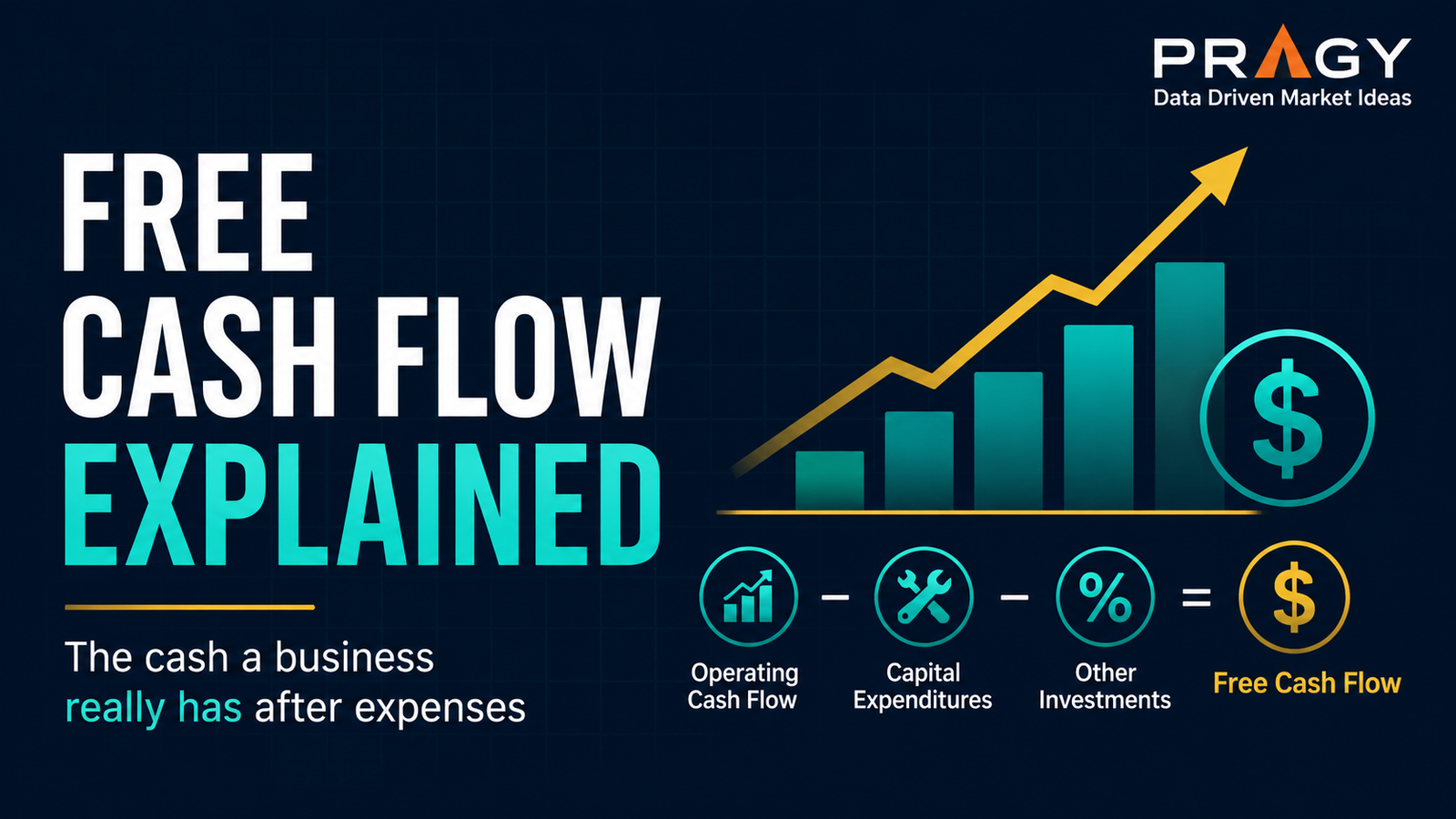
Free cash flow, often shortened to FCF, is the cash a company generates after paying for operating needs and capital expenditures.
Capital expenditures, or capex, means money spent on long-term assets like equipment, buildings, technology infrastructure, manufacturing capacity, or other assets needed to keep the business running and growing.
The common formula is:
Free Cash Flow = Operating Cash Flow - Capital Expenditures
Operating cash flow is cash generated from the company’s normal business operations. It answers: “Did the core business bring in cash?”
Capital expenditures answers: “How much cash had to go back into long-term assets?”
Free cash flow answers: “What is left after both?”
The clean version:
A business with strong free cash flow has more flexibility. A business with weak or negative free cash flow may need more outside funding, tighter discipline, or more time before the model proves itself.
Why free cash flow matters
Free cash flow matters because businesses do not survive on presentation slides. They survive on cash.
A company can use free cash flow for several things:
- paying down debt
- reinvesting in growth
- building a cash cushion
- funding acquisitions
- returning capital to shareholders
- surviving rough markets without panicking
None of those outcomes are automatic. Management still has to make good decisions. But free cash flow gives the company options.
That is why many investors look at FCF as a quality check.
Revenue shows demand.
Net income shows accounting profit.
Free cash flow shows cash reality.
Free cash flow vs. net income
This is where people mess up.
Net income is the accounting profit shown on the income statement. It includes non-cash items, timing differences, depreciation, amortization, stock-based compensation, taxes, interest, and other accounting adjustments.
That does not make net income useless. It just means net income is not the same thing as cash in the bank.
Free cash flow comes from the cash flow statement, which is built to show cash movement more directly.
A company may report positive net income but weak free cash flow if customers are slow to pay, inventory is building, or the business needs heavy ongoing capex.
A company may report lower net income but strong free cash flow if non-cash expenses make accounting profit look smaller than cash generation.
The trap is treating one metric like the whole story.
Better approach:
Use net income and free cash flow together. If they tell very different stories, slow down and investigate why.
A simple free cash flow example
Imagine a company reports:
Operating Cash Flow: $500 million
Capital Expenditures: $180 million
Using the basic formula:
Free Cash Flow = $500 million - $180 million
Free Cash Flow = $320 million
That means the company generated $320 million in cash after funding its core operations and long-term asset needs.
Now compare that to a second company:
Operating Cash Flow: $500 million
Capital Expenditures: $520 million
This company has:
Free Cash Flow = -$20 million
Same operating cash flow. Very different free cash flow.
The first company has more leftover cash. The second company may still be building something valuable, but it is consuming cash after capex.
That is not automatically bad. A growing company may spend heavily today to expand capacity. But it changes the risk profile.
Positive free cash flow is not always “good”
Green flag: a company consistently produces free cash flow while maintaining or growing its business.
Red flag: a company talks about growth while constantly needing outside capital just to keep the lights on.
But don’t overcomplicate it. Positive FCF is not magic.
A company can boost free cash flow temporarily by cutting investment too aggressively. That may make the short-term numbers look better while damaging the long-term business.
A company can also show strong free cash flow during a short window because of timing effects, such as collecting receivables faster or delaying payments.
The question is not just:
“Is free cash flow positive?”
The better question is:
“Is this free cash flow durable, repeatable, and supported by the business model?”
Negative free cash flow is not always “bad”
Negative FCF means the company spent more cash on operations and capital needs than it generated during the period.
That can be a warning sign.
But context matters.
Negative free cash flow may be expected for a company that is:
- building factories
- launching a new product cycle
- expanding infrastructure
- investing heavily in growth
- recovering from a temporary disruption
The key is whether the spending has a credible path to future cash generation.
A young business burning cash with no clear unit economics is very different from an established business investing in a high-return expansion project.
The clean version:
Negative free cash flow is a question mark, not an automatic verdict.
Free cash flow margin
Free cash flow margin compares free cash flow to revenue.
Free Cash Flow Margin = Free Cash Flow / Revenue
If a company has $100 million in revenue and $15 million in free cash flow, its FCF margin is 15%.
This helps answer:
For every dollar of sales, how much cash is left after operating needs and capex?
Higher FCF margins can suggest an efficient, cash-generative business. Lower margins may suggest heavy reinvestment needs, pricing pressure, weaker execution, or a capital-intensive model.
But compare companies carefully. A software company and a railroad do not have the same capex needs. A bank and a retailer do not convert revenue into cash the same way.
Use FCF margin mostly within the same industry or business model.
Free cash flow yield
Free cash flow yield compares free cash flow to the company’s market value.
A simple version is:
Free Cash Flow Yield = Free Cash Flow / Market Capitalization
Market capitalization means the total market value of the company’s equity.
FCF yield helps learners ask:
How much free cash flow is the business generating compared with what the market is currently pricing it at?
A higher FCF yield can mean the company looks cheaper relative to its cash generation. But it can also mean the market expects trouble.
A lower FCF yield can mean the company is expensive relative to current cash flow. But it can also mean the market expects strong future growth.
This is why FCF yield should never be used alone.
It is a starting point for research, not a final answer.
What to check before trusting free cash flow
Here is a practical beginner framework.
1. Look at the trend
One strong year is interesting.
Five consistent years are more useful.
Check whether free cash flow is improving, declining, volatile, or heavily dependent on one unusual period.
2. Compare FCF to net income
If net income rises but free cash flow does not, ask why.
It could be timing. It could be working capital. It could be aggressive accounting. It could be normal for that industry.
Do not assume. Investigate.
3. Review capex
Capex is not just a subtraction line. It tells you how much the business may need to keep operating and growing.
A business with low capex requirements can often convert more operating cash flow into free cash flow.
A business with high capex needs may still be excellent, but it has a heavier cash burden.
4. Check debt
Free cash flow can look strong until you compare it with debt obligations.
A company with steady FCF and manageable debt has more breathing room.
A company with unstable FCF and heavy debt has less room for mistakes.
5. Read management’s explanation
Numbers tell you what happened.
Management commentary can help explain why.
Look for plain, consistent explanations. Be cautious when the language gets too glossy, too complicated, or too focused on adjusted metrics without explaining cash reality.
Common mistakes beginners make
Mistake 1: Treating FCF as a perfect metric
Free cash flow is useful, not flawless.
It can be affected by timing, accounting choices, business cycles, and investment phases.
Mistake 2: Comparing unrelated businesses
A capital-light software business and a heavy industrial company can have very different free cash flow profiles.
That does not automatically make one better.
Mistake 3: Ignoring reinvestment quality
A company can have lower FCF because it is investing aggressively.
The question is whether those investments create future value or just consume cash.
Mistake 4: Looking at one quarter only
Quarterly cash flow can be messy.
Inventory, receivables, tax payments, seasonal demand, and supplier timing can distort the picture.
Look at annual numbers and multi-year trends when possible.
Mistake 5: Forgetting dilution
A company may produce free cash flow but also issue a lot of stock-based compensation.
Stock-based compensation is a non-cash expense, but it can dilute shareholders over time. Dilution means existing owners may own a smaller percentage of the company after new shares are issued.
That does not make the company bad. It just means the full picture matters.
Action checklist
Use this checklist when reviewing free cash flow:
- Find operating cash flow on the cash flow statement.
- Find capital expenditures.
- Calculate free cash flow.
- Compare FCF across several years.
- Compare FCF to net income.
- Check whether capex is maintenance, growth, or both.
- Review debt levels and interest obligations.
- Compare FCF margin with similar companies.
- Treat FCF yield as research context, not a standalone signal.
- Read the company’s explanation before forming a conclusion.
Final takeaway
Free cash flow is one of the most practical numbers in company research because it cuts through the noise.
It does not tell you everything. No single metric does.
But it helps answer a powerful question:
After the business does what it needs to do, is real cash left over?
That question can reveal quality, flexibility, pressure, and risk.
The smart move is not to worship free cash flow. It is to use it as part of a disciplined research process.
Clean numbers. Clear context. No hero worship.
Disclaimer
Educational content only. Not personalized financial advice or a recommendation to buy, sell, or hold any security. Investing and trading involve risk, including possible loss of capital.