
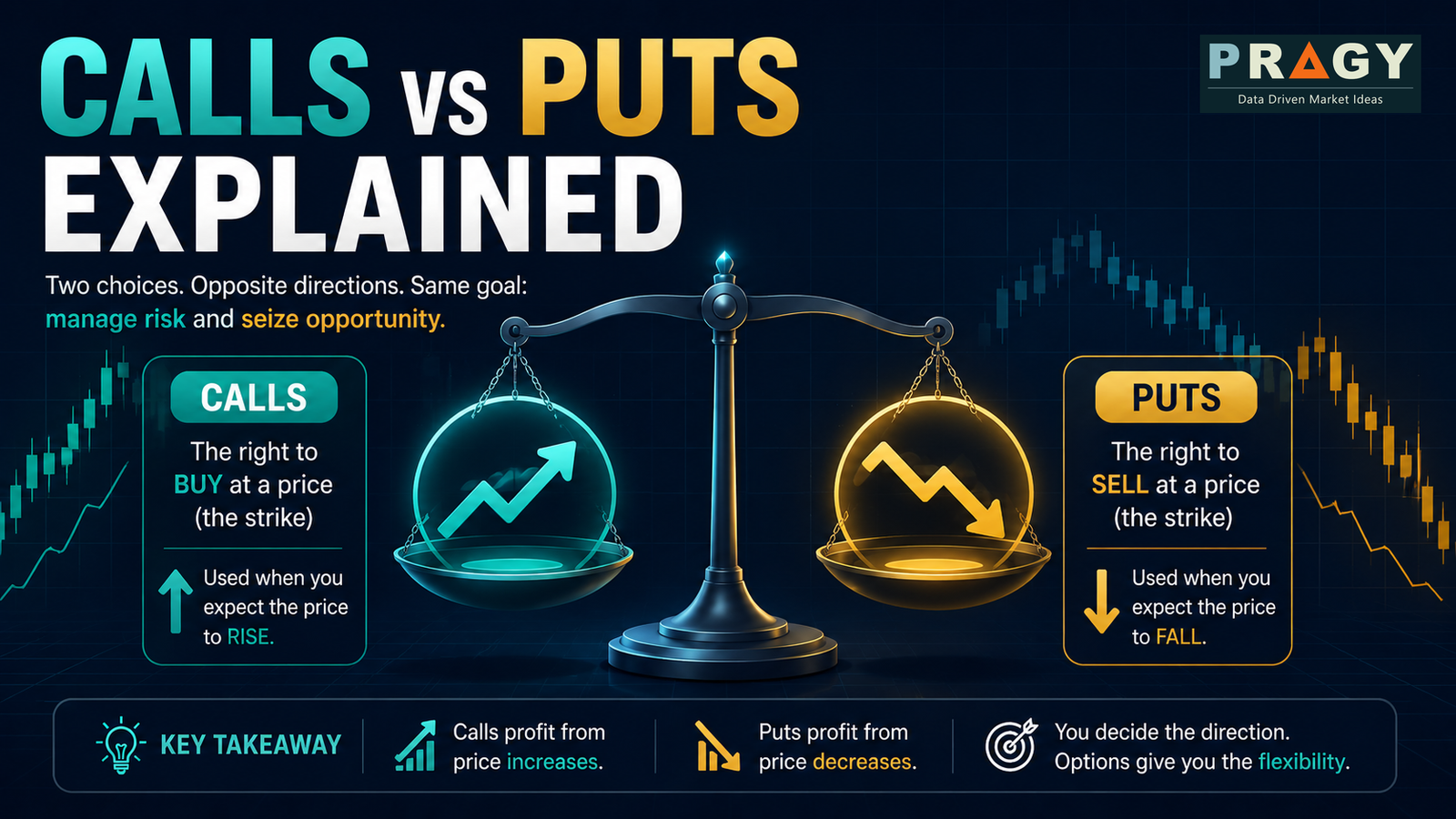
Options can look intimidating because the language sounds like it escaped from a derivatives textbook wearing a tiny suit.
The good news: the first split is simple.
A call is an option contract tied to the right to buy.
A put is an option contract tied to the right to sell.
That does not mean calls are always “good” and puts are always “bad.” It means they point in different directions and create different rights, obligations, risks, and payoff shapes.
Here’s the simple version
An option is a contract connected to an underlying asset, such as a stock or ETF. The contract has a strike price, an expiration date, and a premium.
The premium is the price of the option contract. The strike price is the price written into the contract. The expiration date is the deadline after which the option no longer has life.
For standard U.S. listed equity options, one contract usually represents 100 shares of the underlying security. That contract size matters because a small-looking premium can still represent a larger dollar amount once the multiplier is included.
The clean beginner version:
| Contract type | Buyer has the right to | Seller may be obligated to | Intrinsic value at expiration generally appears when |
|---|---|---|---|
| Call option | Buy the underlying at the strike price | Sell the underlying at the strike price | Market price is above the strike price |
| Put option | Sell the underlying at the strike price | Buy the underlying at the strike price | Market price is below the strike price |
“Right” is the key word for the buyer. The buyer can choose whether to use the contract. The seller, also called the writer, takes on an obligation if assignment occurs.
Calls: the right to buy
A call option gives the buyer the right, but not the obligation, to buy the underlying asset at the strike price before or at expiration, depending on the option style.
Think of a call like a price door above the market.
If the underlying price rises meaningfully above the strike price, the call may gain intrinsic value. If the underlying price stays below the strike price through expiration, the call may expire worthless.
Simple call example
Imagine a stock is trading at $50.
A learner is studying a call option with:
- Strike price: $55
- Premium: $2
- Expiration: one month away
- Contract multiplier: 100
The premium cost is:
$2 premium × 100 shares = $200
At expiration, the simplified break-even price is:
$55 strike + $2 premium = $57
If the stock finishes above $57 at expiration, the call has more intrinsic value than the premium paid. If it finishes below $55, the call has no intrinsic value at expiration. Between $55 and $57, the call has intrinsic value but not enough to cover the premium in this simplified example.
This is not a recommendation. It is just arithmetic.
Puts: the right to sell
A put option gives the buyer the right, but not the obligation, to sell the underlying asset at the strike price before or at expiration, depending on the option style.
Think of a put like a price floor below the market.
If the underlying price falls meaningfully below the strike price, the put may gain intrinsic value. If the underlying price stays above the strike price through expiration, the put may expire worthless.
Simple put example
Imagine the same stock is trading at $50.
A learner is studying a put option with:
- Strike price: $45
- Premium: $2
- Expiration: one month away
- Contract multiplier: 100
The premium cost is:
$2 premium × 100 shares = $200
At expiration, the simplified break-even price is:
$45 strike - $2 premium = $43
If the stock finishes below $43 at expiration, the put has more intrinsic value than the premium paid. If it finishes above $45, the put has no intrinsic value at expiration. Between $43 and $45, the put has intrinsic value but not enough to cover the premium in this simplified example.
Again, this is math for education. It is not a trade idea.
The real difference: direction of the contract right
Here is where beginners often get tangled.
Calls and puts are not “optimistic” and “pessimistic” by themselves. They are contracts with different rights.
A call buyer has the right to buy.
A put buyer has the right to sell.
A call seller may have to sell.
A put seller may have to buy.
That is the whole chessboard.
The market view depends on which side of the contract someone is on, what strategy they are using, whether the position is hedged, and how the position fits with other holdings. One isolated option contract does not automatically reveal the trader’s full intent.
Buyer risk versus seller risk
For a basic long call or long put, the buyer’s maximum loss is generally the premium paid, plus transaction costs. That does not make the trade “safe.” A 100% loss of the premium is still a real loss.
For option sellers, risk can be much larger.
A short call can carry substantial risk if the underlying price rises sharply. A short put can create large losses if the underlying price falls sharply. Sellers may also face assignment, margin requirements, and risk that changes quickly when volatility moves.
This is why options education should treat “limited risk” carefully. Limited does not mean painless. Defined does not mean small. And “usually” is doing a lot of work in options.
Moneyness: where price sits relative to the strike
Moneyness describes the relationship between the underlying price and the strike price.
For calls:
- In the money: underlying price is above the strike
- At the money: underlying price is near the strike
- Out of the money: underlying price is below the strike
For puts:
- In the money: underlying price is below the strike
- At the money: underlying price is near the strike
- Out of the money: underlying price is above the strike
This flips because calls and puts face opposite directions.
A call wants the market above the strike. A put wants the market below the strike. Simple enough — until time decay enters the room and starts eating the snacks.
Time matters because options expire
Stocks do not have expiration dates. Options do.
That deadline changes everything.
An option can be directionally correct and still disappoint if the move happens too slowly, if implied volatility falls, or if the premium paid was too high relative to the move. This is why beginners should avoid thinking of calls and puts as simple “up” or “down” buttons.
Option value usually includes:
- Intrinsic value: the value the option would have if exercised immediately.
- Extrinsic value: the extra value linked to time, volatility expectations, rates, dividends, and market demand.
As expiration approaches, extrinsic value can shrink. This is commonly called time decay. It is not the only pricing factor, but it is one of the biggest reasons options feel different from shares.
A clean way to remember calls and puts
Use this two-line memory tool:
Call = right to call shares away from the seller.
Put = right to put shares to the seller.
That sounds almost too simple. Good. The first layer should be simple.
The advanced part is not remembering the definitions. The advanced part is understanding how strike price, expiration, volatility, liquidity, and position size interact.
Common mistakes beginners make
Mistake 1: Thinking calls are always bullish and puts are always bearish
A long call is often used for upside exposure. A long put is often used for downside exposure or hedging. But options can also be part of spreads, hedges, income strategies, volatility trades, and multi-leg positions.
One contract rarely tells the whole story.
Mistake 2: Ignoring the premium
Direction is only one part of the equation. The option also has a price.
A call can be “right” about direction and still lose money if the move is too small relative to the premium. A put can be “right” about direction and still disappoint for the same reason.
The premium is not decoration. It is the hurdle.
Mistake 3: Forgetting the multiplier
A quoted premium of $2 usually means $200 per standard equity option contract because of the 100-share multiplier.
That multiplier can surprise beginners. It should not.
Mistake 4: Treating expiration like a minor detail
Expiration is not a footnote. It is the countdown clock.
A contract expiring this week behaves differently from a contract expiring months from now. Shorter-dated options can move quickly, but they can also lose time value quickly.
Mistake 5: Ignoring liquidity
Liquidity means how easily something can be traded without a large price impact.
With options, learners should pay attention to bid-ask spreads, open interest, volume, and whether the contract is actively traded. A wide bid-ask spread can make a strategy harder to evaluate.
Mistake 6: Confusing exercising with closing
Many learners assume the point of an option is always to exercise it. In practice, options can also be closed before expiration, depending on market conditions and liquidity.
Exercise, assignment, closing, and expiration are separate ideas. Mixing them up can create avoidable confusion.
Beginner framework: the C-P-S-T checklist
Before analyzing any call or put, walk through four questions.
1. Contract type
Is it a call or a put?
Call means right to buy. Put means right to sell.
2. Position side
Is the example showing the buyer or the seller?
The buyer has a right. The seller has an obligation.
3. Strike relationship
Where is the underlying price compared with the strike?
This tells you whether the option is in the money, at the money, or out of the money.
4. Time remaining
How long until expiration?
More time can create more flexibility, but it can also mean a higher premium. Less time can reduce premium, but the clock becomes less forgiving.
Practical example: reading two contracts side by side
Assume a stock is trading at $50.
| Example contract | What the buyer controls | Where intrinsic value appears at expiration | Simplified break-even |
|---|---|---|---|
| $55 call bought for $2 | Right to buy at $55 | Above $55 | $57 |
| $45 put bought for $2 | Right to sell at $45 | Below $45 | $43 |
Both examples cost $200 before transaction costs because of the standard 100-share multiplier.
The call is linked to upside movement above the strike. The put is linked to downside movement below the strike. Both can lose the full premium if the market does not move far enough, fast enough, or in the expected relationship to the strike.
That is the beginner lesson in one table.
Final takeaway
Calls and puts are not magic market buttons.
A call gives the buyer the right to buy.
A put gives the buyer the right to sell.
The strike price defines the contract price.
The expiration date defines the deadline.
The premium is the cost and the hurdle.
Once those pieces click, options stop looking like alphabet soup and start looking like structured risk contracts. Still risky, yes. But much easier to read.
Sources
- Options Industry Council, “Options Basics”: https://www.optionseducation.org/optionsoverview/options-basics
- Options Industry Council, “Options Pricing”: https://www.optionseducation.org/optionsoverview/options-pricing
- Investor.gov, “Investor Bulletin: An Introduction to Options”: https://www.investor.gov/introduction-investing/general-resources/news-alerts/alerts-bulletins/investor-bulletins-63
- Investor.gov, “Options”: https://www.investor.gov/introduction-investing/investing-basics/glossary/options
- OCC, “Equity Options Product Specifications”: https://www.theocc.com/clearance-and-settlement/clearing/equity-options-product-specifications
Disclaimer
Pragy Investments provides financial education and market research only. This content is not investment advice, financial planning, portfolio management, tax advice, legal advice, or a recommendation to buy, sell, or hold any security.