
Options sound complicated because people usually explain them like they are trying to win an award for making beginners quit.
Here’s the deal: an option contract is not magic. It is a contract with a few moving parts. Once you understand those parts, the whole topic gets a lot less weird.
Options can be useful for learning about market expectations, risk, leverage, and strategy design. They can also create fast losses when used casually. That second part matters.
This article gives you the clean version.
Here’s the simple version
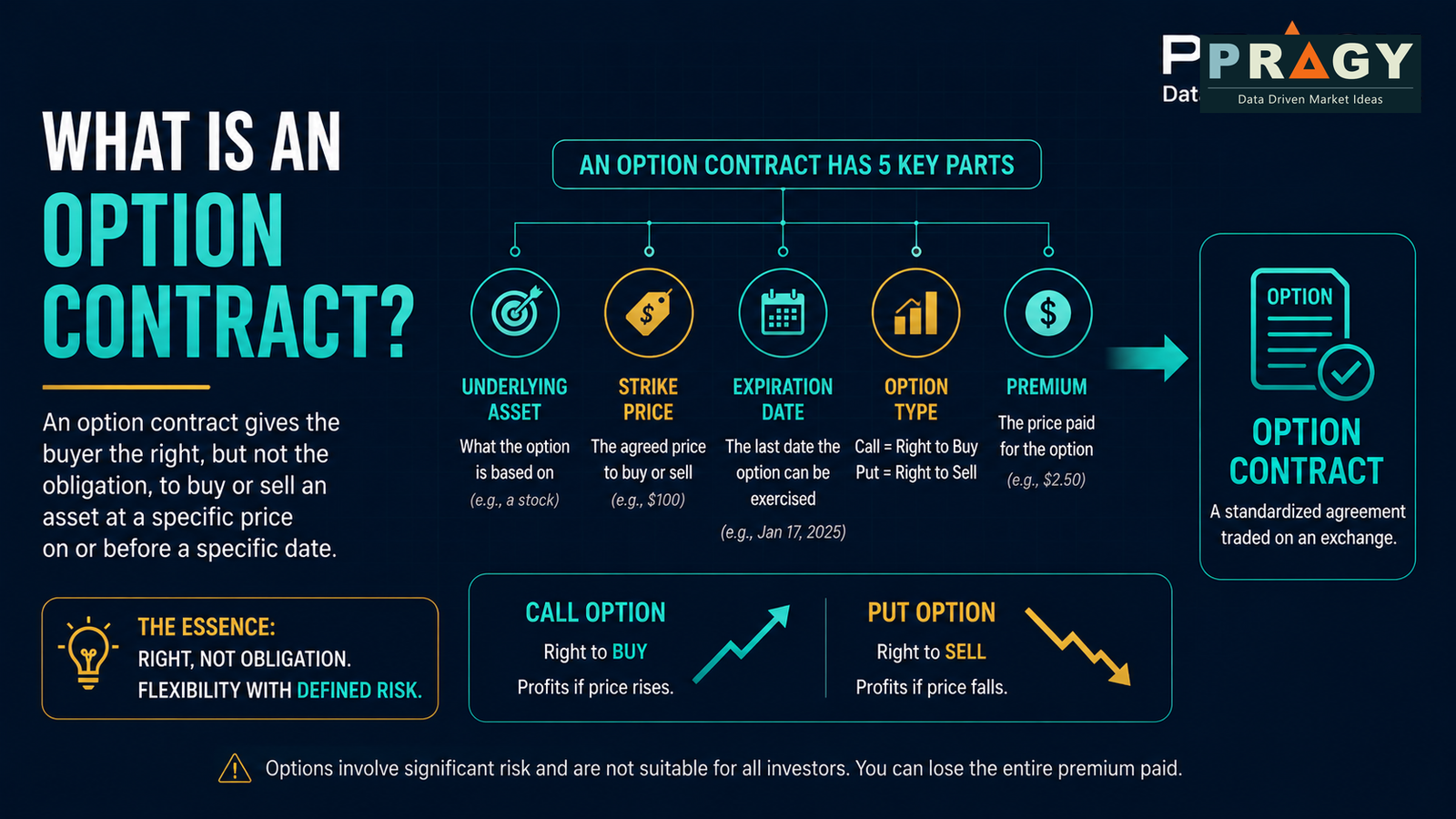
An option contract gives the buyer the right, but not the obligation, to buy or sell an underlying asset at a specific price before or on a specific date.
That sentence has three key ideas:
- Right, not obligation — the option buyer can choose whether to use the contract.
- Specific price — called the strike price.
- Specific date — called the expiration date.
The underlying asset is the thing the option is based on. For stock options, the underlying asset is usually a stock or exchange-traded fund.
Don’t overcomplicate it. An option is basically a time-limited contract connected to a market price.
The two basic types: calls and puts
There are two main types of option contracts: calls and puts.
Call option
A call option gives the buyer the right to buy the underlying asset at the strike price.
A beginner-friendly way to think about it:
If a stock is trading at $50 and a call option has a strike price of $55, that call becomes more interesting if the stock moves above $55 before expiration.
That does not automatically mean the trade is profitable. The buyer also paid a premium, and that cost matters.
Put option
A put option gives the buyer the right to sell the underlying asset at the strike price.
A simple example:
If a stock is trading at $50 and a put option has a strike price of $45, that put becomes more interesting if the stock moves below $45 before expiration.
Again, the premium matters. Price direction alone is not the full story.
The building blocks of an option contract
Every option contract has a few core ingredients.
1. Underlying asset
The underlying asset is what the contract is based on.
For stock options, that could be a company’s stock. For ETF options, it could be an exchange-traded fund. The option’s value moves partly because the underlying price moves.
2. Strike price
The strike price is the contract price.
For a call, it is the price where the option buyer has the right to buy the underlying asset.
For a put, it is the price where the option buyer has the right to sell the underlying asset.
This is where beginners often get tripped up. The strike price is not a prediction. It is a contract term.
3. Expiration date
The expiration date is when the option contract runs out of time.
Time matters because options are wasting assets. A wasting asset is something that can lose value as time passes, even if the underlying stock does not move much.
The trap: being directionally correct but too slow.
A stock can move the way you expected, but if it takes too long, the option may still lose value.
4. Premium
The premium is the price paid for the option contract.
If you buy an option, the premium is the cost of entering the position. If you sell or write an option, the premium is the amount collected, but the risk profile can be very different.
For beginners, premium is where the reality check starts. The market is not just asking, “Will price move?” It is also asking, “Will price move enough, soon enough?”
5. Contract size
Standard stock option contracts usually represent 100 shares of the underlying stock.
So if an option is quoted at $2.00, the actual contract cost is usually:
$2.00 × 100 = $200
This is where people mess up. They see the quoted option premium and forget the multiplier.
Intrinsic value vs. extrinsic value
Option prices are often discussed using two value buckets: intrinsic value and extrinsic value.
Intrinsic value
Intrinsic value is the value an option would have if it were exercised right now.
For a call option:
If the stock trades at $60 and the call strike is $55, the call has $5 of intrinsic value.
For a put option:
If the stock trades at $40 and the put strike is $45, the put has $5 of intrinsic value.
Extrinsic value
Extrinsic value is the extra value based on time, volatility, and market expectations.
Volatility means how much price tends to move. Higher expected volatility can make options more expensive because the market sees a larger possible price range before expiration.
The clean version:
Option premium = intrinsic value + extrinsic value
In the money, at the money, and out of the money
These terms describe the relationship between the underlying price and the strike price.
In the money
An option is in the money when it has intrinsic value.
A call is in the money when the underlying price is above the strike price.
A put is in the money when the underlying price is below the strike price.
At the money
An option is at the money when the underlying price is close to the strike price.
This area often has a lot of sensitivity because the contract is sitting near the decision zone.
Out of the money
An option is out of the money when it has no intrinsic value.
A call is out of the money when the underlying price is below the strike price.
A put is out of the money when the underlying price is above the strike price.
Out-of-the-money options can look cheap, but cheap does not mean low risk. Sometimes cheap simply means the market thinks the probability is lower.
Why options can move so fast
Options can move quickly because they combine several forces at once:
- Price movement in the underlying asset
- Time remaining until expiration
- Changes in expected volatility
- Distance from the strike price
- Market liquidity
Liquidity means how easily something can be traded without a large price difference between buyers and sellers. In options, weak liquidity can create wide bid-ask spreads. The bid is what buyers are offering. The ask is what sellers are asking.
Red flag: an option with a wide spread can look attractive on paper but be expensive to enter or exit.
A practical example
Let’s say a stock trades at $50.
A beginner is studying a call option with:
- Strike price: $55
- Expiration: 30 days away
- Premium: $2.00
- Contract size: 100 shares
The quoted premium is $2.00, but the actual cost is:
$2.00 × 100 = $200
For the call buyer to break even at expiration, the stock would need to be above:
$55 strike + $2 premium = $57
That does not mean $57 is guaranteed, likely, or recommended. It simply shows the math.
The option needs the underlying price to move enough to overcome the premium before time runs out.
Options are not just “cheaper stock”
This is one of the biggest beginner mistakes.
A stock position can sit there without an expiration date. An option contract has a clock attached.
That clock changes the entire game.
With options, you can be:
- Right on direction
- Wrong on timing
- Hurt by falling volatility
- Hurt by poor liquidity
- Hurt by position size
That is why options require a risk framework, not just a market opinion.
Position sizing matters even more with options
Position sizing means deciding how much capital to risk on one trade idea before entering.
A common beginner guardrail is risking about 1% to 2% of total account size on a single trade idea. For example, with a $5,000 account, 1% risk equals $50 of planned risk.
With options, the full premium paid can often be at risk. That means a $200 option contract may represent a meaningful risk even if the quote looks small.
Green flag: knowing the maximum planned loss before entering.
Red flag: choosing the contract first and thinking about risk later.
Common mistakes beginners make with options
Mistake 1: Ignoring expiration
Expiration is not a small detail. It is part of the product.
The shorter the time remaining, the less room there is for the trade idea to develop.
Mistake 2: Only focusing on direction
“Bullish” or “bearish” is not enough.
With options, the better question is:
What needs to happen, by when, and how much movement is needed?
Mistake 3: Buying cheap contracts without understanding probability
Low-priced options can be tempting.
The trap is thinking low cost automatically means a good setup. Sometimes the option is cheap because it is far away from the current price or close to expiration.
Mistake 4: Forgetting the 100-share multiplier
A $3.50 option is usually not $3.50 total.
For a standard stock option contract, it is usually:
$3.50 × 100 = $350
Mistake 5: Skipping liquidity
Wide spreads can quietly damage execution.
Execution means the actual process of entering and exiting a position. In options, poor execution can turn a decent idea into a messy result.
A simple option contract checklist
Before studying any option contract, ask:
- What is the underlying asset?
- Is it a call or a put?
- What is the strike price?
- When does it expire?
- What is the premium?
- What is the actual dollar cost after the contract multiplier?
- How much can be lost?
- Is the bid-ask spread reasonable?
- What needs to happen for the contract to make sense?
- What would make the thesis invalid?
Invalidation is the point where the original idea no longer makes sense. It could be a price level, a failed breakout, a change in volatility, or simply time running out.
Final takeaway
An option contract is a structured bet on price, time, and volatility.
That is the part beginners need to respect.
The clean version: calls and puts are not confusing once you understand the contract terms. What makes options tricky is that the clock, premium, liquidity, and position size all matter at the same time.
Don’t treat options like cheaper shares.
Treat them like contracts with rules.
Disclaimer
Educational content only. Not financial advice or a recommendation to buy, sell, or hold any security or option contract.