
A stock is one of those words people hear constantly but rarely get explained cleanly.
Someone says, “I own Apple stock.” Another person says, “The market is down.” A headline says, “Stocks rally after earnings.” Cool. But what does any of that actually mean?
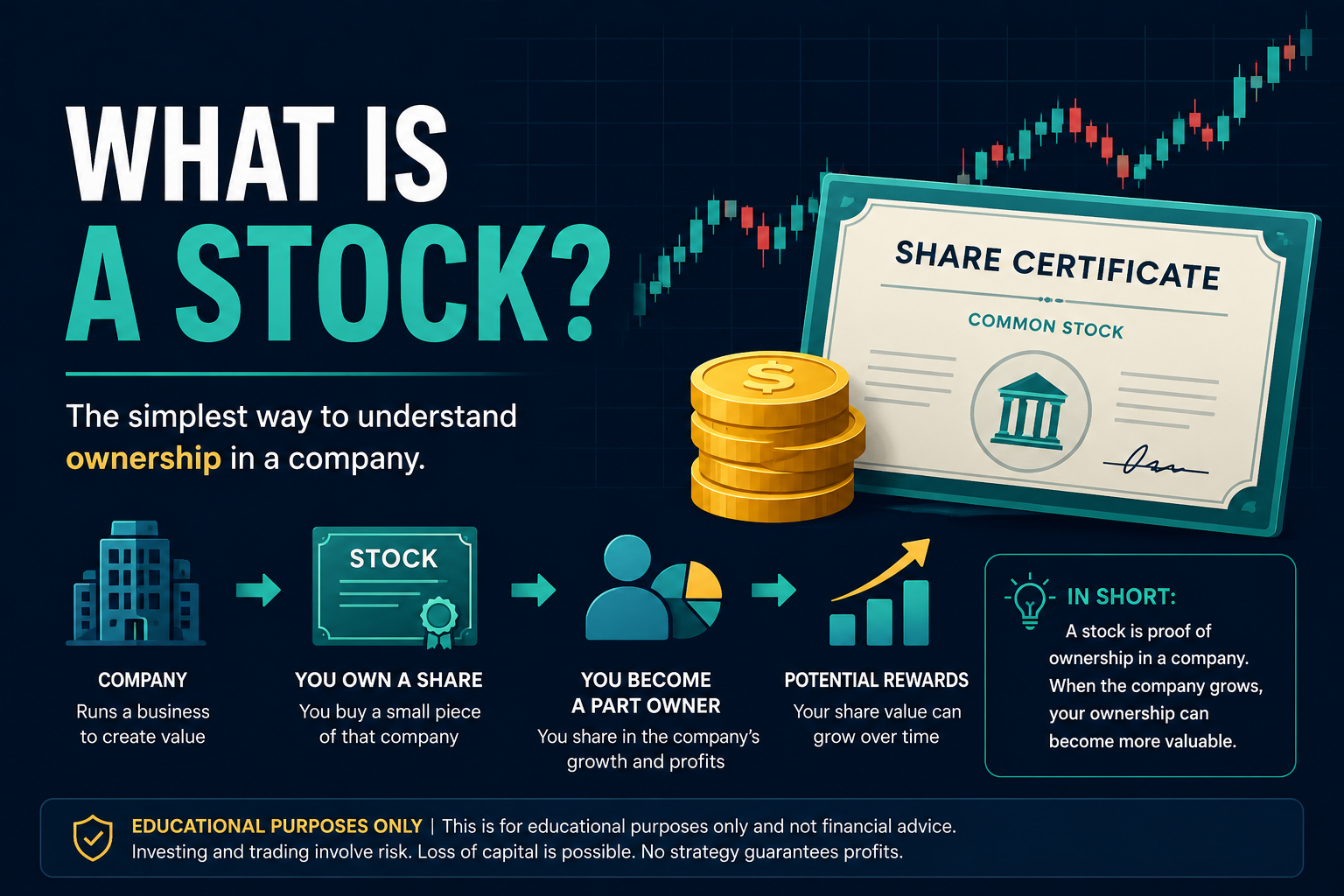
Here’s the deal: a stock is not just a flashing price on a chart. It represents ownership in a real business.
Not control-the-company ownership. Not walk-into-headquarters-and-demand-a-corner-office ownership. But a small legal ownership claim in a company.
Once you understand that, the stock market starts looking less like a casino screen and more like a giant marketplace for business ownership.
Here’s the simple version
A stock is a piece of ownership in a company.
A share is one unit of that stock.
So when someone says they bought 10 shares of a company, they bought 10 small pieces of ownership in that business.
The clean version:
- Company: the business
- Stock: ownership in that business
- Share: one slice of that ownership
- Shareholder: someone who owns shares
Don’t overcomplicate it. A stock is basically a way for regular people, funds, institutions, and other investors to own parts of public companies.
Why do companies issue stock?
Companies issue stock to raise money.
Instead of borrowing from a bank, a company can sell ownership pieces to investors. That money can help the business expand, hire people, build products, pay debt, open locations, or invest in growth.
When a private company first sells shares to the public, that process is called an IPO, which stands for initial public offering. It means the company is moving from private ownership to public market ownership.
After that, shares can trade on stock exchanges.
A stock exchange is a regulated marketplace where buyers and sellers trade shares. Examples include the New York Stock Exchange and Nasdaq.
The company gets money when it sells shares in certain offerings. After shares are already trading in the market, most daily buying and selling happens between investors.
That part matters. When you buy a stock on a normal trading day, you are usually buying from another investor, not directly from the company.
What do shareholders actually get?
Owning stock can give shareholders a few potential benefits.
First, shareholders may benefit if the company becomes more valuable and the stock price rises. That price increase is called capital appreciation.
Second, some companies pay dividends. A dividend is a cash payment a company sends to shareholders, usually from profits. Not every company pays dividends. Some companies reinvest profits back into the business instead.
Third, shareholders may get voting rights. Voting rights allow shareholders to vote on certain company matters, like board members. The amount of influence depends on the number and type of shares owned.
The trap is thinking every stock gives the same benefits. It does not.
Some stocks pay dividends. Some do not. Some shares have voting rights. Some have limited voting rights. Some companies are stable. Some are extremely volatile.
Why does a stock price move?
A stock price moves because buyers and sellers disagree about value.
That sounds simple because it is.
If more buyers are willing to pay higher prices, the stock can rise. If more sellers accept lower prices, the stock can fall.
But the reasons behind that buying and selling can vary.
Stock prices can move because of:
- earnings reports
- company news
- interest rates
- economic data
- industry trends
- investor expectations
- fear and greed
- overall market conditions
Earnings are a company’s profits over a period of time. Public companies usually report earnings quarterly, which means every three months.
This is where people mess up: a good company does not automatically mean a good stock at any price.
If expectations are too high, even solid results can disappoint investors. If expectations are too low, decent results can surprise the market.
Stock prices are not just about what happened. They are often about what investors expected to happen.
Stock price versus company value
A stock’s price is the cost of one share.
A company’s total market value is called market capitalization, or market cap.
Market cap is calculated like this:
Share price × total shares outstanding = market cap
Example:
A company has 100 million shares outstanding.
Its stock trades at $20 per share.
That company’s market cap is:
$20 × 100 million = $2 billion
This is why a $20 stock is not automatically “cheaper” than a $200 stock.
A $20 stock could represent a huge company with many shares. A $200 stock could represent a smaller company with fewer shares.
Red flag: judging a stock only by the share price.
Green flag: looking at the business, valuation, risk, and context together.
Common stock versus preferred stock
Most beginners are talking about common stock.
Common stock usually gives shareholders potential voting rights and the ability to benefit if the company grows. But common shareholders are lower in priority if the company runs into serious financial trouble.
Preferred stock is different. It often acts more like a hybrid between stock and debt. Preferred shareholders may receive fixed dividend payments and may have higher priority than common shareholders, but they usually have less upside and fewer voting rights.
For most beginner stock market education, common stock is the main focus.
What does it mean to invest in a stock?
Investing in a stock means buying shares with the goal of benefiting from the company’s future performance.
That does not mean the stock will go up.
A business can perform well and still have a falling stock price if investors expected even better results. A weak business can rally temporarily if expectations improve. Markets are messy like that.
A beginner-friendly way to think about stocks:
You are not just buying a price.
You are buying exposure to a business story.
That story includes revenue, profits, debt, competition, leadership, industry trends, and investor sentiment.
Practical example: the coffee shop version
Imagine a local coffee shop wants to expand.
The owner divides the business into 1,000 ownership pieces.
You buy 10 pieces.
You now own 1% of the business.
If the business grows, opens new locations, and becomes more profitable, your ownership may become more valuable. If the business struggles, your ownership may lose value.
That is the basic stock idea.
Public stocks work at a much larger scale. Instead of a local coffee shop with 1,000 pieces, a public company may have millions or billions of shares trading in the market.
Same concept. Bigger machine.
A simple beginner framework for understanding any stock
Before getting excited about a stock, ask five basic questions.
1. What does the company actually do?
If you cannot explain how the company makes money in plain English, slow down.
A company can sound impressive and still have a confusing business model.
2. Is the company profitable?
Profit is not the only thing that matters, but it matters.
Some companies focus on growth before profit. That can work, but it usually comes with more risk.
3. How much debt does the company have?
Debt can help a company grow, but too much debt can create pressure.
A business with heavy debt may struggle when interest rates rise or sales slow down.
4. Why might the stock price rise or fall?
Look for the main drivers.
Is the stock moving because of earnings growth? Hype? Sector momentum? Cost cutting? A turnaround story? A new product?
Knowing the “why” helps you avoid random decision-making.
5. What could prove the idea wrong?
This is called invalidation. Invalidation is the point where your original idea no longer makes sense.
For investors, invalidation might be a major business decline, broken growth story, worsening balance sheet, or a valuation that no longer fits reality.
For traders, invalidation may be a specific price level. A stop loss is a planned exit level used to limit damage if a trade goes wrong.
Different strategies use different rules. The key is having rules before emotions take over.
Common mistakes beginners make with stocks
Mistake 1: Thinking a low price means a bargain
A $5 stock is not automatically cheap.
A $500 stock is not automatically expensive.
Price alone tells you almost nothing.
Mistake 2: Buying a story without understanding the risk
A good story can be dangerous if you ignore the numbers.
Every stock has risk. Even popular companies can fall hard.
Mistake 3: Confusing investing with guessing
Guessing is “I think this goes up.”
Investing is “I understand the business, the risk, the valuation, and why I am involved.”
There is a big difference.
Mistake 4: Ignoring position size
Position sizing means deciding how much money to risk on one idea.
A common beginner guardrail is risking about 1% to 2% of total account size on a single trade idea. For example, with a $5,000 account, 1% risk equals $50 of planned risk.
Even when investing longer term, the principle still matters: do not let one idea become so large that it can wreck your account or your decision-making.
Mistake 5: Expecting the market to be logical every day
The market can be emotional, noisy, and dramatic.
Some days, prices move because of real information. Other days, they move because people are reacting, overreacting, or repositioning.
Don’t overcomplicate it. Your job is not to explain every wiggle. Your job is to make better decisions over time.
Action checklist
Before buying or studying any stock, run through this checklist:
- Can I explain what the company does?
- Do I understand how it makes money?
- Do I know whether it is profitable?
- Have I checked its debt and financial health?
- Do I understand why investors might value it higher or lower?
- Do I know what could prove my idea wrong?
- Have I decided how much risk is acceptable?
- Am I acting from a plan instead of emotion?
That checklist will not make you perfect.
It will make you less reckless. That is already a major upgrade.
Final takeaway
A stock is a slice of ownership in a company.
That is the foundation.
But the real skill is learning how business quality, investor expectations, valuation, risk, and market psychology all connect.
The stock market rewards patience, discipline, and clear thinking more than hot takes.
The clean version: learn what you own, understand why it moves, respect the risk, and avoid turning every stock into a lottery ticket.
Disclaimer
Educational content only. This article is not personalized financial advice and is not a recommendation to buy, sell, or hold any security. Investing and trading involve risk, and loss of capital is possible.