
A company can tell a great story.
Revenue is growing. Management sounds confident. The investor presentation looks clean. The stock chart has drama.
Then you open the balance sheet and realize the company is carrying too much debt, too little cash, and a business model held together with accounting tape.
Here’s the deal: the balance sheet is not exciting. That is exactly why it matters.
It shows what a company owns, what it owes, and what is left for shareholders after the bills are accounted for.
Here’s the simple version
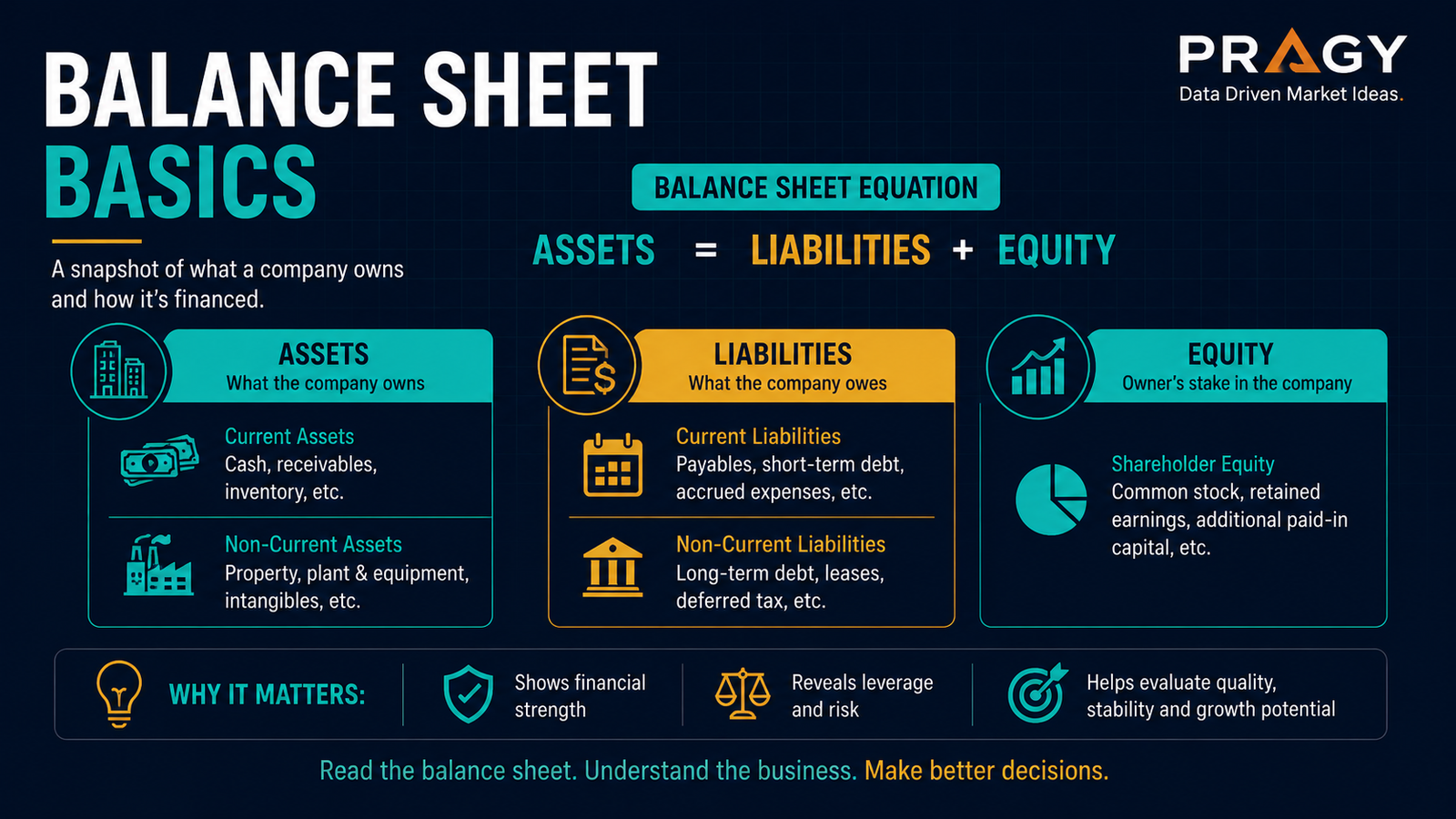
A balance sheet answers three basic questions:
- What does the company own?
These are assets.
- What does the company owe?
These are liabilities.
- What is left for owners?
This is shareholders’ equity.
The clean version looks like this:
Assets = Liabilities + Equity
That equation is the entire balance sheet in one line.
Assets are funded by either borrowed money, which creates liabilities, or owner/shareholder capital, which creates equity.
Don’t overcomplicate it.
What are assets?
Assets are resources the company owns or controls that may help it generate value.
Common assets include:
- Cash and cash equivalents: money available right away.
- Accounts receivable: money customers owe the company.
- Inventory: products or materials waiting to be sold.
- Property, plant, and equipment: factories, buildings, machines, vehicles, and similar long-term operating assets.
- Intangible assets: non-physical assets like patents, trademarks, software, or acquired brand value.
The trap is treating all assets as equally strong.
Cash is simple. Inventory can become stale. Receivables may not get collected. Intangible assets can be hard to value. A company with “lots of assets” is not automatically financially strong.
Quality matters.
Current assets vs long-term assets
A balance sheet usually separates assets into two groups.
Current assets are expected to turn into cash or be used within about one year. Cash, receivables, and inventory usually sit here.
Long-term assets support the business over a longer period. Buildings, equipment, long-term investments, and some intangible assets usually sit here.
For beginners, current assets are especially useful because they help you judge short-term flexibility.
A company with strong current assets has more room to handle bills, slowdowns, and surprise problems.
What are liabilities?
Liabilities are obligations the company owes to others.
Common liabilities include:
- Accounts payable: bills owed to suppliers.
- Short-term debt: debt due soon.
- Long-term debt: borrowings due later.
- Accrued expenses: costs the company has incurred but not yet paid.
- Lease obligations: future payments for leased assets.
Liabilities are not automatically bad.
Debt can help a company expand. Supplier credit can help operations run smoothly. The issue is whether the company can comfortably handle what it owes.
This is where people mess up: they see debt and panic, or they ignore debt because the company is growing fast.
Both reactions are too simple.
The better question is: Can the company support its obligations through cash, earnings power, and business stability?
What is shareholders’ equity?
Shareholders’ equity is what remains after subtracting liabilities from assets.
Equity = Assets - Liabilities
Think of it as the accounting value left for shareholders.
Equity can include:
- money originally invested by shareholders
- retained earnings, which are profits kept in the business instead of paid out
- accumulated gains or losses from certain accounting adjustments
A growing equity base can be a green flag, especially when it comes from retained earnings and steady business performance.
But equity also needs context. Some asset-light companies can be valuable even with modest book equity. Some asset-heavy companies can show high equity but still struggle if returns are weak.
The balance sheet gives clues. It does not give the full movie.
The balance sheet snapshot problem
A balance sheet is a snapshot at one point in time.
That matters.
A company may look cash-rich at quarter-end because it raised money right before reporting. Another company may look debt-heavy because it just made a large acquisition. A retailer may carry more inventory before a busy shopping season.
One balance sheet is useful. Several balance sheets over time are better.
Look for direction:
- Is cash rising or falling?
- Is debt growing faster than assets?
- Are receivables increasing faster than revenue?
- Is inventory piling up?
- Is equity improving or shrinking?
Trend matters more than one pretty quarter.
Key balance sheet areas beginners should check
1. Cash
Cash gives a company breathing room.
A strong cash position can help fund operations, repay debt, invest in growth, or survive weak periods.
Red flag: cash falling quickly while losses or debt keep rising.
Green flag: cash is stable or growing while the business funds itself more efficiently.
2. Debt
Debt can magnify outcomes.
When business is strong, debt may help accelerate growth. When business weakens, debt can become a heavy weight.
Beginners should compare debt to cash, earnings power, and the stability of the company’s industry.
A utility, bank, software company, and mining company can all carry very different balance sheet structures. Context matters.
3. Working capital
Working capital is current assets minus current liabilities.
Working Capital = Current Assets - Current Liabilities
It gives a rough view of short-term financial flexibility.
Positive working capital means current assets are larger than current liabilities. Negative working capital means short-term obligations are larger than short-term resources.
Negative working capital is not always bad. Some strong businesses collect cash from customers before paying suppliers. But for a struggling company, negative working capital can become a serious pressure point.
4. Receivables
Accounts receivable is money customers owe the company.
If receivables are rising much faster than revenue, pause.
It may mean customers are taking longer to pay, sales quality is weakening, or the company is booking revenue before cash arrives.
The trap: revenue can look strong while cash collection is getting worse.
5. Inventory
Inventory is product waiting to be sold.
For retailers, manufacturers, and hardware companies, inventory matters a lot.
Rising inventory can be normal before a busy season. But inventory growing faster than sales can signal demand problems, discounting risk, or obsolete products.
Red flag: inventory keeps rising while revenue slows.
6. Goodwill and intangible assets
Goodwill often appears after a company buys another business for more than the accounting value of its net assets.
Goodwill is not cash. It is not inventory. It is not a machine you can easily sell.
Large goodwill balances deserve attention because they can lead to impairment charges if an acquisition performs poorly. An impairment is an accounting write-down that reduces asset value.
Not all goodwill is bad. But it should not be ignored.
Practical example: two companies, same revenue, different balance sheets
Imagine two companies each generate $500 million in annual revenue.
Company A
- $120 million in cash
- $40 million in debt
- current assets are comfortably above current liabilities
- receivables grow roughly in line with revenue
- inventory is stable
Company A may have flexibility. It has cash, manageable debt, and no obvious short-term pressure.
Company B
- $15 million in cash
- $220 million in debt
- current liabilities are larger than current assets
- receivables are rising faster than revenue
- inventory is building while sales slow
Company B may still have potential, but the balance sheet adds risk. It has less room for mistakes.
Same revenue. Very different financial strength.
That is why the balance sheet matters.
How investors can use the balance sheet
The balance sheet should not be used alone.
Pair it with:
- the income statement, which shows revenue, expenses, and profit
- the cash flow statement, which shows actual cash moving in and out
- valuation metrics, which help compare price to fundamentals
- business quality, industry position, and management execution
The balance sheet tells you whether the company has financial durability.
It helps answer:
- Can this company survive a bad year?
- Is growth being funded responsibly?
- Is debt becoming a problem?
- Are customers paying on time?
- Is inventory under control?
- Does the company have flexibility or financial stress?
Common mistakes beginners make
Mistake 1: Only looking at revenue
Revenue growth is useful, but it does not erase balance sheet risk.
A company can grow sales while burning cash, increasing debt, and weakening its financial position.
Growth is better when the balance sheet can support it.
Mistake 2: Assuming all debt is bad
Debt is a tool.
The problem is not debt by itself. The problem is debt the company cannot comfortably service.
Look at debt size, interest costs, maturity timing, cash flow, and business stability.
Mistake 3: Ignoring share dilution
Companies with weak balance sheets may raise cash by issuing more shares.
Share dilution happens when a company increases the number of shares outstanding, which can reduce each existing shareholder’s ownership percentage.
Dilution is not always bad if it funds smart growth. But repeated dilution to cover operating losses can be a red flag.
Mistake 4: Treating book value as market value
Book value is an accounting measure of equity. Market value is what investors are willing to pay for the company in the stock market.
They are not the same.
Some companies trade above book value because investors expect strong future returns. Others trade below book value because the market doubts asset quality or earnings power.
Mistake 5: Looking at one period only
One quarter can mislead.
Use several periods to see whether the company is improving or deteriorating.
A single balance sheet gives a snapshot. A trend gives a story.
Action checklist
Before studying a stock, use this quick balance sheet checklist:
- Does the company have enough cash for near-term needs?
- Is debt reasonable for the business model?
- Are current assets larger than current liabilities?
- Are receivables growing faster than revenue?
- Is inventory rising while sales slow?
- Is shareholders’ equity improving over time?
- Is goodwill unusually large compared with total assets?
- Has the company been issuing lots of new shares?
- Does the balance sheet support the growth story?
- Are risks getting better or worse across several quarters?
Final takeaway
The balance sheet is where the financial story gets real.
The income statement may show growth. The chart may show momentum. The headline may sound exciting.
But the balance sheet shows the company’s financial backbone.
The clean version: look for cash, debt, working capital, receivables, inventory, and equity trends. You do not need to become an accountant. You need to know whether the company has strength, flexibility, or pressure hiding under the surface.
Don’t overcomplicate it. Strong businesses usually leave clues. Weak balance sheets do too.
Disclaimer
Educational content only. Not personalized financial advice, not a recommendation to buy, sell, or hold any security. Investing involves risk, including possible loss of capital.