
A cash-secured put sounds calm.
That is partly fair. Compared with selling a put without enough buying power behind it, setting aside cash is more disciplined. But “cash-secured” does not mean “risk-free.”
It means the obligation has funding behind it.
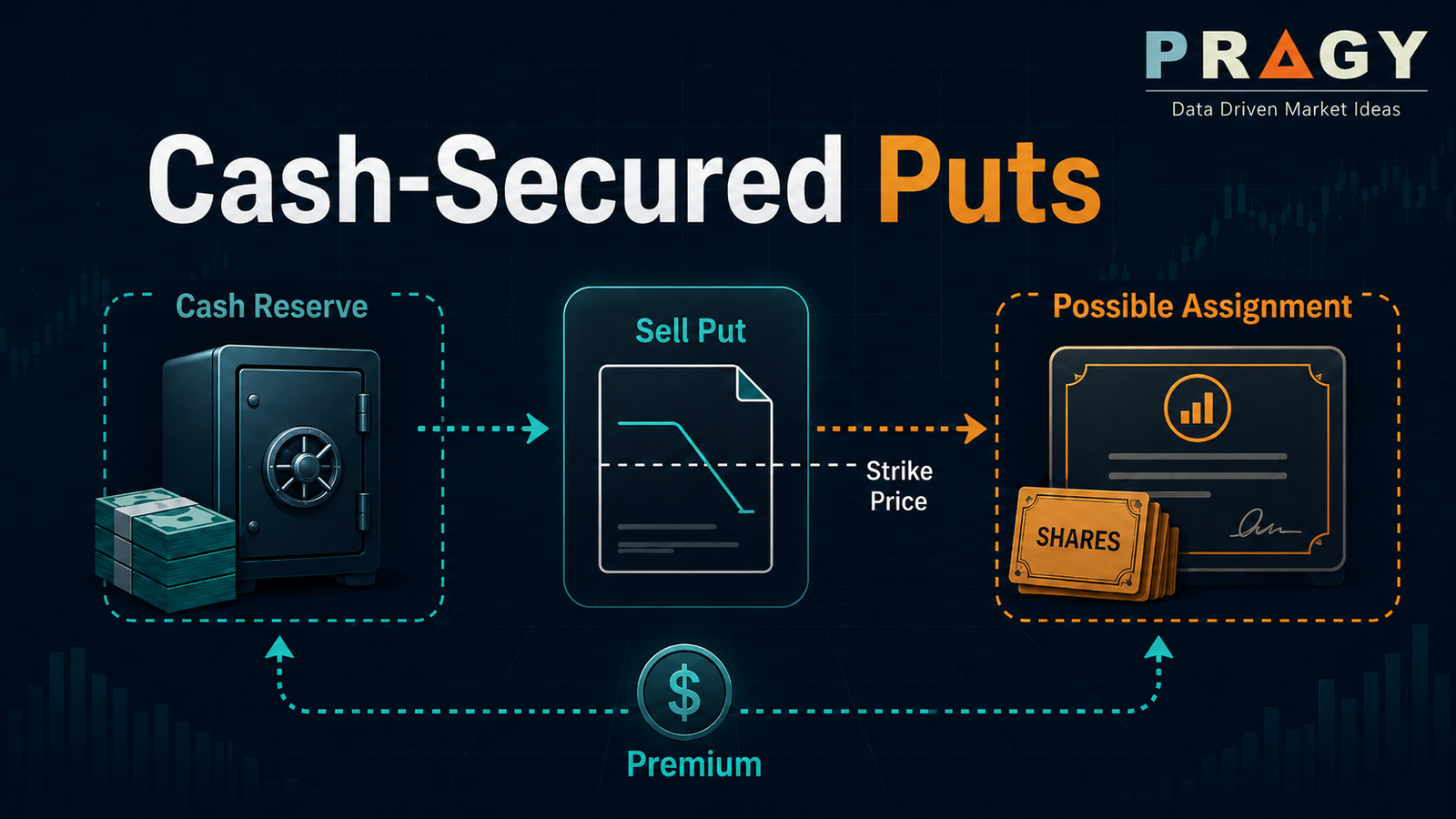
A cash-secured put is an options strategy where a trader sells a put option and keeps enough cash available to buy the shares if assigned. The seller receives option premium upfront. In exchange, they accept the obligation to buy the underlying shares at the strike price if the option holder exercises.
That premium is not a gift. It is compensation for taking assignment risk and downside stock risk.
Here’s the simple version
A cash-secured put has two moving pieces:
- The put option sold: This creates the obligation to buy shares at the strike price if assigned.
- The cash reserve: This is the money set aside to pay for those shares if assignment happens.
The clean formula is:
Cash-secured put = premium received + obligation to buy shares if assigned
That is the part beginners need to respect.
A cash-secured put is often studied as a potential stock-acquisition strategy. Instead of buying shares immediately, the trader sells a put at a strike price where they would be willing to own the stock in a defined research scenario.
If the put expires worthless, the seller keeps the premium. If the put is assigned, the seller buys the shares at the strike price, with the premium reducing the effective cost.
Clean. Useful. Still risky.
What a put option actually does
A put option gives the buyer the right, but not the obligation, to sell the underlying asset at a specific strike price before or at expiration, depending on the option style.
The seller of that put is on the other side.
That means the seller has the obligation to buy the shares at the strike price if assigned. For standard U.S. equity options, one contract typically represents 100 shares, although learners should always check the specific contract details.
Here are the key terms:
| Term | Plain-English meaning |
|---|---|
| Put option | A contract giving the buyer the right to sell shares at the strike price |
| Strike price | The price where the put seller may be required to buy shares |
| Premium | The money received for selling the option |
| Assignment | When the option seller must fulfill the contract obligation |
| Cash-secured | Cash is reserved to cover the possible share purchase |
| Breakeven | Strike price minus premium received, before fees and taxes |
This is where people mess up: they focus on the premium first.
The better question is: “Would this obligation still make sense if assignment happens during a bad move?”
How a cash-secured put works step by step
A basic cash-secured put process looks like this:
| Step | What happens | Why it matters |
|---|---|---|
| 1 | A trader studies a stock or ETF | The underlying risk matters more than the option premium |
| 2 | They choose a put strike | The strike defines the possible purchase price |
| 3 | They sell the put | Selling creates an obligation, not just income |
| 4 | They reserve cash | The cash can fund assignment if required |
| 5 | The option moves toward expiration | Price, volatility, time, and events affect the option value |
| 6 | The put expires, is closed, or is assigned | The strategy outcome depends on what happens next |
The “secured” part is operational discipline. It means the trader is not pretending the obligation does not exist.
The three main outcomes
A cash-secured put can end in several ways.
1. The stock stays above the strike
If the underlying stays above the strike price through expiration, the put may expire worthless.
The seller keeps the premium. The cash reserve is no longer needed for that contract. The downside is opportunity cost: the stock may have moved higher without the seller owning it.
That is not automatically bad. It is simply the trade-off.
2. The stock falls below the strike
If the underlying falls below the strike price, assignment becomes more likely.
The seller may be required to buy 100 shares per contract at the strike price. The premium received lowers the effective cost, but it does not protect against a large decline.
A small dip can be manageable in a well-researched scenario. A collapse is a different animal.
3. The option is closed before expiration
The seller may buy back the put before expiration. This can happen for a gain, loss, or strategic adjustment.
But there is no magic here. If the underlying drops sharply or implied volatility rises, buying back the put may be expensive.
Closing a position is a risk-management choice, not an escape hatch that always works cheaply.
A fictional example
Assume a fictional stock, ABC, trades at $52.
A learner studies the company and wants to understand how a cash-secured put would behave around the $50 strike.
| Input | Educational example |
|---|---|
| Current stock price | $52 |
| Put strike price | $50 |
| Put premium received | $1.50 per share |
| Contract multiplier | 100 shares |
| Cash set aside | $5,000 |
| Premium received | $150 |
| Effective assigned cost | $48.50 per share |
| Expiration breakeven | $48.50, before fees and taxes |
The premium is calculated like this:
$1.50 premium × 100 shares = $150 received
The cash set aside is calculated like this:
$50 strike × 100 shares = $5,000 reserved
If assigned, the effective cost is:
$50 strike – $1.50 premium = $48.50 per share
That looks tidy on paper. Markets are less tidy.
Scenario map
| ABC price at expiration | Likely outcome | Educational interpretation |
|---|---|---|
| $55 | Put likely expires worthless | Seller keeps the premium but does not buy shares |
| $49 | Assignment possible or likely | Seller may buy shares at $50; effective cost is $48.50 before fees and taxes |
| $45 | Assignment likely | Seller owns shares above current market price, partly offset by premium |
| $20 | Major loss scenario | Premium helps only slightly; downside risk is still substantial |
The maximum gain from the option itself is the premium received: $150 in this simplified example.
The maximum loss is substantial. If ABC fell to zero, the seller could lose:
($50 strike – $1.50 premium) × 100 shares = $4,850
That is the boring math that keeps people honest.
Why the premium is not “free income”
Premium feels good because it arrives upfront.
That is the trap.
The premium is paid because the seller is taking risk. Specifically, the seller is agreeing to buy the underlying if the option holder exercises. If the stock drops hard, the premium can look tiny compared with the loss on the assigned shares.
A cash-secured put is not just an income idea. It is a conditional stock-ownership idea.
Better framing:
“Am I being paid enough to accept the possibility of owning this underlying at this strike under imperfect conditions?”
That question is much more useful than:
“How much premium can I collect?”
Where the risk hides
Downside risk is similar to owning the stock
If the stock falls sharply, the put seller can be assigned and end up owning shares above the current market price.
The premium reduces the effective cost. It does not remove the downside.
Assignment can happen before expiration
Many equity options are American-style, which means exercise can occur before expiration. A short put seller should not assume assignment only happens on expiration Friday.
The practical lesson: know what happens if assignment occurs earlier than expected.
Volatility can make the position harder to close
If implied volatility rises, the short put may increase in value even if the stock has not moved much. Since the seller would have to buy back the put to close it, a higher option value can mean a higher closing cost.
Implied volatility is the market’s estimate of expected future movement. It does not predict direction. It prices uncertainty.
The cash reserve has an opportunity cost
Cash set aside for assignment is not available for other ideas.
That may be acceptable. It may not be. The point is to count it as part of the decision, not ignore it because the option premium looks attractive.
A high premium may be a warning
Premium often rises when risk rises.
Upcoming earnings, litigation, sector stress, macro events, or poor liquidity can all make an option look “juicy.” Sometimes the market is simply pricing danger.
No free lunch. Sometimes not even a discounted sandwich.
Cash-secured puts vs. covered calls
Cash-secured puts and covered calls are often discussed together because both involve selling options and receiving premium.
They are not the same.
| Strategy | Starting position | Option sold | Main obligation | Common educational use |
|---|---|---|---|---|
| Cash-secured put | Cash | Put | Buy shares if assigned | Study potential stock acquisition at a defined strike |
| Covered call | Shares | Call | Sell shares if assigned | Study premium collection against existing shares |
A covered call begins with stock ownership.
A cash-secured put begins with cash and the possibility of stock ownership.
Both strategies exchange flexibility for premium. Neither removes market risk.
Common beginner mistakes
Mistake 1: Choosing the strike by premium only
A higher premium can be tempting, but the strike controls the possible purchase obligation.
A better beginner question is: “What does this strike imply if the stock drops quickly?”
Mistake 2: Ignoring the underlying
The option is attached to a real asset.
If the underlying is weak, illiquid, event-heavy, or poorly understood, the option premium does not magically clean up the risk.
Mistake 3: Treating assignment as failure
Assignment is not automatically failure. It is one possible outcome of the strategy.
But assignment becomes a problem when the seller did not actually want the shares, did not understand the downside, or used cash they could not afford to commit.
Mistake 4: Forgetting position size
One contract can represent 100 shares. A $50 strike can mean a $5,000 purchase obligation per contract.
Two contracts? $10,000.
This is where “small premium” can quietly become “large obligation.”
Mistake 5: Assuming breakeven means safe
Breakeven is just a line on the map.
If the stock falls far below breakeven, losses continue. A $48.50 breakeven does not help much if the stock trades at $30 after bad news.
A practical cash-secured put checklist
Before studying or using a cash-secured put as an educational framework, walk through this checklist:
| Question | Why it matters |
|---|---|
| Do I understand the underlying? | The stock or ETF drives the real risk |
| What is the strike price? | This defines the possible purchase obligation |
| How much cash must be reserved? | Cash-secured means the obligation is funded |
| What is the premium after fees? | Fees can affect small-premium setups |
| What is the breakeven? | Strike minus premium gives the basic reference point |
| What happens if assignment occurs tomorrow? | Assignment can happen before expiration |
| What event risk exists before expiration? | Earnings, news, and macro events can change the setup fast |
| What would invalidate the original research? | A clear invalidation condition prevents wishful thinking |
The best risk question is not, “Can this expire worthless?”
It is, “What happens if the ugly scenario shows up first?”
Final takeaway
A cash-secured put is a promise with cash behind it.
The premium is real. So is the obligation.
Used thoughtfully, the strategy can help options learners understand strike selection, assignment, breakeven, and downside risk. Used casually, it can turn a small upfront credit into a much larger stock exposure.
The clean version:
Do not study the premium without studying the purchase obligation.
That is the heart of cash-secured puts.
Sources
Sources checked on June 29, 2026.
- Options Industry Council, Cash-Secured Put
- FINRA, Trading Options: Understanding Assignment
- Investor.gov, Investor Bulletin: An Introduction to Options
Disclaimer
Pragy Investments provides financial education and market research only. This content is not investment advice.