
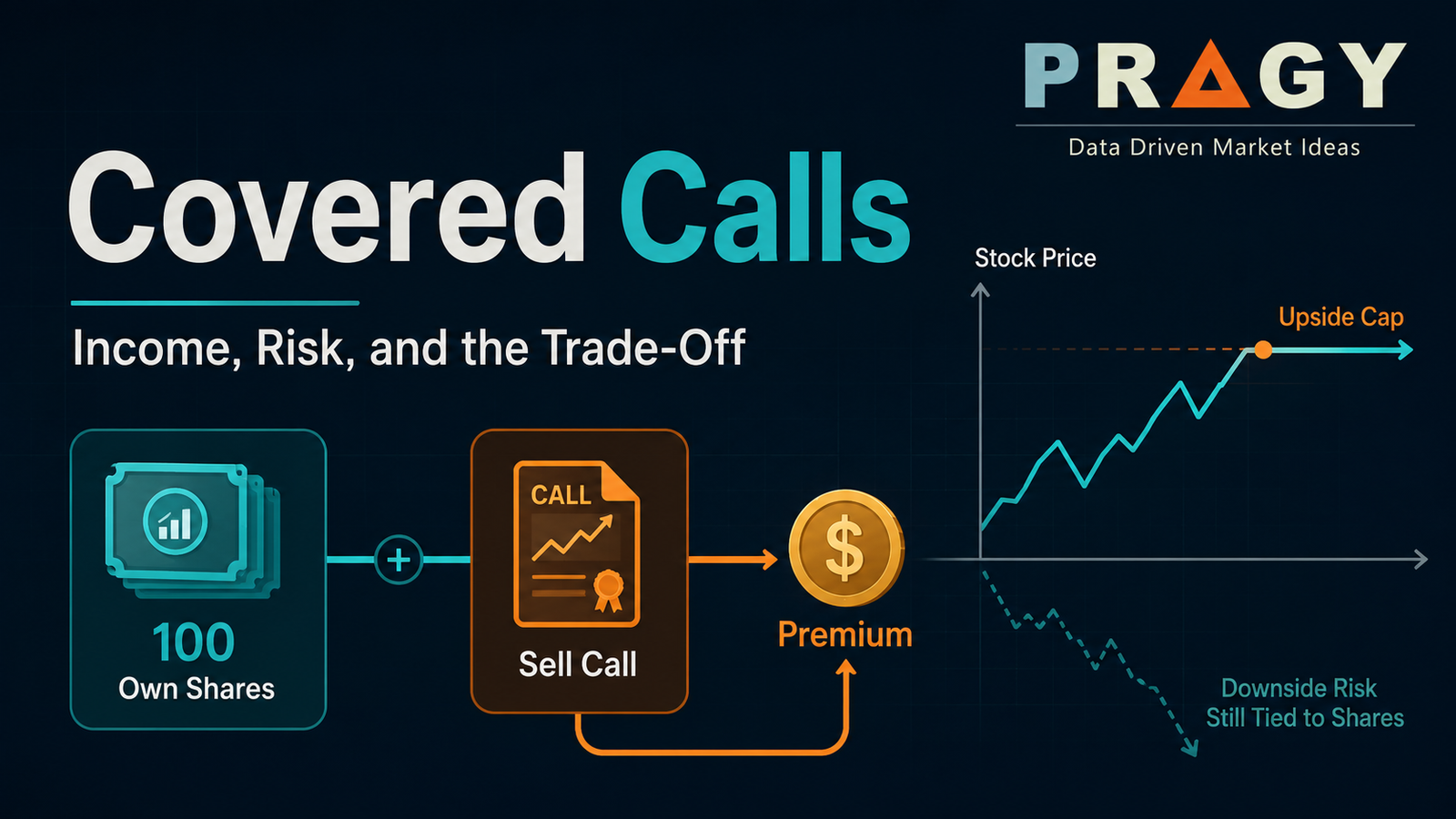
Covered calls sound almost too clean at first.
Own shares. Sell a call option. Collect premium. Smile politely.
Here’s the deal: a covered call is not free income. It is a trade-off. The premium you receive comes in exchange for giving someone else upside rights on stock you already own.
That can be useful in the right educational scenario. It can also be misunderstood very quickly.
Here’s the simple version
A covered call combines two positions:
- You own shares of a stock or ETF.
- You sell a call option against those shares.
A call option gives the buyer the right, but not the obligation, to buy the underlying shares at a set price called the strike price before or at expiration, depending on the option style.
When you sell the call, you receive the premium. In return, you accept an obligation: if assigned, you may have to sell your shares at the strike price.
The strategy is called “covered” because the shares you already own can be delivered if the call is exercised. That is very different from selling a naked call, where the seller does not already own the shares.
Clean version:
A covered call turns some upside potential into upfront option premium.
That sentence is the whole strategy.
Why people study covered calls
Covered calls are commonly discussed because they are one of the first options strategies learners encounter after basic calls and puts.
The appeal is easy to see:
- The seller receives premium upfront.
- The premium can slightly reduce the impact of a small stock decline.
- The strategy can create a defined exit price if the shares are called away.
- The mechanics are easier to understand than many multi-leg options strategies.
But the trap is also easy to miss:
- The stock can still fall sharply.
- The upside is capped while the short call is open.
- Assignment can happen.
- A high premium is usually attached to higher uncertainty, volatility, or event risk.
A covered call is not a magic income machine. It is stock ownership with an option obligation attached.
The three moving parts
1. The shares
In a standard listed equity options example, one option contract generally represents 100 shares. That means a basic covered call usually pairs 100 shares with one short call contract.
If someone owns 200 shares, two calls would be fully covered. If someone owns 100 shares and sells two calls, only one call is covered by shares. The second call creates additional risk.
This is where beginners should slow down. Contract quantity matters.
2. The short call
Selling a call means selling upside rights.
The call buyer gets the right to buy shares at the strike price. The call seller receives premium and accepts the obligation to sell shares at the strike price if assigned.
Example language:
- Stock price: $50
- Call strike: $55
- Expiration: 30 days
- Premium received: $1.50 per share
- Contract size: 100 shares
- Total premium: $150 before commissions and fees
That $150 is not a gift. It is compensation for taking on the obligation.
3. The expiration date
The expiration date matters because time affects the option’s value and assignment risk.
A call with more time until expiration usually has more time value than a similar near-expiration call, all else equal. That extra time gives the stock more opportunity to move above the strike.
Shorter-term calls may decay faster, but they can still carry event risk around earnings, dividends, news, or major market moves.
A practical covered call example
Let’s use a fictional stock, ABC, so this stays educational.
Assume a learner owns 100 shares of ABC at $50 per share.
They sell one 30-day call with a $55 strike and receive $1.50 per share.
That means:
| Item | Amount |
|---|---|
| Shares owned | 100 |
| Stock price at start | $50 |
| Share value at start | $5,000 |
| Call sold | $55 strike |
| Premium received | $1.50 per share |
| Total premium received | $150 |
| Simplified breakeven on shares | $48.50 before fees/taxes |
| Effective sale price if assigned | $56.50 before fees/taxes |
The simplified breakeven is the starting share price minus the premium received:
$50.00 – $1.50 = $48.50
That does not mean the trade is safe. It only means the premium creates a small cushion compared with owning the shares without the call.
Now look at three possible expiration outcomes.
| ABC price at expiration | What may happen to the call | Educational result |
|---|---|---|
| $48 | Call likely expires worthless | The premium helps cushion the stock decline, but the share position is still down. |
| $54 | Call likely expires worthless | The shares rose, and the seller kept the premium. |
| $60 | Call likely ends in-the-money and may be assigned | The shares may be sold at $55, so gains above the strike are missed while the call is open. |
This is the covered call trade-off in one table.
The seller may collect premium, but they give up much of the upside beyond the strike price. If ABC jumps from $50 to $60, the covered call seller does not fully participate in that move if assigned at $55.
That is not a flaw. That is the deal.
Assignment: the part beginners underweight
Assignment means the option seller must fulfill the contract.
For a covered call seller, assignment usually means selling the shares at the strike price. If the call buyer exercises, the seller delivers shares and receives the strike price in cash.
Many beginners think assignment only matters at expiration. That is too casual.
American-style equity options can generally be exercised before expiration. That means assignment can happen before the final trading day, especially when a call is in-the-money, near expiration, or affected by dividend timing.
This does not mean assignment is always bad. If the covered call seller was truly willing to sell shares at the strike, assignment may simply execute the planned exit.
The problem appears when someone sells calls on shares they did not actually want to lose.
That is the classic covered call faceplant.
What covered calls can and cannot do
Covered calls can
- Generate option premium.
- Create a small downside cushion equal to the premium received.
- Define a possible sale price for shares.
- Work as an educational example of how option selling changes a stock position.
- Help learners understand assignment, time decay, and opportunity cost.
Covered calls cannot
- Protect against a large stock decline.
- Remove stock ownership risk.
- Guarantee income.
- Preserve unlimited upside.
- Prevent assignment.
- Turn a weak stock thesis into a strong one.
The most important line:
A covered call reduces some downside by the premium received, but it does not remove the downside risk of owning the shares.
If the stock falls hard, the premium may feel tiny. A $1.50 premium does not save a $50 stock that drops to $35.
The risk/reward shape
A covered call has a specific shape.
| Area | What it means |
|---|---|
| Premium received | The upfront cash collected for selling the call. |
| Downside cushion | Limited to the premium received. |
| Downside risk | Still tied to the stock falling. |
| Upside potential | Capped while the call is open. |
| Assignment risk | The shares may be called away if the option is exercised. |
| Best conceptual environment | Often neutral to moderately bullish, not extremely bearish or wildly bullish. |
A covered call is often studied as a neutral-to-moderately-bullish strategy because the seller generally benefits if the stock stays flat, rises modestly, or does not move too far above the strike before expiration.
But market reality is messy. Stocks gap. Volatility changes. Assignment timing can surprise people. Tax treatment may matter. Commissions and bid-ask spreads can change the result.
The textbook diagram is clean. The account statement is less polite.
Choosing a strike: the hidden decision
The strike price is not just a number on an options chain. It defines the trade-off.
A lower strike usually brings in more premium but gives up more upside.
A higher strike usually preserves more upside but brings in less premium.
| Strike choice | Premium | Upside room | Assignment likelihood |
|---|---|---|---|
| Lower strike | Higher | Lower | Higher, all else equal |
| Higher strike | Lower | Higher | Lower, all else equal |
This is why “which covered call should I sell?” is not a simple question. It depends on the educational scenario being studied:
- Is the person willing to sell the shares?
- What price would make assignment acceptable?
- Is there an upcoming earnings report?
- Is there an ex-dividend date?
- Is implied volatility unusually high or low?
- Is the option liquid, or is the bid-ask spread wide?
No single strike is automatically “best.” The strike expresses the trade-off.
Common beginner mistakes
Mistake 1: Treating premium as free money
Premium is payment for risk and obligation. It is not found money.
The market does not hand out cash because it likes your vibe.
Mistake 2: Selling calls on shares you would hate to lose
If assignment would feel like a disaster, the covered call may not match the actual goal.
A clean covered call mindset is: “I understand these shares may be sold at the strike.”
Mistake 3: Ignoring downside stock risk
The word “covered” can make the strategy sound safer than it is.
Covered means the seller owns the shares needed for delivery. It does not mean the stock cannot fall.
Mistake 4: Chasing the biggest premium
High premium often exists for a reason: volatility, earnings, news risk, uncertainty, or a strike close to the current stock price.
Bigger premium usually means a bigger trade-off.
Mistake 5: Forgetting dividends and early assignment
Dividend timing can affect early assignment risk for in-the-money calls. A covered call seller should understand the calendar, not just the premium.
Mistake 6: Rolling forever without a plan
“Rolling” means closing one option and opening another, often at a later expiration or different strike.
Rolling can be a valid management concept, but it can also become a fancy way to avoid admitting the original scenario changed.
A beginner checklist before studying a covered call
Use this as an educational framework, not a recommendation.
| Question | Why it matters |
|---|---|
| Do I understand the stock risk? | The shares can still decline significantly. |
| Would assignment at the strike be acceptable in this scenario? | The short call can lead to selling shares. |
| What is the premium actually compensating for? | High premium may reflect high uncertainty. |
| Is there an earnings date, dividend date, or major event? | Events can change volatility and assignment risk. |
| Is the option liquid? | Wide spreads can make entry and exit less efficient. |
| What is the simplified breakeven? | It shows the limited cushion from premium. |
| What upside am I giving up? | Covered calls cap gains while the short call is open. |
| What would make this educational setup invalid? | Every options scenario needs a risk boundary. |
Covered calls in one sentence
A covered call is not “getting paid to wait.”
A better definition is:
A covered call is agreeing to sell shares at a chosen strike price in exchange for option premium, while keeping the downside risk of owning the shares.
That is less flashy.
It is also more honest.
Final takeaway
Covered calls are popular because the concept is simple: own shares, sell a call, collect premium.
The real skill is understanding the trade-off. Premium helps, but only a little. Assignment is not a technicality. Upside is capped. Downside remains.
A covered call can be a useful options education case study because it forces the learner to connect stock ownership, option premium, strike selection, time decay, and assignment risk into one clean framework.
Just do not confuse “covered” with “protected.”
Those are not the same thing.
Sources
Sources checked: 2026-06-29.
- Options Industry Council, Covered Call (Buy/Write)
- FINRA, Options
- FINRA, Trading Options: Understanding Assignment
- Investor.gov, Investor Bulletin: An Introduction to Options
Disclaimer
Pragy Investments provides financial education and market research only. This content is not investment advice.