
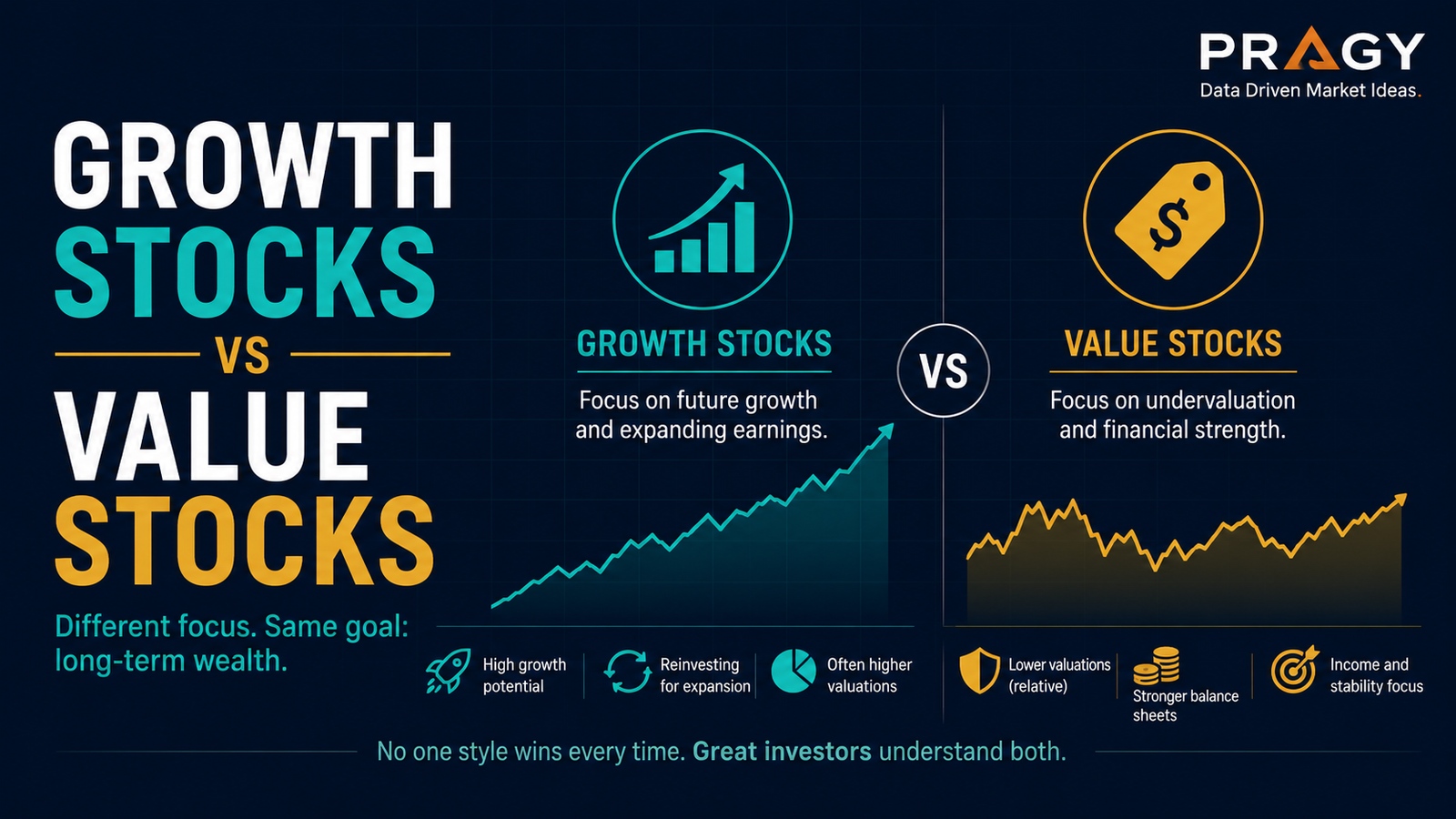
Some investors chase companies growing fast.
Others hunt for companies trading cheaper than their fundamentals suggest.
Both styles can work. Both can also humble you quickly.
Here’s the deal: growth and value are not personality types. They are investing lenses. Each lens helps you ask a different question about a stock.
Growth asks: “How much bigger can this company become?”
Value asks: “Is the market underpricing what already exists?”
The mistake is thinking one style is automatically smarter than the other. Markets are not that polite.
Here’s the simple version
A growth stock is usually a company expected to increase revenue, earnings, users, market share, or cash flow faster than the average company.
A value stock is usually a company that appears inexpensive compared with its earnings, sales, assets, cash flow, or industry peers.
The clean version:
- Growth stocks are often priced for future potential.
- Value stocks are often priced around current fundamentals.
- Growth investors pay up for expansion.
- Value investors look for mispricing.
- Both require risk management, patience, and a clear reason for owning or studying the stock.
Don’t overcomplicate it. Growth is about future acceleration. Value is about present price versus business quality.
What is a growth stock?
A growth stock is a company the market expects to grow faster than average.
That growth may show up through revenue, earnings, customers, margins, new products, or market share.
Growth companies often reinvest heavily back into the business. That can mean spending on research, hiring, marketing, technology, acquisitions, or expansion. Because of that, some growth companies may look “expensive” using traditional valuation metrics.
Valuation means estimating what a company may be worth compared with what the market is currently charging for it.
Growth stocks often trade at higher valuation ratios because investors are paying for expected future results.
Common growth clues include:
- revenue growing faster than peers
- expanding market opportunity
- strong product demand
- improving margins
- recurring revenue
- high reinvestment into the business
- strong price momentum during favorable market environments
Green flag: growth backed by real numbers.
Red flag: a big story with weak execution.
What is a value stock?
A value stock is a company that appears cheaper than the market, sector, or its own history based on fundamentals.
Fundamentals are the business numbers behind the stock: revenue, profit, cash flow, debt, margins, assets, and return on capital.
Value investors are usually looking for a gap between price and business reality. The idea is not simply “cheap stock equals good stock.” That is where people mess up.
A stock can be cheap for a reason.
The trap is buying a weak business only because the valuation ratio looks low.
Common value clues include:
- lower price-to-earnings ratio compared with peers
- stable cash flow
- strong balance sheet
- dividends or buybacks
- mature business model
- temporarily negative sentiment
- assets or earnings the market may be undervaluing
Green flag: low valuation plus durable business quality.
Red flag: low valuation because the business is deteriorating.
Growth vs value: the core difference
Growth and value stocks are judged using different questions.
Growth investors usually ask:
“Can this company become much larger than the market currently expects?”
Value investors usually ask:
“Is this company worth more than the market is currently pricing in?”
That sounds similar, but the mindset is different.
Growth investing tends to reward imagination plus execution. Value investing tends to reward patience plus discipline.
Growth gets exciting when the business keeps beating expectations.
Value gets interesting when the market becomes too pessimistic.
Valuation matters, but it means different things
Valuation is where the two styles often separate.
A growth stock may have a high P/E ratio, or price-to-earnings ratio. P/E compares the stock price to the company’s earnings per share.
A value stock may have a lower P/E ratio, but that does not automatically make it better.
For growth stocks, investors may focus more on:
- revenue growth
- gross margin
- future earnings potential
- customer retention
- total addressable market
- operating leverage
Operating leverage means profits may grow faster than revenue when fixed costs stay controlled as the business scales.
For value stocks, investors may focus more on:
- earnings stability
- free cash flow
- book value
- dividend coverage
- debt levels
- industry comparison
Free cash flow is cash left after a company pays for operating needs and capital spending. It matters because accounting profits do not always equal usable cash.
The clean version: growth can deserve a premium if execution is strong. Value can deserve attention if pessimism is overdone.
Market cycles matter
Growth and value do not perform the same way in every market environment.
Growth stocks often benefit when investors are willing to pay for future potential. That can happen when interest rates are lower, risk appetite is strong, and markets reward expansion.
Value stocks may become more attractive when investors care more about current earnings, cash flow, dividends, and lower valuations.
But this is not a hard rule. Markets rotate. Leadership changes. Narratives flip.
A market rotation happens when money moves from one type of stock or sector into another. For example, investors may rotate from high-growth technology stocks into energy, banks, industrials, or defensive companies.
This is why beginners should avoid building an entire worldview around one style.
Growth is not always reckless.
Value is not always safe.
Risk profile: different risks, same need for discipline
Growth stocks can fall sharply when expectations reset.
If a company is priced for perfection, even a decent earnings report can disappoint investors. High expectations create less room for mistakes.
Value stocks can also be risky.
A low valuation may signal that investors expect earnings to decline, debt to become a problem, or the business model to weaken. This is called a value trap.
A value trap is a stock that looks cheap but keeps getting cheaper because the business fundamentals continue to deteriorate.
The trap:
- Growth investors can overpay for a dream.
- Value investors can underthink why something is cheap.
Different road. Same pothole.
Simple comparison framework
Use this beginner-friendly framework when studying a stock.
1. Business quality
Ask:
- What does the company sell?
- Is demand growing, stable, or shrinking?
- Does the company have a real advantage?
- Are margins improving or getting squeezed?
For growth stocks, quality often means the company can scale.
For value stocks, quality often means the business can survive and keep producing cash.
2. Valuation
Ask:
- Is the stock expensive or cheap compared with peers?
- Is the valuation justified by growth?
- Is the discount justified by risk?
- What assumptions are baked into the price?
A high valuation is not automatically bad.
A low valuation is not automatically good.
The question is whether the valuation matches the business reality.
3. Expectations
Stocks move when reality differs from expectations.
A great company can be a poor investment idea at the wrong price. A boring company can become interesting if expectations are too low and fundamentals are steady.
Ask:
- What does the market seem to expect?
- What could surprise investors?
- What could disappoint investors?
4. Risk
Before studying any setup, define what could prove the idea wrong.
Invalidation is the point where the original idea no longer makes sense.
For a long-term investor, invalidation might be declining fundamentals, rising debt, or broken growth assumptions.
For a trader, invalidation may be a price level on a chart.
Position sizing means deciding how much money to risk on one trade or investment idea before entering. A common beginner guardrail is risking about 1% to 2% of total account size on a single trade idea. For example, with a $5,000 account, 1% risk equals $50 of planned risk.
Practical example: same company, two different lenses
Imagine Company A has strong revenue growth, expanding margins, and a large market opportunity. It trades at a high valuation compared with peers.
A growth-focused learner might say:
“This company is expensive, but if growth continues and margins improve, the premium may be understandable.”
A value-focused learner might say:
“The business is strong, but the valuation leaves little room for disappointment.”
Now imagine Company B has slower growth, steady cash flow, lower valuation, and negative market sentiment.
A value-focused learner might say:
“The market may be too pessimistic if the cash flow is durable.”
A growth-focused learner might say:
“The stock may be cheap, but I need a clearer growth catalyst.”
Same market. Different questions.
Neither view is automatically right. The point is to know which game you are playing.
Common mistakes beginners make
Mistake 1: Thinking growth means good
Growth is attractive only when it is useful, durable, and eventually profitable.
Revenue growth without discipline can become expensive chaos.
Mistake 2: Thinking value means safe
Cheap stocks can get cheaper.
A low valuation can reflect real business damage, not hidden opportunity.
Mistake 3: Comparing unrelated companies
Do not compare a software company, a bank, a miner, and a retailer using the same assumptions.
Different industries deserve different valuation tools.
Mistake 4: Ignoring debt
Debt can change the entire picture.
A company may look cheap based on earnings but risky once you factor in interest costs, refinancing risk, or weak cash flow.
Mistake 5: Using one metric
One ratio does not tell the whole story.
P/E, P/S, EV/EBITDA, free cash flow, margins, growth, debt, and industry context all matter.
This is where people mess up: they find one number they like and ignore the rest of the business.
Action checklist
Before labeling a stock “growth” or “value,” ask:
- Is the business growing, stable, or declining?
- Is the stock priced for high expectations or low expectations?
- Does the valuation make sense compared with peers?
- Are margins and cash flow improving or weakening?
- Is debt manageable?
- What could prove the idea wrong?
- Is the stock cheap because of fear, or cheap because the business is breaking?
- Is the stock expensive because of quality, or expensive because of hype?
The goal is not to memorize labels.
The goal is to build better questions.
Final takeaway
Growth stocks and value stocks are two different ways to study opportunity.
Growth focuses on future expansion.
Value focuses on price versus fundamentals.
Both can be useful. Both can be dangerous when used lazily.
The best beginner move is simple: learn both lenses. Growth helps you understand potential. Value helps you respect price.
Use the label, but do not worship it.
Disclaimer
Educational content only. Not financial advice or a recommendation to buy, sell, or hold any security.