
Most beginners think the stock market is a giant room where people shout prices and panic dramatically.
That version makes for good movie scenes.
The real market is cleaner, faster, and a lot more mechanical. A stock exchange is basically a structured marketplace where buyers and sellers meet, orders get matched, prices update, and ownership changes hands through a controlled system.
Here’s the deal: stock exchanges do not magically decide what a company is worth. They organize the auction.
And once you understand that auction, the market starts looking less mysterious.
Here’s the simple version
A stock exchange is a marketplace for buying and selling listed securities, like shares of public companies.
A listed security is an investment that has been approved to trade on an exchange. A share represents partial ownership in a company.
The exchange’s job is to help three things happen:
- Buyers can submit prices they are willing to pay.
- Sellers can submit prices they are willing to accept.
- The system matches compatible orders fairly and efficiently.
That’s the clean version.
The exchange is not there to tell you whether a stock is “good.” It is there to make the trading process organized, transparent, and liquid.
Liquidity means how easily something can be bought or sold without causing a huge price move. A heavily traded stock usually has better liquidity than a thinly traded one.
The stock exchange is not the whole market
This is where people mess up.
When someone says “the stock market,” they often mean everything at once: exchanges, brokers, investors, traders, market makers, indexes, financial news, and price charts.
But a stock exchange is only one piece of the system.
Think of it like this:
- The broker is your access point.
- The exchange is the marketplace.
- The order book is the live list of buy and sell orders.
- The clearinghouse helps make sure trades are finalized correctly.
- The regulators set and enforce market rules.
Your trading app may feel like the market, but it is really just the front door.
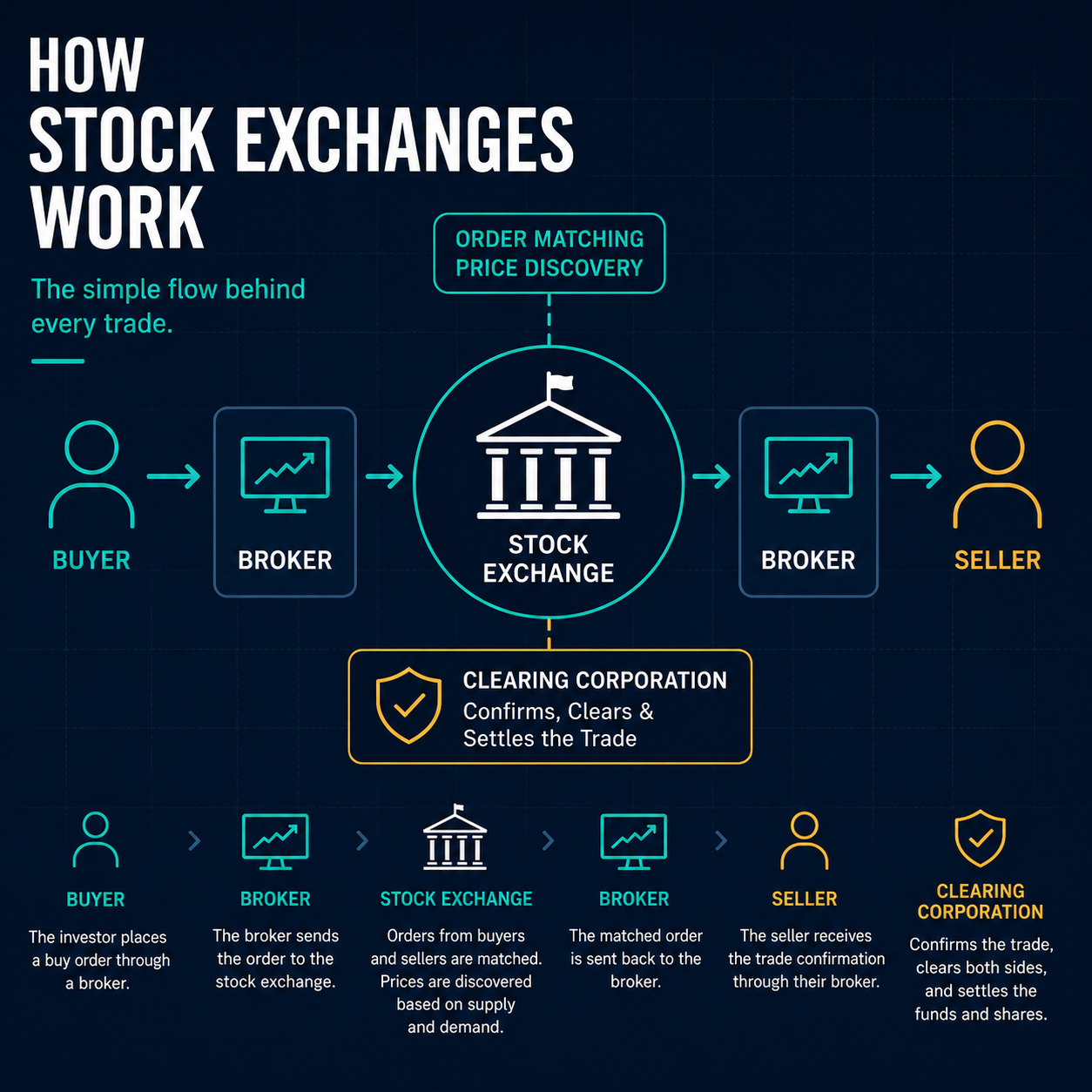
How an order travels through the market
Let’s say a beginner wants to buy shares of a company.
They usually do not send an order directly to the exchange. They use a brokerage platform.
A brokerage is a firm or platform that routes investor orders to market venues. That venue may be an exchange or another regulated trading system, depending on the order and market structure.
Here is the basic flow:
- You enter an order in your brokerage account.
- The broker checks the order details.
- The order gets routed to a market venue.
- The venue tries to match it with an opposite order.
- If a match happens, the trade is executed.
- Clearing and settlement happen behind the scenes.
Execution means the trade actually happened. An order is just a request. Execution is the fill.
The trap is thinking that clicking a button means you automatically get the price you saw. Markets move. Liquidity changes. Different order types behave differently.
The order book: where buyers and sellers line up
The order book is the heart of the exchange.
An order book is a live queue of buy orders and sell orders waiting to be matched.
Buyers place bids, which are prices they are willing to pay. Sellers place asks, which are prices they are willing to accept.
The highest bid and lowest ask create the visible market.
Example:
| Side | Price | Meaning |
|---|---|---|
| Highest bid | $49.95 | Buyers are willing to pay up to $49.95 |
| Lowest ask | $50.00 | Sellers are willing to sell at $50.00 |
| Spread | $0.05 | The gap between bid and ask |
The spread is the difference between the best bid and best ask.
A tight spread usually means stronger liquidity. A wide spread can mean the stock is less liquid, more volatile, or both.
Volatility means how much and how quickly price moves. High volatility can create opportunity, but it also increases risk.
Market orders vs. limit orders
The exchange matches orders based on price and priority.
Two basic order types matter for beginners:
Market order
A market order tells the system: “Fill this order now at the best available price.”
It prioritizes speed over price control.
Green flag: useful when liquidity is strong and speed matters.
Red flag: dangerous in thin, fast, or volatile markets because the final execution price can surprise you.
Limit order
A limit order tells the system: “Only fill this order at my price or better.”
It prioritizes price control over speed.
Green flag: useful when you care about the maximum price you will pay or minimum price you will accept.
Red flag: your order may not fill if the market never reaches your limit price.
Don’t overcomplicate it: market orders chase execution. Limit orders control price.
How prices actually move
A stock price moves because trades happen at new prices.
If aggressive buyers keep accepting higher asks, the last traded price can rise. If aggressive sellers keep hitting lower bids, the last traded price can fall.
The exchange records the transaction. The price chart updates.
But the exchange does not “push” price up or down on its own. Buyers and sellers do that through supply, demand, urgency, and available liquidity.
This is why a stock can move sharply after news. If many buyers want in and fewer sellers are available at nearby prices, buyers may have to accept higher asks. The auction moves upward.
If sellers become urgent and buyers step back, sellers may have to accept lower bids. The auction moves downward.
What market makers do
A market maker is a participant that helps provide liquidity by quoting prices where they are willing to buy and sell.
They are not doing charity work. They aim to earn from the spread, manage inventory, and control risk.
Market makers can help the market function more smoothly because they may stand ready to trade when natural buyers and sellers are not perfectly balanced.
But they do not remove risk. In stressful markets, liquidity can thin out fast.
The clean version: market makers help keep the auction moving, but they are not a guarantee that every trade will be smooth or cheap.
What happens after the trade
Once a trade is executed, the story is not technically finished.
The market still needs clearing and settlement.
Clearing is the process of confirming trade details and preparing both sides to complete the transaction.
Settlement is when ownership and payment officially transfer.
Beginners usually never see this machinery because it happens behind the scenes. Your brokerage platform simplifies it into account balances, positions, and trade confirmations.
That does not mean it is unimportant. Clearing and settlement are part of what makes modern markets scalable.
Why companies list on exchanges
Companies list shares on exchanges to access public capital and create a tradable market for ownership.
A public listing can help a company raise money, give early investors a way to sell shares, and make ownership more transparent.
But listing also comes with rules. Public companies must meet reporting requirements, disclose important information, and follow exchange and securities regulations.
For investors, this creates a more structured environment than random private deals.
Not perfect. More structured.
What exchanges do for investors
A well-functioning exchange helps investors by creating:
Price discovery
Price discovery means the market is constantly finding a price based on real buy and sell activity.
It is not always “correct.” It is simply the current auction result.
Transparency
Exchanges publish prices, trade data, and order information depending on the market and data access level.
More transparency helps participants understand what is happening.
Liquidity
By concentrating buyers and sellers, exchanges make trading easier than trying to find a counterparty yourself.
Rules
Exchanges operate under market rules. That does not eliminate bad decisions, emotional trading, or market losses, but it gives the system structure.
Practical example: the coffee shop auction
Imagine a coffee shop selling one limited-edition mug.
Five people want to buy it. Three people already own one and might sell.
Buyers shout:
- “I’ll pay $20.”
- “I’ll pay $21.”
- “I’ll pay $22.”
Sellers respond:
- “I’ll sell for $25.”
- “I’ll sell for $24.”
- “I’ll sell for $23.”
The current best bid is $22. The current best ask is $23. No trade happens yet because nobody agrees.
Then one buyer gets impatient and accepts $23.
Trade executed.
The last price is now $23.
That is the stock exchange model in plain English. Just faster, electronic, regulated, and running at massive scale.
Common mistakes beginners make
Mistake 1: Thinking the last price is the only price
The last traded price is useful, but it is not the whole market.
The bid, ask, spread, volume, and liquidity matter too.
Volume means how many shares trade during a period. Higher volume usually means more activity and often better liquidity.
Mistake 2: Ignoring the spread
A wide spread is a hidden cost.
If the best bid is $10.00 and the best ask is $10.20, a market buy may execute near $10.20, while selling immediately may happen near $10.00. That gap matters.
Mistake 3: Using market orders in messy conditions
Market orders can be fine in liquid markets, but they can be sloppy in fast-moving or thin markets.
The trap is assuming the screen price is locked in. It is not.
Mistake 4: Confusing exchange structure with strategy
Understanding exchanges helps you understand mechanics.
It does not tell you what to trade, when to trade, or how much risk to take.
A common beginner guardrail is risking about 1% to 2% of total account size on a single trade idea. For example, with a $5,000 account, 1% risk equals $50 of planned risk.
That is position sizing: deciding how much capital to risk before entering. It belongs in risk management, not market excitement.
Mistake 5: Believing liquidity is always there
Liquidity can look great until everyone wants the same exit.
In calm markets, spreads may be tight. In stressed markets, spreads can widen and fills can get worse.
Red flag: assuming “I can always exit quickly at the exact price I want.”
Action checklist for beginners
Before placing an order, ask:
- What type of order am I using?
- Is the spread tight or wide?
- Is the stock liquid enough for my trade size?
- Am I prioritizing execution speed or price control?
- Do I understand what happens if the price moves quickly?
- Have I planned my risk before entering?
The goal is not to become a market plumbing expert overnight.
The goal is to stop treating the exchange like a mystery box.
Final takeaway
A stock exchange is a matching engine with rules.
It connects buyers and sellers, organizes order flow, updates prices, supports liquidity, and helps the market function at scale.
The beginner mistake is thinking the exchange gives you certainty. It does not.
It gives you a venue.
Your job is to understand the mechanics, respect liquidity, use order types wisely, and avoid turning a simple trade into an emotional button-clicking contest.
Don’t overcomplicate it: the exchange runs the auction. You are responsible for how you participate.
Disclaimer
Educational content only. Not personalized financial advice. Not a recommendation to buy, sell, or hold any security. Trading and investing involve risk, including possible loss of capital.