
An option price can look simple on the screen.
A call is quoted at $4.20. A put is quoted at $1.35. Easy, right?
Not quite.
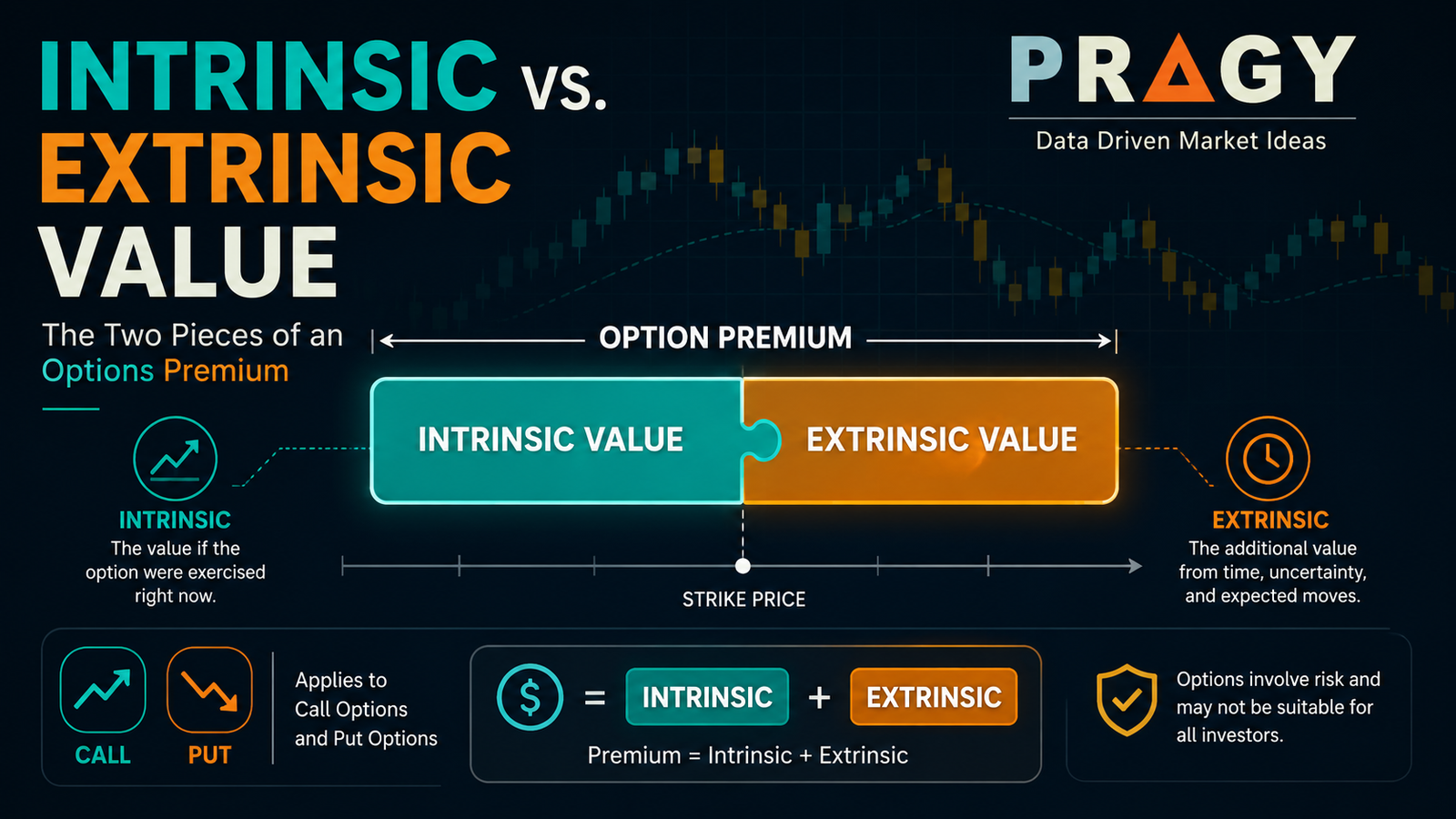
That premium is usually a mix of two very different things: intrinsic value and extrinsic value. One part is based on what the option is already worth because of where the stock is trading. The other part is based on what could still happen before expiration.
This is where beginners often get tripped up. They look at the option price, but they do not ask what they are actually paying for.
Here's the simple version
Intrinsic value is the option's built-in value right now.
Extrinsic value is everything else in the option premium.
The clean formula:
Option premium = intrinsic value + extrinsic value
Or, flipped around:
Extrinsic value = option premium - intrinsic value
Think of it like this:
| Component | Plain-English meaning | Main question it answers |
|---|---|---|
| Intrinsic value | The value the option already has based on stock price versus strike price | "Is this option already in-the-money?" |
| Extrinsic value | The extra premium paid for time, uncertainty, and possible future movement | "What is the market charging for what could still happen?" |
Intrinsic is the now.
Extrinsic is the maybe.
What intrinsic value means
Intrinsic value exists only when an option is in-the-money.
An option is in-the-money when exercising it would have immediate economic value before considering the premium paid, commissions, taxes, or real-world trading frictions.
For a call option, intrinsic value appears when the stock price is above the strike price.
Call intrinsic value = max(0, stock price - strike price)
For a put option, intrinsic value appears when the stock price is below the strike price.
Put intrinsic value = max(0, strike price - stock price)
The `max(0, …)` part just means intrinsic value cannot be negative. If an option is out-of-the-money, its intrinsic value is zero.
Quick call example
Suppose a stock is trading at $52.
A $50 call has:
$52 stock price - $50 strike = $2 intrinsic value
The call is in-the-money by $2.
If that call trades for $4.20, only $2 of that premium is intrinsic value. The rest is extrinsic value.
$4.20 premium - $2.00 intrinsic value = $2.20 extrinsic value
Quick put example
Suppose the same stock is trading at $52.
A $55 put has:
$55 strike - $52 stock price = $3 intrinsic value
The put is in-the-money by $3.
If that put trades for $4.10, then:
$4.10 premium - $3.00 intrinsic value = $1.10 extrinsic value
Same concept. Different direction.
What extrinsic value means
Extrinsic value is the part of the premium above intrinsic value. Beginners often hear it called time value, but that nickname can be a little too narrow.
Time matters, yes. But extrinsic value also reflects other pricing forces, especially:
- Time until expiration: more time generally gives the underlying more opportunity to move.
- Implied volatility: higher expected movement can increase option premiums.
- Distance from the strike: at-the-money options often carry meaningful extrinsic value because small stock moves can change their status quickly.
- Dividends and interest rates: usually smaller factors for many beginner examples, but still part of options pricing.
- Supply and demand: real market pricing can move around theoretical value.
Here is the trap: extrinsic value is real, but it is fragile.
It can shrink even when the stock does not move. It can shrink when time passes. It can shrink when implied volatility falls. That is why an options learner can be directionally "right" and still disappointed by the option's price movement.
The market does not only ask, "Did the stock move?"
It also asks, "Did it move enough, fast enough, before expiration, with volatility still supporting the premium?"
A simple options chain snapshot
Here is a hypothetical mini-chain for a stock trading at $52.
| Option | Premium | Intrinsic value | Extrinsic value | What it means |
|---|---|---|---|---|
| $50 call | $4.20 | $2.00 | $2.20 | In-the-money call with both built-in value and time value |
| $55 call | $1.60 | $0.00 | $1.60 | Out-of-the-money call; entire premium is extrinsic |
| $55 put | $4.10 | $3.00 | $1.10 | In-the-money put with more intrinsic than extrinsic |
| $50 put | $1.20 | $0.00 | $1.20 | Out-of-the-money put; entire premium is extrinsic |
Notice something important.
The out-of-the-money options are not "worthless" before expiration. They may have no intrinsic value, but they can still have extrinsic value because the market is pricing the possibility of future movement.
At expiration, though, that possibility disappears. Any remaining value is based on whether the option is in-the-money.
Why extrinsic value changes
Extrinsic value is not a fixed fee stapled onto an option. It moves around.
1. Time passing can reduce extrinsic value
As expiration approaches, there is less time for the underlying stock to move in a useful direction. All else equal, that tends to reduce extrinsic value.
This is the basic idea behind theta, an options Greek that estimates the effect of time passing on an option's price, holding other factors constant.
Plain English: the clock is part of the trade.
2. Implied volatility can inflate or deflate extrinsic value
Implied volatility is the market's expectation of future movement embedded in option prices.
When implied volatility rises, options often become more expensive because the market is pricing a wider range of possible outcomes. When implied volatility falls, extrinsic value can drop even if the stock price barely moves.
This is why options can be especially tricky around known events like earnings. The option may be priced for a large move before the event. After the event, implied volatility can fall sharply if uncertainty is resolved.
3. Moneyness changes the mix
Moneyness describes where the stock price sits relative to the option's strike price.
- In-the-money: has intrinsic value.
- At-the-money: strike is near the stock price.
- Out-of-the-money: has no intrinsic value.
At-the-money options often carry a lot of extrinsic value because they sit near the decision line. A small move can push them in or out of intrinsic value.
Deep in-the-money options may have a larger share of intrinsic value. Far out-of-the-money options may be entirely extrinsic, but that extrinsic value can be highly sensitive to time and volatility.
Intrinsic value is not the same as profit
This is a big beginner mistake.
Suppose a $50 call has $2 of intrinsic value because the stock is at $52. That does not mean the option buyer has a profit.
If the option cost $4.20, the buyer paid $4.20 in premium. At that moment, the option has $2 of intrinsic value and $2.20 of extrinsic value. Profit or loss depends on the current option price versus the entry price, not simply whether the option has intrinsic value.
The clean distinction:
| Concept | What it measures |
|---|---|
| Intrinsic value | Built-in exercise value based on stock price and strike |
| Extrinsic value | Premium above intrinsic value |
| Break-even at expiration | Strike plus premium for calls, strike minus premium for puts |
| Profit or loss before expiration | Current option price compared with the price paid or received |
Do not mash these together. That is how option math becomes soup.
Common mistakes beginners make
Mistake 1: Thinking cheap means attractive
A $0.40 option can still be expensive if the chance of it finishing in-the-money is low and the premium is mostly hope.
Low dollar price does not automatically mean good value. It may simply mean the option is far out-of-the-money, close to expiration, or both.
Mistake 2: Ignoring the extrinsic value paid
If most of the premium is extrinsic, the option needs future movement, volatility support, or both to justify that price. Otherwise, the extrinsic portion can erode.
This is especially important for short-dated options.
Mistake 3: Assuming an in-the-money option is safer
In-the-money options have intrinsic value, but they can still lose money. The underlying can move against the position, extrinsic value can decay, and spreads or liquidity can affect execution.
"In-the-money" is a pricing description, not a safety label.
Mistake 4: Forgetting that implied volatility can change
An option can lose value after a major event even if the stock moves in the expected direction. That can happen when implied volatility falls enough to offset some or all of the directional benefit.
The event was not a surprise anymore. The market repriced the uncertainty.
Mistake 5: Treating expiration like a footnote
Expiration is not administrative paperwork. It is central to the option's value.
The same strike can have very different premiums across different expirations because time itself has value.
A beginner checklist for reading an option premium
Before analyzing an option price, ask these five questions:
- Is the option in-the-money, at-the-money, or out-of-the-money?
- How much of the premium is intrinsic value?
- How much of the premium is extrinsic value?
- What has to happen before expiration for the extrinsic value to be justified?
- What could reduce extrinsic value: time decay, lower implied volatility, price stagnation, or a combination?
This checklist does not tell you what to trade. It tells you what you are looking at.
That is the point.
The clean takeaway
Intrinsic value is the part of an option premium that already exists because of the relationship between the stock price and the strike price.
Extrinsic value is the part of the premium the market assigns to time, uncertainty, volatility, and possible future movement.
A beginner does not need to memorize every options model on day one. But understanding this split makes the option chain much less mysterious.
When you see a premium, do not just ask, "How much does it cost?"
Ask, "What am I paying for?"
Sources
Sources checked on 2026-06-29.
- Options Industry Council — Options Pricing
- Investor.gov — Investor Bulletin: An Introduction to Options
Disclaimer
Pragy Investments provides financial education and market research only. This content is not investment advice.