
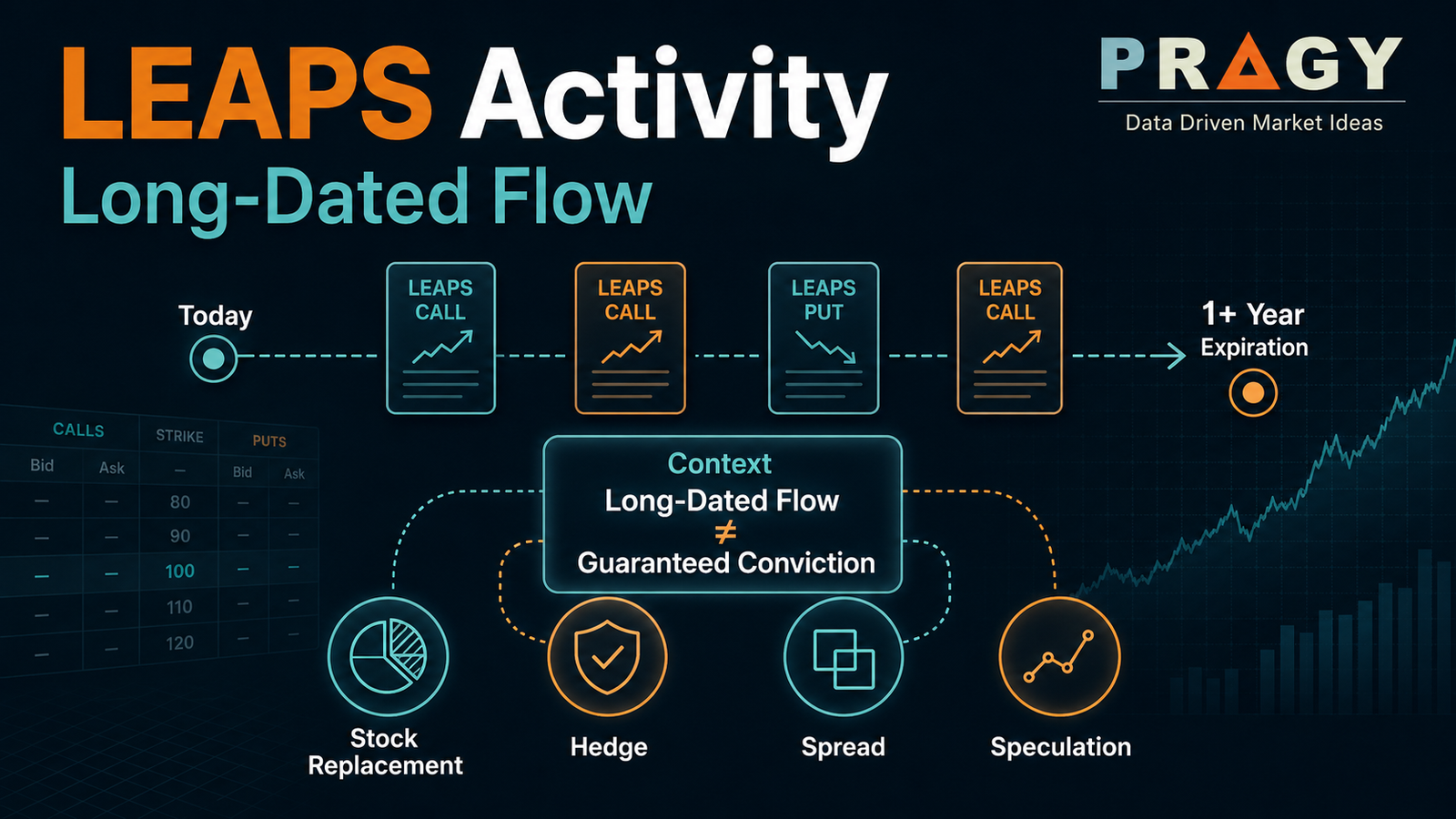
A huge options print appears in a contract expiring more than a year from now.
The premium is large. The expiration is far away. The comments section immediately decides someone “knows something.”
Maybe.
Or maybe the trade is a hedge, a stock substitute, a volatility position, a spread leg, a roll, or just an expensive contract because time costs money.
That is the problem with LEAPS activity: it often looks serious before you know what it actually means.
Here’s the simple version
LEAPS activity is long-dated options activity. It can be useful, but it is not automatically a high-conviction directional signal.
LEAPS are options with long expiration dates. In U.S. listed equity and ETF options, LEAPS are generally longer-dated contracts compared with standard monthly or weekly options.
Because they have more time until expiration, LEAPS often carry larger premiums. That can make flow scanners light up, even when the trade is not as meaningful as the dollar amount suggests.
The clean interpretation:
LEAPS flow tells you that someone is using a longer time horizon. It does not tell you, by itself, why.
What are LEAPS?
LEAPS stands for Long-Term Equity AnticiPation Securities. In plain English, they are long-dated options.
They work like regular listed options:
- a call gives the buyer the right, but not the obligation, to buy the underlying at the strike price
- a put gives the buyer the right, but not the obligation, to sell the underlying at the strike price
- each standard equity option contract usually represents 100 shares
- the contract has a strike price and an expiration date
The difference is the expiration window.
Instead of expiring in days, weeks, or a few months, LEAPS give the position more time to play out. That extra time can be useful, but it also changes the pricing, risk, and interpretation.
Why LEAPS flow gets attention
LEAPS activity attracts attention for three reasons.
First, the premium can be large. A long-dated option has more time value, so the contract price may be much higher than a short-dated option.
Second, the trade can look more “intentional.” A far-dated expiration feels less like a quick gamble and more like a longer-term thesis.
Third, LEAPS are often used in bigger-picture strategies: stock replacement, portfolio hedging, collars, long-term speculation, or structured spreads.
Those are real reasons to pay attention.
But attention is not the same as conclusion.
The main ways traders use LEAPS
LEAPS activity can represent several very different ideas.
1) Long-term speculation
A trader may buy long-dated calls because they expect the stock to rise over a longer window. They may buy long-dated puts because they expect weakness or want downside exposure over time.
This is the simple interpretation.
It is also the one people overuse.
A long-dated call is not automatically “bullish smart money.” A long-dated put is not automatically “someone knows bad news is coming.”
The trade might be directional. It might not be.
2) Stock replacement
A long-dated call can sometimes be used as a stock replacement, meaning the trader seeks upside exposure with less upfront capital than buying the shares outright.
That sounds clean, but it has trade-offs.
A LEAPS call can expire worthless. It does not pay dividends. It has a finite life. Its price depends on volatility, time, rates, dividends, and the underlying stock’s movement.
The key idea:
Stock replacement is not the same as owning stock. It is an options position with options risk.
3) Portfolio hedging
A long-dated put can be used to hedge a stock or portfolio position. That means the put is acting more like insurance than a standalone bearish bet.
This matters because a large LEAPS put purchase may look bearish on a scanner, but the trader could simply be protecting a long position.
In that case, the flow says, “risk management may be happening,” not necessarily, “this trader expects a collapse.”
4) Collars and covered structures
LEAPS can appear inside broader strategies such as collars, covered calls, diagonals, and other multi-leg structures.
A collar often combines stock ownership, a protective put, and a short call. A diagonal spread may involve options with different strike prices and different expirations.
If a scanner only shows one leg, the story can be misleading.
A long-dated call purchase might be paired with a short call. A long-dated put might be paired with stock. A large print might be one piece of a risk-defined structure.
5) Rolling existing exposure
A trader may roll a long-dated option from one expiration to another, or from one strike to another.
A roll can create large volume, but it may not represent a fresh thesis. It may simply be position maintenance.
This is why comparing volume with open interest matters. A big print is more interesting when it appears to create new exposure, not merely adjust old exposure.
Why LEAPS premium can be misleading
High premium LEAPS flow can be especially deceptive because longer-dated options naturally cost more.
The premium can be large because of:
- time value, since more time usually increases option value
- stock price, because expensive underlying stocks often have expensive options
- implied volatility, because uncertainty raises option prices
- moneyness, because deep-in-the-money options contain more intrinsic value
- contract size, because each standard contract usually controls 100 shares
So a $750,000 LEAPS print might be meaningful.
Or it might be a normal-sized long-dated trade in a high-priced stock.
Big number. Not enough context.
LEAPS flow versus weekly flow
Weekly options and LEAPS often attract different types of activity.
| Feature | Weekly options | LEAPS |
|---|---|---|
| Time horizon | Short-term | Long-term |
| Premium | Usually lower per contract | Usually higher per contract |
| Theta pressure | Often intense | Usually slower at first |
| Common use | Event trades, quick speculation, short-term hedges | Stock replacement, longer-term speculation, portfolio hedging, structured trades |
| Interpretation risk | Can be noisy and urgent | Can look more meaningful than it is because premium is large |
| Key question | Is this a catalyst trade? | Is this new long-term exposure, a hedge, or a structure? |
The trap is different.
With weekly options, beginners often overreact to urgency.
With LEAPS, beginners often overreact to size.
The Greeks matter more than the headline
Options Greeks are sensitivity measures. They help explain how an option may respond to changes in the underlying price, time, and volatility.
For LEAPS, four Greeks deserve special attention.
Delta: how stock-like is the option?
Delta estimates how much the option price may change for a $1 move in the underlying stock, all else equal.
A deep-in-the-money LEAPS call may have a high delta, making it behave more like stock. A far-out-of-the-money LEAPS call may have a lower delta, making it more speculative and more dependent on a large move.
That difference matters.
Two LEAPS call buys can have the same premium but completely different risk profiles.
Theta: time decay still exists
Theta estimates the effect of time decay.
LEAPS often decay more slowly than short-dated options at first, but time decay does not disappear. As expiration gets closer, the option can become more sensitive to time passing.
“Long-dated” does not mean “safe.”
It just means the clock is longer.
Vega: volatility can dominate
Vega estimates sensitivity to implied volatility.
Because LEAPS have more time remaining, they can be highly sensitive to changes in implied volatility. If implied volatility falls, a LEAPS buyer can lose money even if the stock moves somewhat in the expected direction.
This is one reason long-dated options are not as simple as “less risky because more time.”
Gamma: usually lower, until time changes the story
Gamma measures how quickly delta changes.
LEAPS generally have lower gamma than very short-dated options, meaning their delta usually changes more gradually. But as time passes and the contract gets closer to expiration, that profile can change.
A long-dated option today eventually becomes a shorter-dated option later.
A practical example
Imagine a fictional stock called Atlas Components trading at $80.
A scanner shows:
- Contract: January 2028 $90 call
- Price: $12.50
- Size: 400 contracts
- Headline premium: $500,000
- Prior open interest: 75 contracts
The headline looks big.
The quick calculation is:
$12.50 × 100 × 400 = $500,000
Now the better questions begin.
What could this mean?
It could be a long-term bullish position.
It could be stock replacement.
It could be part of a call spread if another strike traded nearby.
It could be a roll from an older long call.
It could be hedging against a short stock position.
It could be volatility positioning.
The premium number helped you notice the trade. It did not explain the trade.
What would make it more interesting?
This flow becomes more research-worthy if:
- volume is far above prior open interest
- similar long-dated calls repeat over multiple sessions
- the trade appears to execute aggressively
- implied volatility is not already extremely elevated
- the stock has a clear research catalyst or technical level
- there is no obvious matching spread leg that changes the interpretation
Even then, it is still a research clue—not a signal to copy.
How to read LEAPS activity without fooling yourself
Use this framework.
| Check | What to ask | Why it matters |
|---|---|---|
| Expiration | How far out is the contract? | LEAPS reflect longer time horizons and usually higher premiums. |
| Strike | Is it ITM, ATM, or OTM? | Moneyness changes delta, risk, and probability profile. |
| Premium | How large is the dollar amount? | Useful for attention, but not enough for interpretation. |
| Volume vs. open interest | Is this likely new activity? | Helps separate fresh positioning from closing or rolling. |
| Implied volatility | Is IV elevated or cheap relative to context? | Long-dated options can be sensitive to volatility changes. |
| Spread check | Did another leg trade nearby? | One leg can misrepresent the full strategy. |
| Stock context | Is there a thesis, catalyst, or meaningful chart level? | Flow is more useful when it fits a broader research setup. |
| Repeat activity | Is this isolated or repeated? | Repetition can matter more than one flashy print. |
| Risk profile | Could this expire worthless or create assignment exposure? | Long-dated does not mean low-risk. |
Common mistakes beginners make
Mistake 1: Assuming LEAPS are safer because they last longer
More time can help, but it does not remove risk. A long LEAPS buyer can still lose the full premium paid.
Mistake 2: Treating high premium as proof of conviction
LEAPS are expensive because time has value. Large premium does not automatically mean large insight.
Mistake 3: Ignoring implied volatility
A LEAPS buyer can be directionally right and still struggle if implied volatility falls enough.
Mistake 4: Forgetting the position may be a hedge
A long-dated put may be portfolio insurance. A long-dated call may be stock replacement. The label “bullish” or “bearish” can be too simple.
Mistake 5: Missing spread legs
If the trade is part of a diagonal, vertical, collar, or other structure, the visible leg alone can be misleading.
Mistake 6: Ignoring liquidity
Some LEAPS contracts have wider bid-ask spreads and thinner volume than short-dated options. A theoretical idea can look clean on paper and messy in execution.
A clean LEAPS flow checklist
Before calling LEAPS activity meaningful, ask:
- What is the expiration date?
- Is the contract in the money, at the money, or out of the money?
- What is the total premium?
- How does today’s volume compare with open interest?
- Is the trade likely opening, closing, or rolling?
- Did related strikes or expirations trade at the same time?
- Is implied volatility elevated?
- Is the underlying near a meaningful level or catalyst?
- Could the trade be a hedge or stock replacement?
- What would disprove the simple bullish or bearish interpretation?
If you cannot answer most of those, you do not have a thesis yet. You have a print.
Final takeaway
LEAPS activity can be useful because it shows where longer-dated options exposure is appearing.
But useful does not mean obvious.
A large LEAPS call does not automatically prove long-term bullish conviction. A large LEAPS put does not automatically prove hidden bearish information. The trade may be speculation, hedging, stock replacement, a spread, or a roll.
The clean way to read LEAPS flow is simple:
Start with the print. Then force it through context.
That is where the hype ends and the research begins.
Sources
Sources checked June 29, 2026.
- Options Industry Council (OIC), LEAPS® – Options for the Long Term: https://www.optionseducation.org/optionsoverview/leaps-overview
- Options Clearing Corporation (OCC), Long Term Equity Anticipation Securities (LEAPS®): https://www.theocc.com/clearance-and-settlement/clearing/equity-and-etf-leaps
- FINRA, Options investor education overview: https://www.finra.org/investors/investing/investment-products/options
- Investor.gov, Investor Bulletin: An Introduction to Options: https://www.investor.gov/introduction-investing/general-resources/news-alerts/alerts-bulletins/investor-bulletins-63
- OCC, Characteristics and Risks of Standardized Options: https://www.theocc.com/company-information/documents-and-archives/options-disclosure-document
Disclaimer
Pragy Investments provides financial education and market research only. This content is not investment advice, financial planning, portfolio management, tax advice, legal advice, or a recommendation to buy, sell, or hold any security. Examples and scenarios are for educational purposes only. Investing and trading involve risk, including possible loss of capital. Readers are responsible for their own decisions and should consult an appropriately qualified professional where needed. Options involve additional risks and may not be suitable for all investors. Options activity can reflect speculation, hedging, multi-leg strategies, volatility positioning, or other motives and does not by itself establish directional conviction.