
A $20 stock can look “cheaper” than a $500 stock.
That is one of the first traps beginners fall into.
Here’s the deal: stock price is only one piece of the puzzle. A company’s size is not measured by the price of one share. It is measured by market capitalization, usually shortened to market cap.
Market cap helps you understand how big a company is in the stock market, how investors may view it, and why two stocks with very different share prices can have very different risk profiles.
Here’s the simple version
Market cap is the total market value of a company’s shares.
The formula is:
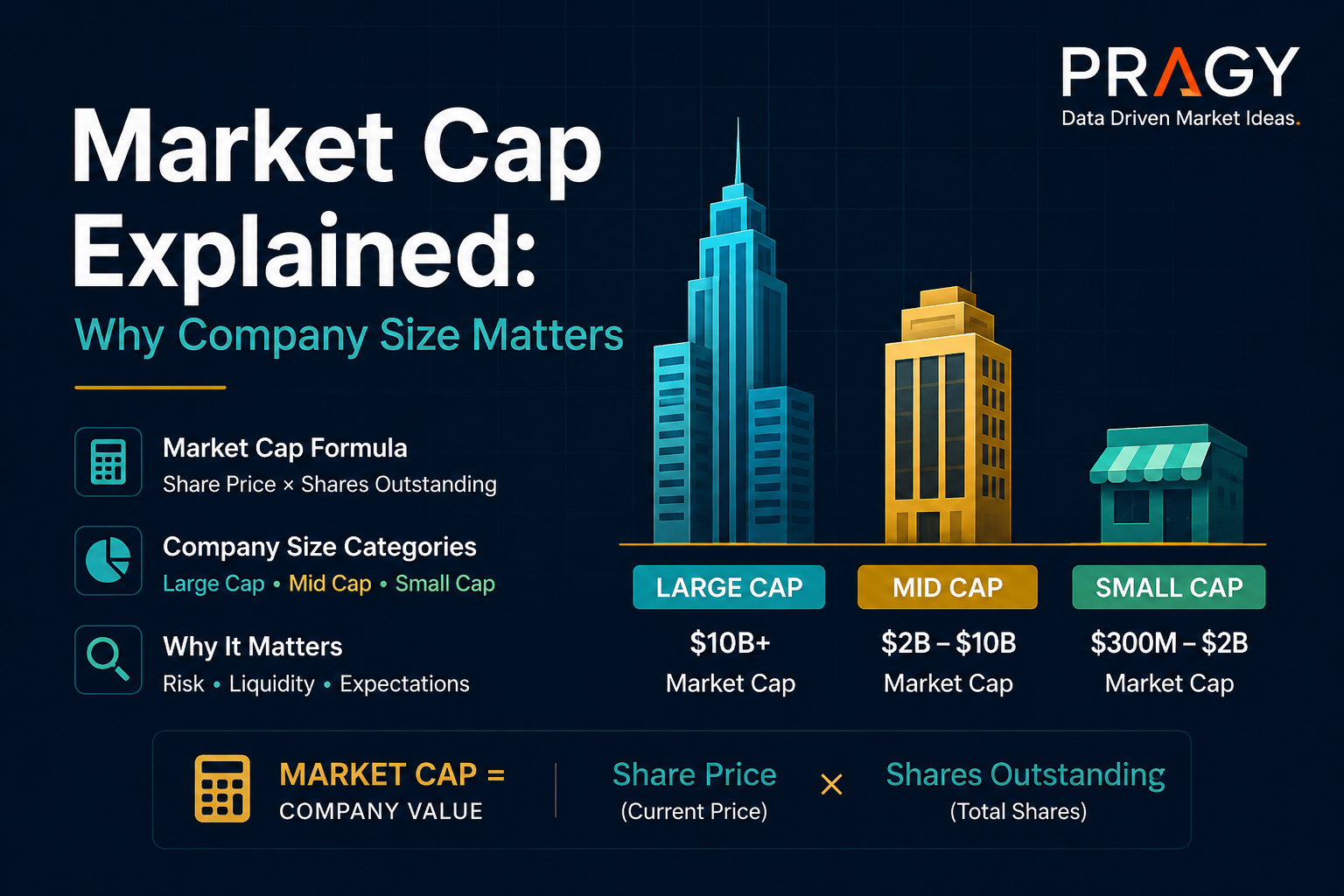
Market Cap = Stock Price × Shares Outstanding
Shares outstanding means the number of company shares currently held by investors, insiders, and institutions.
So when you see a stock trading at $20, that price alone does not tell you whether the company is small, cheap, expensive, risky, or attractive. You need to know how many shares exist.
Don’t overcomplicate it. One share price is just a slice. Market cap tells you the size of the whole pie.
Market cap formula: the clean version
Let’s use two simple examples.
| Company | Stock Price | Shares Outstanding | Market Cap |
|---|---|---|---|
| Company A | $20 | 5 billion | $100 billion |
| Company B | $500 | 10 million | $5 billion |
Company A has the lower share price, but it is the much larger company.
Company B has the higher share price, but it is much smaller by market value.
This is where people mess up. They compare price per share instead of comparing total company value.
Market cap vs. stock price
A stock price tells you what one share costs.
Market cap tells you what the market currently values the whole company at.
Those are not the same thing.
Think of it like pizza. If one pizza is cut into 8 slices and another is cut into 100 slices, comparing the price of one slice does not tell you which whole pizza costs more. You need the full pizza math.
In stocks, the “slice” is one share. The “whole pizza” is the company’s market cap.
Why a lower stock price does not mean “cheaper”
A $5 stock is not automatically a bargain.
A $500 stock is not automatically expensive.
The market may value the $5 stock at $50 billion if there are many shares outstanding. The $500 stock may only be worth $2 billion if there are fewer shares outstanding.
The better beginner question is not:
“Which stock price is lower?”
The better question is:
“How much is the whole company worth, and what expectations are already priced in?”
That question leads to smarter research.
Large cap, mid cap, and small cap
Investors often group companies by market cap size. The exact cutoffs can vary, but a common framework looks like this:
| Category | Typical Market Cap Range | Beginner Translation |
|---|---|---|
| Large cap | $10 billion or more | Bigger, more established companies |
| Mid cap | $2 billion to $10 billion | Growing companies with some scale |
| Small cap | $300 million to $2 billion | Smaller companies with higher uncertainty |
There are also mega cap companies, which are extremely large businesses, and micro cap companies, which are very small public companies.
The label is not a quality score. A large cap can struggle. A small cap can perform well. Market cap simply gives you context for company size.
Why company size matters
Market cap matters because company size often affects three important things: risk, liquidity, and expectations.
1. Risk
Risk means the chance that an investment outcome is worse than expected, including loss of capital.
Large cap companies are often more established. They may have stronger brands, deeper financing options, broader analyst coverage, and more stable operations.
Small cap companies may have more room to grow, but they can also be more sensitive to weak earnings, funding pressure, customer concentration, and market stress.
The trap is thinking “small” always means “early opportunity.” Sometimes it means “fragile.” Sometimes it means “misunderstood.” Your job is to research which one it is.
2. Liquidity
Liquidity means how easily shares can be bought or sold without heavily moving the price.
Larger companies often trade more shares each day. That can make entries and exits smoother.
Smaller companies may trade less volume. Volume means the number of shares traded during a period. Low volume can create wider gaps between buyers and sellers, quicker price jumps, and messier execution.
For beginners, liquidity matters because a chart can look clean until you actually try to trade it.
3. Expectations
Market cap also reflects what investors expect from a company.
A massive company may need huge revenue, strong margins, and consistent execution just to keep investors satisfied. A smaller company may have lower expectations, but it may also have less room for mistakes.
Green flag: market cap helps you ask better questions.
Red flag: using market cap alone as a reason to like or dislike a stock.
Market cap is context. It is not a complete investment thesis.
Market cap can change fast
Market cap moves when the stock price moves.
If a company has 1 billion shares outstanding and the stock rises from $50 to $60, market cap moves from $50 billion to $60 billion.
That is a $10 billion increase in market value.
The number of shares outstanding can also change over time through events like share issuance, buybacks, stock splits, or compensation plans.
A stock split changes the number of shares and the price per share, but it does not automatically change the company’s total value at the moment of the split. For example, in a 2-for-1 split, an investor may own twice as many shares at roughly half the price per share. The slice count changes. The pizza does not magically become bigger.
Practical framework: the 3-question market cap check
Before comparing two stocks, run this quick check.
Question 1: What is the market cap?
Start with the full company value, not the share price.
A $30 stock with a $200 billion market cap is not “smaller” than a $300 stock with a $5 billion market cap.
Question 2: What size category is it in?
Is it large cap, mid cap, small cap, mega cap, or micro cap?
That gives you a rough idea of scale, maturity, potential liquidity, and expected stability.
Question 3: What expectations are attached to that size?
A large company may be expected to deliver consistency.
A smaller company may be expected to deliver growth.
A struggling small company may need financing, better execution, or a major business turnaround. A struggling large company may need operational discipline, margin improvement, or renewed growth.
Different size. Different game.
Common mistakes beginners make
Mistake 1: Thinking low price means cheap
A low share price can still belong to a richly valued company.
Always check market cap.
Mistake 2: Ignoring shares outstanding
The share count is half the formula. Skipping it makes the comparison incomplete.
Mistake 3: Assuming small caps always grow faster
Some small companies grow. Some stay small for a reason.
Small cap investing often requires extra attention to balance sheets, dilution risk, liquidity, and business quality.
Mistake 4: Treating market cap like a buy signal
Market cap is not a signal. It does not tell you what to do.
It helps you frame research, compare companies, and understand the type of risk you may be looking at.
Mistake 5: Comparing companies from different sectors too casually
A $20 billion software company and a $20 billion mining company can have very different margins, capital needs, growth expectations, and valuation norms.
Same market cap. Different business engine.
Action checklist
Use this checklist when studying a stock:
- Find the company’s market cap.
- Compare market cap, not just share price.
- Check whether it is large cap, mid cap, small cap, mega cap, or micro cap.
- Look at average trading volume to understand liquidity.
- Ask what expectations are already priced into the company’s size.
- Watch for share count changes from dilution, buybacks, or stock splits.
- Compare companies within the same sector when possible.
Final takeaway
Market cap is one of the first stock market concepts beginners should learn because it fixes a major misunderstanding early.
A $20 stock is not automatically cheaper than a $500 stock.
A stock price tells you the cost of one share. Market cap tells you the market value of the whole company.
The clean version:
Price × Shares Outstanding = Market Cap
Learn that formula, and you stop judging companies by the price tag on one slice.
Disclaimer
Educational content only. This article is not personalized investment advice and is not a recommendation to buy, sell, or hold any security. Trading and investing involve risk, including possible loss of capital.