
Most beginners think the hard part is picking the stock.
Then they meet the order screen.
Market order. Limit order. Stop. Stop limit. Time in force. Bid. Ask. Spread.
Suddenly, placing the trade feels like trying to defuse a tiny financial bomb.
Here’s the deal: market orders and limit orders are not complicated, but they do solve different problems. One prioritizes getting the trade done. The other prioritizes controlling the price.
Mix them up, and you may get filled at a price you do not like — or not get filled at all.
Here’s the simple version
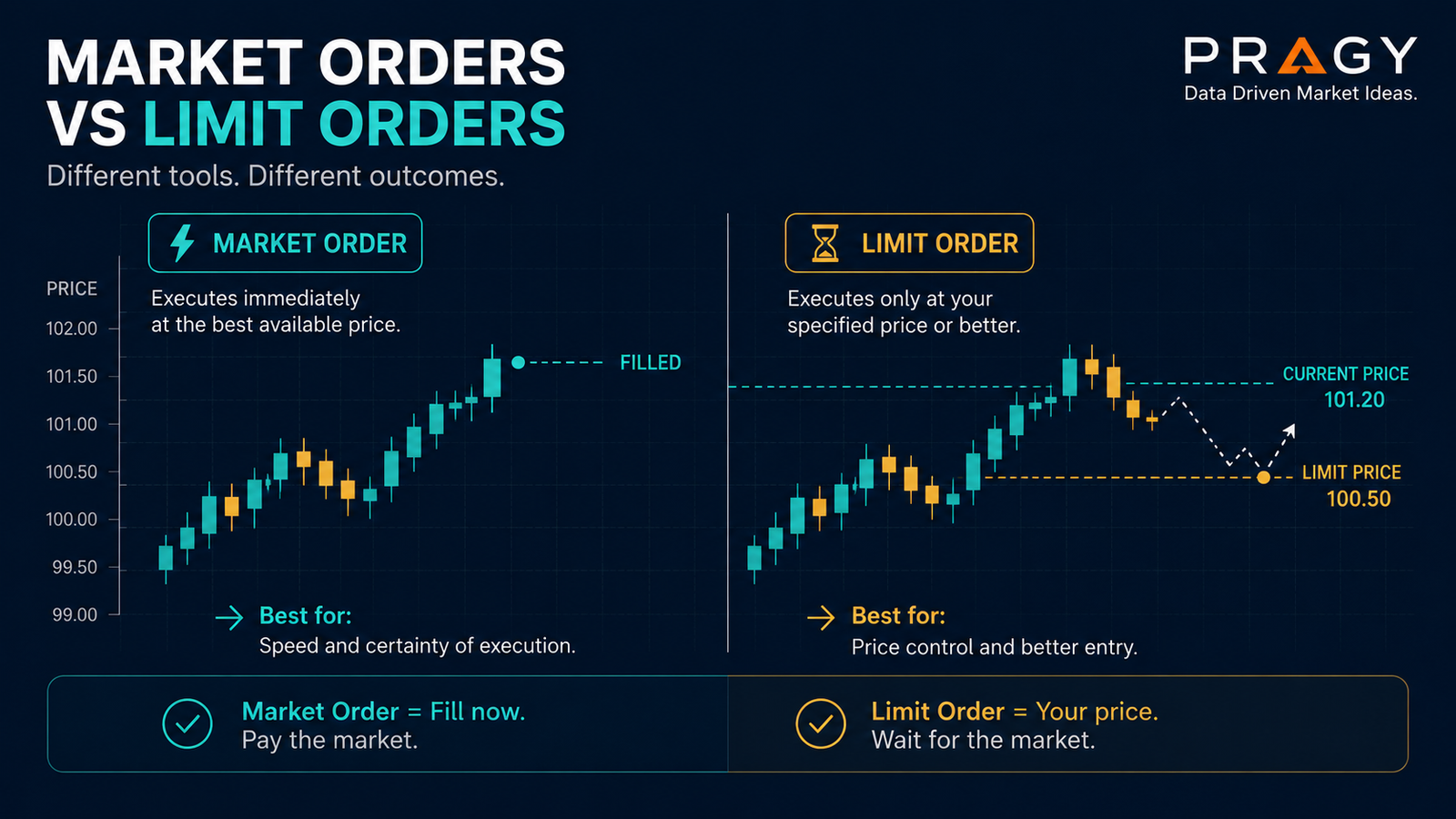
A market order tells your broker: “Fill this order now at the best available price.”
A limit order tells your broker: “Fill this order only at my chosen price or better.”
That is the clean version.
Market orders give you execution certainty. You are more likely to get filled, but the exact price can move.
Limit orders give you price control. You define the worst price you are willing to accept, but the order may not fill.
Neither is automatically “better.” The better choice depends on what you are trying to control.
What is a market order?
A market order is an instruction to execute immediately at the best available price in the market.
For a beginner, think of it like this:
You are saying, “I want in or out now. Price is secondary.”
That can be useful when speed matters. But the trap is assuming the price you see on the screen is the exact price you will get.
It might be close.
It might not be.
The final fill depends on available buyers and sellers, how fast price is moving, and how liquid the stock is.
Liquidity means how easily something can be traded without moving the price too much. A highly liquid stock usually has many buyers and sellers. A thinly traded stock may have fewer participants, which can make fills less predictable.
What is a limit order?
A limit order is an instruction to execute only at a specific price or better.
For a buy limit order, you are setting the highest price you are willing to pay.
For a sell limit order, you are setting the lowest price you are willing to accept.
You are saying, “I care about price. Do not fill me worse than this.”
Green flag: limit orders help beginners slow down and think before clicking.
Red flag: a limit order can sit there and do nothing if the market never trades at your price.
That is not a bug. That is the point.
The key trade-off: execution vs price control
Every order type has a job.
A market order is built for execution. Execution means the order actually gets filled.
A limit order is built for price control. Price control means you decide the worst acceptable price before the order goes to the market.
Here is the simple trade-off:
| Order type | Main priority | Main risk |
|---|---|---|
| Market order | Getting filled quickly | Final price may be worse than expected |
| Limit order | Controlling the price | Order may not fill |
Don’t overcomplicate it.
Ask one question:
Do I care more about getting filled, or do I care more about the price?
That question does most of the work.
Why the bid-ask spread matters
Before you understand market and limit orders, you need to understand the bid-ask spread.
The bid is the highest price a buyer is currently offering.
The ask is the lowest price a seller is currently asking.
The spread is the gap between them.
Example:
- Bid: $49.95
- Ask: $50.05
- Spread: $0.10
If you place a market order to buy, you may be filled near the ask.
If you place a market order to sell, you may be filled near the bid.
That spread is not just trivia. It is part of the cost of entering and exiting.
In liquid stocks, the spread may be tight. In less liquid stocks, the spread can be wider. Wider spreads make market orders more dangerous because the final fill can be farther from the price you expected.
Slippage: the sneaky market order problem
Slippage happens when your order fills at a different price than expected.
Sometimes the difference is tiny.
Sometimes it is not.
Slippage can happen when price moves quickly, volume is low, the spread is wide, or the order size is large compared with available liquidity.
Volume means how many shares trade during a period. Higher volume often means more participation, but it does not guarantee a perfect fill.
Volatility means how much and how quickly price moves. Higher volatility can make market orders more unpredictable.
This is where people mess up: they see a clean chart, click a market order, and forget that the market is not frozen in place.
The chart is a picture.
The order book is live.
When a market order may make sense
A market order can make sense in an educational scenario where:
- The stock is highly liquid.
- The bid-ask spread is tight.
- The order size is small relative to typical trading volume.
- Speed matters more than getting a specific price.
- The trader understands the risk of slippage.
For example, a self-directed learner may use a market order to exit quickly from a small position in a highly liquid stock when the spread is only a few cents.
That does not make market orders “safe.” It just means the trade-off may be acceptable in that context.
When a limit order may make sense
A limit order can make sense in an educational scenario where:
- Price control matters.
- The spread is wider.
- The stock moves quickly.
- The trader wants to avoid chasing.
- The setup only makes sense near a specific level.
For example, a learner watching a stock near support may decide that the idea only makes sense at or below a certain price.
Support is an area where buyers have previously stepped in.
A limit order can help define that boundary. It says, “I am only interested if price comes to my area.”
That is more disciplined than smashing the button because a candle is moving.
A candlestick is a chart bar that shows the open, high, low, and close for a period. A wick is the thin line above or below the candlestick showing how far price moved before closing.
Practical example: same stock, different orders
Imagine a fictional stock trading with:
- Bid: $99.90
- Ask: $100.10
- Last traded price: $100.00
A beginner wants to enter an educational example position.
Scenario 1: Market order
They place a market order to buy.
The order fills immediately at the best available price, maybe around $100.10.
But if the stock is moving fast, the fill could be higher.
The benefit: the order is likely filled.
The risk: the final price is not guaranteed.
Scenario 2: Limit order
They place a limit order to buy at $100.00.
Now the instruction is clear: fill at $100.00 or better.
If price comes down and sellers are available, the order may fill.
If price never trades there, the order may not fill.
The benefit: the trader controls the maximum price.
The risk: they may miss the entry.
Neither result is morally superior. It is just a different trade-off.
A simple beginner framework
Use this before choosing the order type.
1. Check the spread
Is the bid-ask spread tight or wide?
A tight spread may reduce the risk of a surprise fill. A wide spread is a red flag.
2. Check liquidity and volume
Is the stock actively traded, or does it move in jumpy gaps?
Thin liquidity can make market orders more unpredictable.
3. Decide what matters more
Do you need execution, or do you need price control?
If the setup only works at a certain price, a limit order may fit the logic better.
4. Define invalidation before entry
Invalidation is the price level or area where the trade idea is no longer valid.
Do not place an order first and invent the logic later.
That is backwards.
5. Plan the risk
Position sizing means deciding how much money to risk on one trade before entering.
A common beginner guardrail is risking about 1% to 2% of total account size on a single trade idea. For example, with a $5,000 account, 1% risk equals $50 of planned risk.
That planned risk should be based on the distance between the entry idea and the invalidation area, not on vibes.
Common mistakes beginners make
Mistake 1: Thinking the displayed price is guaranteed
The displayed price is not a promise. It is a snapshot.
Markets move.
Mistake 2: Using market orders in thin stocks
Low volume plus wide spreads can create ugly fills.
If the spread looks weird, slow down.
Mistake 3: Setting unrealistic limit prices
A limit order placed far away from the current market may never fill.
That can be fine if it is intentional. It is a problem if the trader does not understand why nothing happened.
Mistake 4: Chasing after a missed limit order
A missed trade is not an emergency.
The trap is repeatedly raising a limit order because price keeps moving away. That can turn a disciplined plan into an emotional entry.
Mistake 5: Ignoring order size
A small order in a liquid stock may fill easily.
A larger order in a thin stock may move through several price levels.
Same button. Different outcome.
Action checklist
Before placing a market or limit order, ask:
- Is the spread tight enough?
- Is volume healthy enough?
- Is price moving fast?
- Do I care more about execution or price control?
- What price would make this idea invalid?
- What is my planned risk?
- Am I clicking because I have a plan, or because the candle is moving?
That last question saves people from many bad decisions.
Final takeaway
Market orders are about speed.
Limit orders are about control.
A market order says, “Get it done.”
A limit order says, “Only at my price or better.”
The beginner mistake is treating them like interchangeable buttons. They are not.
Use the order type that matches the job. Execution when speed matters. Price control when discipline matters.
Clean decisions beat frantic clicks.
Disclaimer
Educational content only. Not personalized investment, trading, tax, or legal advice. Trading and investing involve risk, and loss of capital is possible.