
Options can feel like regular stock trading with extra buttons. Then you open an option chain and see Delta, Gamma, Theta, Vega, implied volatility, bid/ask spreads, expiration dates, and a tiny voice in your head whispers: “Maybe I should just close the laptop.”
Good news: the Greeks are not there to make you feel underqualified. They are there to explain what is pushing an option premium around.
The clean version: the Greeks are sensitivity measures. They estimate how an option’s theoretical price may react when one input changes, while other inputs stay the same. That last part matters. The market rarely changes one variable at a time, because markets enjoy making simple things annoying.
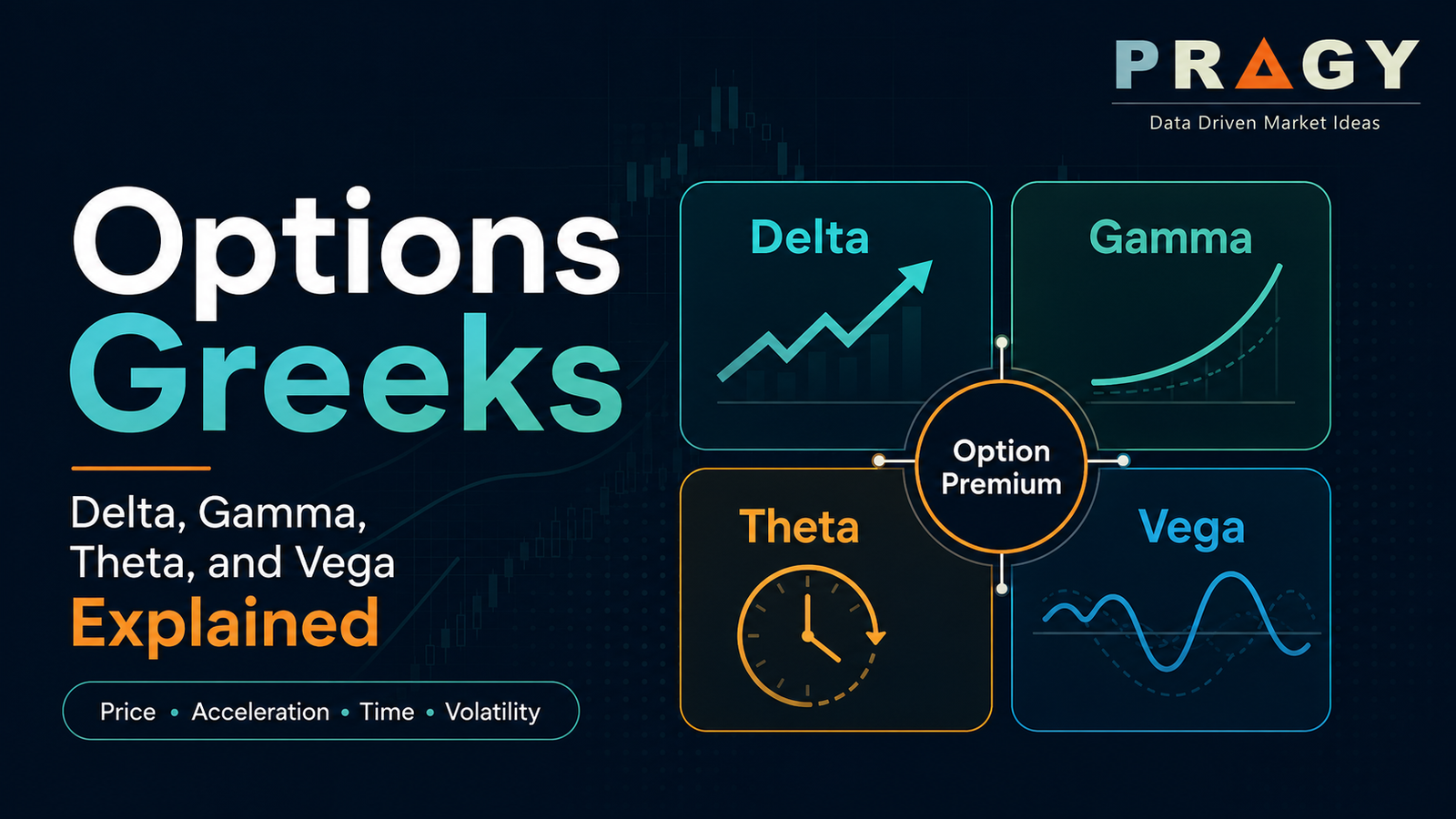
This article covers the four Greeks most beginners should understand first:
- Delta: sensitivity to the underlying price move
- Gamma: sensitivity of Delta itself
- Theta: sensitivity to time passing
- Vega: sensitivity to implied volatility
Rho exists too, but for many beginner option lessons, Delta, Gamma, Theta, and Vega do most of the heavy lifting.
Here’s the Simple Version
An option premium is not just “the price of the contract.” It is a moving estimate shaped by price, time, volatility, interest rates, dividends, and demand for that specific contract.
The Greeks help answer four practical questions:
| Greek | Plain-English Question | Beginner Translation |
|---|---|---|
| Delta | What happens if the stock moves? | Directional exposure |
| Gamma | How quickly can Delta change? | Acceleration risk |
| Theta | What happens as time passes? | Time decay |
| Vega | What happens if implied volatility changes? | Volatility exposure |
Think of them as dashboard gauges, not steering instructions.
A gauge can tell you the engine is hot. It does not tell you where to drive.
What Are Options Greeks?
Options Greeks are model-based estimates used to measure how an option’s theoretical value may change when a pricing input changes.
A pricing input is one of the variables that affects an option premium. Common inputs include the underlying price, strike price, time to expiration, implied volatility, interest rates, and dividends.
A few key points before we get into the details:
- Greeks are estimates, not promises. They are theoretical guideposts, not guaranteed premium changes.
- Greeks change constantly. Delta, Gamma, Theta, and Vega can shift as the underlying moves, time passes, volatility changes, and the contract moves closer to expiration.
- Greeks interact. Delta may explain the first move, but Gamma can change the next move. Theta may pull value lower, but Vega can offset it if implied volatility rises.
- Long and short options feel Greeks differently. A Greek that helps a long option holder can hurt a short option seller, and vice versa.
That is why the Greeks are best used as a risk-reading framework, not a magic decoder ring.
Delta: The Directional Greek
Delta estimates how much an option’s price may change for a $1 move in the underlying asset, holding other variables constant.
For calls, Delta is usually positive. For puts, Delta is usually negative.
A call with a Delta of +0.50 may theoretically gain about $0.50 if the underlying rises by $1. A put with a Delta of -0.40 may theoretically gain about $0.40 if the underlying falls by $1.
That sounds simple. It is not always simple.
Delta Is Not Fixed
Delta changes as the option moves in or out of the money.
- Deep in-the-money calls tend to have Delta closer to +1.
- Deep out-of-the-money calls tend to have Delta closer to 0.
- Deep in-the-money puts tend to have Delta closer to -1.
- Deep out-of-the-money puts tend to have Delta closer to 0.
In-the-money means the option has intrinsic value. For a call, that happens when the underlying price is above the strike price. For a put, it happens when the underlying price is below the strike price.
The Beginner Trap With Delta
The trap is treating Delta as certainty.
Some traders use Delta as a rough probability shortcut, but that shortcut can be sloppy. A 0.30 Delta option does not mean “there is exactly a 30% chance this works.” Delta is an option-pricing sensitivity, and it can change quickly.
The better beginner question is:
“How much directional exposure am I taking right now, and how could that exposure change if the underlying moves?”
That leads directly to Gamma.
Gamma: The Greek That Changes Delta
Gamma estimates how much Delta may change for a $1 move in the underlying asset, holding other variables constant.
If Delta is speed, Gamma is acceleration.
A call may start with a Delta of +0.40. If Gamma is 0.08 and the underlying rises by $1, the new Delta may move toward +0.48. If the underlying rises again, Delta may rise again.
This is why options can feel calm one moment and jumpy the next.
Where Gamma Gets Spicy
Gamma is usually most important near the strike price and near expiration. Translation: when an option is close to at-the-money and there is not much time left, small underlying moves can create larger changes in Delta.
At-the-money means the underlying price is close to the option’s strike price.
This matters because near expiration, an option can rapidly shift between “probably worthless” and “meaningfully in-the-money.” That shift can make Delta unstable.
The Beginner Trap With Gamma
The trap is looking only at Delta and ignoring the possibility that Delta may mutate.
A beginner might say, “This option only has a 0.25 Delta, so it is not very sensitive.”
Maybe. But if Gamma is high, that 0.25 Delta can change quickly after a price move. Gamma is the reason a position’s directional exposure may not stay where it started.
A clean Gamma question:
“If the underlying moves toward my strike, will this option become more sensitive faster than I expect?”
Theta: The Time-Decay Greek
Theta estimates how much an option’s theoretical value may change as one day passes, holding other variables constant.
Theta is usually discussed as time decay. Time decay means the option’s time value can erode as expiration gets closer.
For long options, Theta is often negative. If a long call has a Theta of -0.06, that means the option may theoretically lose about $0.06 of value per share over one day, all else equal. Since many standard equity options contracts represent 100 shares, that would be roughly $6 per contract before commissions, fees, and other market effects.
All else equal is the part people skip. They should not.
The underlying price can move. Implied volatility can rise. Bid/ask spreads can widen. Earnings can arrive. The market can do market things. Theta is not the only force in the room.
Theta Is Not Always Smooth
Theta decay is not a perfectly straight line. It often becomes more noticeable as expiration approaches, especially for at-the-money options.
That does not mean every option loses value at the same pace. Time decay depends on moneyness, implied volatility, expiration, and the structure of the position.
Moneyness describes where the underlying price sits relative to the strike price: in-the-money, at-the-money, or out-of-the-money.
The Beginner Trap With Theta
The trap is assuming “I was right on direction, so the option should be profitable.”
Not always.
A call buyer can be directionally right and still see weak results if the move is too slow, the entry premium was expensive, or implied volatility falls. Theta is the clock quietly charging rent.
A clean Theta question:
“How much time value is this contract losing while I wait for the scenario to develop?”
Vega: The Volatility Greek
Vega estimates how much an option’s theoretical value may change for a one percentage-point change in implied volatility, holding other variables constant.
Implied volatility is the market’s option-price-based estimate of expected movement. It is not a forecast from the sky. It is derived from current options prices.
If an option has a Vega of 0.10, a one-point increase in implied volatility may theoretically add about $0.10 to the option’s premium, all else equal. A one-point decrease may theoretically subtract about $0.10.
Why Vega Matters Around Events
Vega becomes especially important around events where the market expects larger movement, such as earnings, major product announcements, macro reports, or other known catalysts.
Before an event, implied volatility can rise because traders are willing to pay more for optionality. After the event, implied volatility can fall if uncertainty clears. That drop is often called an implied-volatility crush.
This is where many beginners get confused.
They may buy an option, the underlying moves in the “right” direction, and the option still disappoints because implied volatility falls enough to offset part of the directional gain.
That is not the platform being broken. That is Vega doing its job.
The Beginner Trap With Vega
The trap is ignoring whether the option is expensive because the market already expects a big move.
A clean Vega question:
“Is the premium rich because implied volatility is elevated, and what happens if that volatility cools?”
A Practical Example: One Hypothetical Call Option
Let’s use a fictional stock called ABC. No recommendation. No real quote. Just a clean classroom example.
Assume:
- ABC stock price: $100
- Option: $100 strike call
- Expiration: 30 days
- Premium: $4.00
- Delta: +0.52
- Gamma: 0.06
- Theta: -0.08
- Vega: 0.12
Here is how a beginner might read the Greeks:
| Scenario | Greek in Focus | Rough Interpretation |
|---|---|---|
| ABC rises from $100 to $101 | Delta | The call may gain about $0.52 before other effects. |
| ABC rises from $100 to $101 | Gamma | Delta may move from about +0.52 toward +0.58. |
| One day passes with no other change | Theta | The call may lose about $0.08 of value per share. |
| Implied volatility rises by 1 point | Vega | The call may gain about $0.12 of value per share. |
| Implied volatility falls by 3 points | Vega | The call may lose about $0.36 of value per share. |
Now combine the forces.
Suppose ABC rises $1, one day passes, and implied volatility falls by 2 points. A rough mental model could look like this:
| Component | Estimated Premium Effect |
|---|---|
| Delta effect from +$1 underlying move | +$0.52 |
| Theta effect from one day passing | -$0.08 |
| Vega effect from 2-point IV drop | -$0.24 |
| Rough net effect before spread/slippage/model changes | +$0.20 |
The option may still gain, but much less than a beginner might expect from direction alone.
This is why Greeks are useful. They force you to stop asking only, “Was I right on direction?” and start asking, “Which forces are helping or hurting the premium?”
How the Greeks Work Together
Greeks rarely matter in isolation.
Delta and Gamma Are the Price-Move Team
Delta tells you the current directional sensitivity. Gamma tells you how unstable that sensitivity may be.
If Gamma is low, Delta may move more gradually. If Gamma is high, Delta can change faster, especially near expiration.
Theta and Vega Fight Over Extrinsic Value
Extrinsic value is the portion of an option premium beyond intrinsic value. It reflects time, volatility, and other pricing assumptions.
Theta usually pulls extrinsic value lower as time passes. Vega can push extrinsic value higher or lower as implied volatility changes.
This is why a long option can lose value during a quiet market even if the underlying does not move much. Time keeps passing, and implied volatility may fade.
The Contract’s Context Decides Which Greek Matters Most
There is no universal “most important Greek.” It depends on the contract.
| Contract Situation | Greek to Watch Closely | Why |
|---|---|---|
| At-the-money and near expiration | Gamma | Delta can change quickly. |
| Long option with little time left | Theta | Time decay can dominate. |
| Event-driven option | Vega | Implied volatility changes can drive premium. |
| Deep in-the-money option | Delta | The option may behave more like the underlying. |
| Far out-of-the-money option | Vega and Gamma | Premium may depend heavily on volatility and a sharp move. |
The market is not grading you on memorizing Greek letters. It is testing whether you understand the risk drivers.
Annoying, but fair.
Common Mistakes Beginners Make With Greeks
1. Reading Greeks as Guarantees
Greeks are theoretical estimates. Real option prices are affected by bid/ask spreads, liquidity, order flow, dividends, rates, volatility shifts, and model assumptions.
A Delta estimate is not a receipt.
2. Looking at One Greek Alone
An option can have attractive Delta but painful Theta. It can have low Theta but expensive implied volatility. It can have promising direction but poor liquidity.
Single-variable thinking is how options education turns into expensive tuition.
3. Forgetting That Greeks Change
The Greeks shown on an option chain are not permanent labels. They are snapshots.
As the stock moves, expiration approaches, and implied volatility changes, the Greeks can shift meaningfully.
4. Ignoring the Bid/Ask Spread
A theoretical model might say the option is worth $4.10. The market might show a bid of $3.90 and an ask of $4.30.
That spread matters. A beautiful Greek profile does not fix poor liquidity.
Liquidity means how easily an asset can be traded without causing a large price change.
5. Treating Vega as an Advanced Topic
Vega is not just for advanced traders. Any beginner buying options into an event should understand that implied volatility can fall after uncertainty clears.
The move can be right. The premium can still disappoint.
6. Thinking Theta Only Hurts Buyers
Long options often have negative Theta, but short options often carry positive Theta. That does not make short options “easy income.” Short options can carry assignment risk, margin risk, gap risk, and losses beyond the premium received depending on the strategy.
Theta is not free money. It is compensation for taking risk.
A Beginner-Friendly Greeks Checklist
Before analyzing any option contract, run this checklist:
- What is the underlying price relative to the strike?
Is the option in-the-money, at-the-money, or out-of-the-money?
- How much time remains until expiration?
Shorter-dated options can be more sensitive to Gamma and Theta.
- What is Delta telling me about current directional exposure?
Is the option behaving more like the underlying, or more like a low-probability convex bet?
- What is Gamma telling me about how fast Delta may change?
Is the contract near a zone where small price moves can create big sensitivity shifts?
- What is Theta telling me about the cost of waiting?
Is the expected scenario likely to develop fast enough for the time decay profile?
- What is Vega telling me about implied-volatility exposure?
Is the option vulnerable to volatility cooling after an event?
- How wide is the bid/ask spread?
Theoretical value matters less if getting in and out is inefficient.
- What would disprove the learning scenario?
Define the condition that would make the original idea no longer useful as a study case.
That last point matters. Options education should build process, not impulse.
The Clean Mental Model
Use this:
- Delta is the steering wheel. It points to current directional exposure.
- Gamma is steering sensitivity. It tells you how quickly the wheel may turn.
- Theta is the clock. It reminds you that time has a cost.
- Vega is the weather system. It tells you how volatility pressure can inflate or deflate premium.
It is not perfect. No analogy is. But it gives beginners a useful starting map.
Final Takeaway
Options Greeks are not a secret language for predicting the future. They are a practical framework for understanding what can move an option premium.
Delta explains directional exposure. Gamma explains how that exposure can accelerate. Theta explains the cost of time. Vega explains volatility sensitivity.
Once you see those four forces together, options stop looking like random price tags and start looking like structured risk.
That does not make options safe. It makes the risks easier to name.
And in markets, naming the risk is usually the first adult step.
Sources and Further Reading
Source check: June 29, 2026.
- Options Industry Council — Understanding Options Greeks
- FINRA — Options
- Investor.gov — Investor Bulletin: An Introduction to Options
- Cboe — Learning the Greeks: An Expert’s Perspective
Disclaimer
Pragy Investments provides financial education and market research only.