
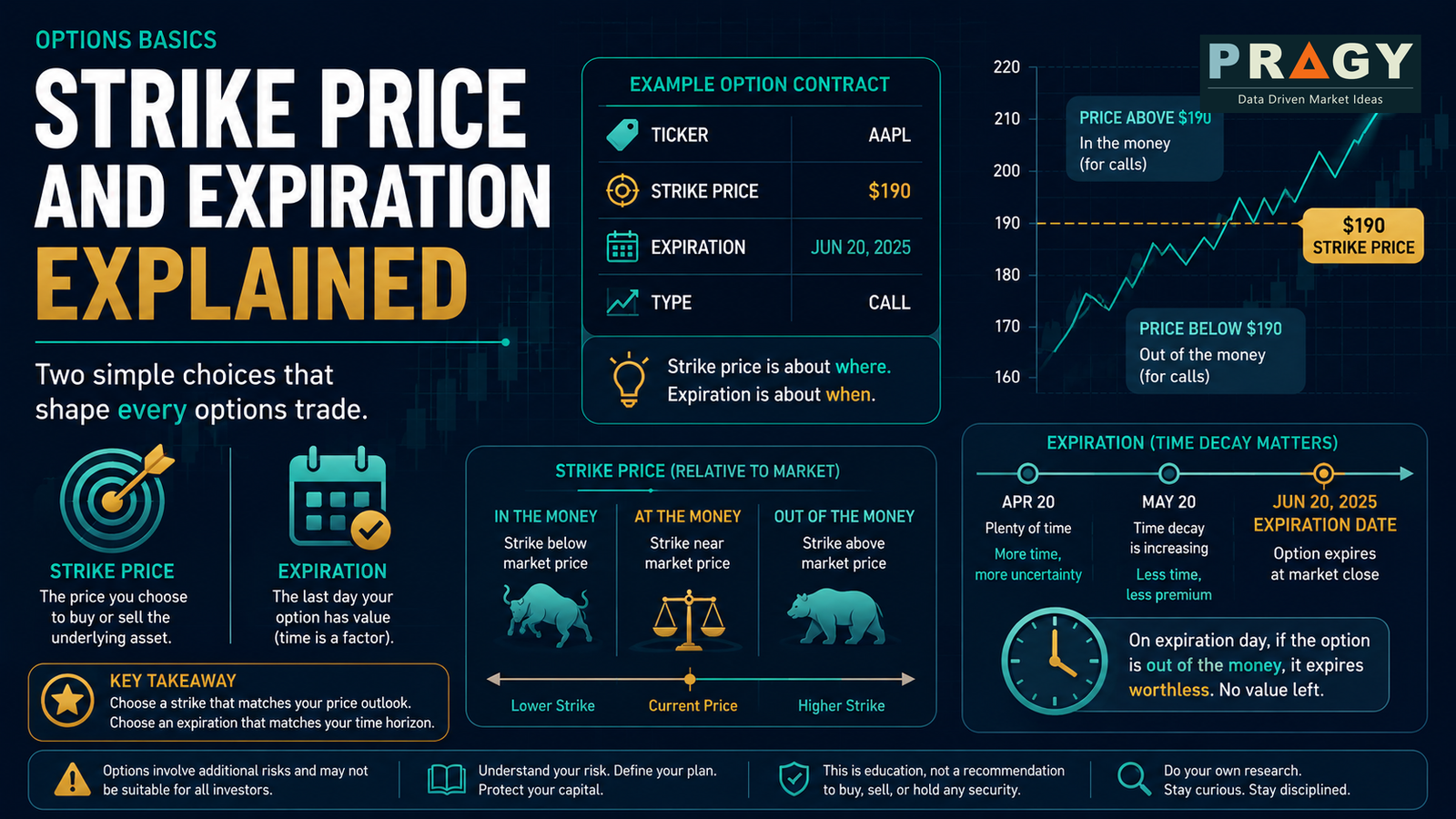
Options can look intimidating because every contract comes with its own little license plate: ticker, call or put, strike price, expiration date, and premium.
The good news: two pieces do most of the beginner confusion. The strike price answers, “At what price does this contract matter?” The expiration date answers, “How long does this contract have to matter?”
Get those two right, and options stop looking like alphabet soup with a deadline.
Here’s the simple version
An option is a contract. It gives the buyer the right, but not the obligation, to buy or sell an underlying asset at a specific price within a set time frame.
The strike price is that specific price.
The expiration date is the final date the contract can be used. After expiration, the contract no longer exists.
That is the clean version. Everything else is a layer on top.
Strike price: the contract’s reference line
The strike price is the price written into the option contract.
For a call option, the strike is the price where the call buyer has the right to buy the underlying shares.
For a put option, the strike is the price where the put buyer has the right to sell the underlying shares.
Think of the strike price as a horizontal line on a chart. The stock can move above it, below it, or sit near it. That relationship is what creates the language beginners see everywhere: in the money, at the money, and out of the money.
Expiration: the clock on the contract
Expiration is the contract’s deadline.
A stock can wander around forever. An option cannot. It has a clock, and the clock matters.
The more time left until expiration, the more opportunity there is for the underlying stock to move. The less time left, the less room there is for “maybe later.” That is why time is part of an option’s premium.
This is where people mess up: they focus only on direction.
A beginner might say, “I think the stock can rise.”
An options learner should ask, “Rise above which strike, by when, and by enough to matter after the premium?”
That one sentence saves a lot of confusion.
How strike and expiration work together
Strike price and expiration are not separate ideas. They are a pair.
The strike sets the price condition.
The expiration sets the time condition.
Here is the relationship:
| Contract detail | Plain-English question | Why it matters |
|---|---|---|
| Strike price | What price level is written into the contract? | It shapes whether the option is in, at, or out of the money. |
| Expiration date | How much time is left? | It affects time value and how quickly the contract’s clock is running. |
| Premium | What does the option cost per share? | It affects the breakeven math and the amount at risk for an option buyer. |
| Call or put | Is the right to buy or sell? | It determines how the strike relates to price movement. |
Moneyness: where price sits compared with the strike
Moneyness describes the relationship between the current stock price and the option’s strike price.
For calls:
- In the money: stock price is above the strike.
- At the money: stock price is around the strike.
- Out of the money: stock price is below the strike.
For puts:
- In the money: stock price is below the strike.
- At the money: stock price is around the strike.
- Out of the money: stock price is above the strike.
Same words. Opposite direction. Options like to make you earn your coffee.
A simple call-option example
Imagine a fictional stock, ExampleCo, trading at $50.
A learner compares three call options with the same expiration date:
| Call strike | Relationship to $50 stock price | Beginner translation |
|---|---|---|
| $45 call | In the money | The right to buy at $45 is already below the current stock price. |
| $50 call | At the money | The strike is close to the current stock price. |
| $55 call | Out of the money | The stock would need to move above $55 for the call to have intrinsic value. |
This does not make one contract “good” and another “bad.” It only tells you where the strike sits.
A lower call strike may have more intrinsic value and a higher premium. A higher call strike may be cheaper but require a larger move before it becomes in the money. The trade-off is the lesson.
A simple put-option example
Now use the same fictional stock at $50, but compare puts:
| Put strike | Relationship to $50 stock price | Beginner translation |
|---|---|---|
| $55 put | In the money | The right to sell at $55 is above the current stock price. |
| $50 put | At the money | The strike is close to the current stock price. |
| $45 put | Out of the money | The stock would need to move below $45 for the put to have intrinsic value. |
Puts often confuse beginners because the logic runs downward. A put generally becomes more valuable when the underlying price falls, all else equal.
Why expiration changes the feel of the same strike
Take the fictional $55 call from earlier.
Now compare two versions:
| Contract | Strike | Expiration | What changes? |
|---|---|---|---|
| Shorter-dated call | $55 | 7 days | Less time for the stock to move above the strike. |
| Longer-dated call | $55 | 60 days | More time for the stock to move above the strike. |
Same strike. Different clock.
The longer-dated option will often carry more time value because there is more time for price, volatility, and market conditions to change. The shorter-dated option has less time value and can lose it quickly as expiration approaches.
That does not mean longer is automatically better. It means the contract is different. More time usually costs more. Less time usually gives less margin for being early, late, or only partly right.
Intrinsic value versus time value
An option premium has two broad pieces:
Intrinsic value is the amount the option is already in the money.
Time value is the extra value tied to what could still happen before expiration.
A call with a $45 strike on a $50 stock has $5 of intrinsic value before considering premium details.
A call with a $55 strike on a $50 stock has no intrinsic value yet. Any premium it has is time value and volatility expectation.
That distinction matters because time value can shrink as expiration gets closer. The closer the deadline, the less time there is for a “maybe.”
The beginner’s contract-reading checklist
Before trying to interpret any option, read it in this order:
- Underlying: What stock or ETF is the contract based on?
- Type: Is it a call or a put?
- Strike: What price level is written into the contract?
- Expiration: What is the final date?
- Premium: What is the quoted price per share?
- Moneyness: Is the option in, at, or out of the money?
- Purpose: Is the example being used for speculation, hedging, income, volatility, or education?
That final question matters because the same strike and expiration can mean different things in different strategies.
Common mistakes beginners make
Mistake 1: Treating the strike like a prediction
A strike price is not a forecast. It is a contract term.
Seeing activity at a $100 strike does not prove a stock is “going to $100.” It may be speculation, hedging, a spread leg, volatility positioning, or something else entirely.
Mistake 2: Ignoring the deadline
Being directionally right after expiration does not help an expired contract.
Options are not just about “where price goes.” They are about where price goes before the clock runs out.
Mistake 3: Forgetting the premium
A call with a $55 strike does not simply need the stock to touch $55 for the buyer to profit at expiration. The premium paid matters.
For example, a $55 call costing $2 per share has a simplified expiration breakeven of $57, before commissions and other costs.
For a put, simplified expiration breakeven is strike minus premium.
Mistake 4: Thinking cheaper means safer
Out-of-the-money options often cost less, but they may also need a larger move before expiration. Cheap can still become worthless. Small price tag, big lesson.
Mistake 5: Reading one contract in isolation
A single option contract rarely tells the full story. Open interest, volume, spreads, implied volatility, underlying price action, earnings dates, and broader market context can all matter.
The clean framework
Use this mental model:
Strike = price condition.
Expiration = time condition.
Premium = cost of the possibility.
A beginner does not need to memorize every advanced options Greek on day one. Start by learning what the contract actually says. Then add pricing, volatility, and strategy context.
Final takeaway
Strike price and expiration are the two coordinates of an option contract.
The strike tells you the price level. The expiration tells you the deadline. Together, they define the basic question behind every option: “What would need to happen, by when, for this contract to matter?”
Keep that question front and center, and the options chain becomes much less noisy.
Sources
- Options Industry Council, “Options Basics”: https://www.optionseducation.org/optionsoverview/options-basics
- Options Industry Council, “Options Pricing”: https://www.optionseducation.org/optionsoverview/options-pricing
- The Options Clearing Corporation, “Primer: Options 101 Basic Concepts and Terminology”: https://www.theocc.com/getmedia/3e02a6d0-c770-49bd-ab0e-09ec6cc3bb73/OCC-Primer-Options-101-Terminology-F.pdf
- Investor.gov, “Investor Bulletin: An Introduction to Options”: https://www.investor.gov/introduction-investing/general-resources/news-alerts/alerts-bulletins/investor-bulletins-63
Disclaimer
Pragy Investments provides financial education and market research only. This content is not investment advice, financial planning, portfolio management, tax advice, legal advice, or a recommendation to buy, sell, or hold any security. Examples and scenarios are for educational purposes only. Investing and trading involve risk, including possible loss of capital. Readers are responsible for their own decisions and should consult an appropriately qualified professional where needed. Options involve additional risks and may not be suitable for all investors. Options activity can reflect speculation, hedging, multi-leg strategies, volatility positioning, or other motives and does not by itself establish directional conviction.