
A fundamental thesis sounds serious because investors love giving simple ideas complicated names.
But the idea is not that mysterious.
A fundamental thesis is the reasoned argument for why a stock may be mispriced based on the actual business behind it. Not the chart. Not the hype. Not “someone online sounded confident.” The business.
Here’s the deal: a real thesis is not just “the company is good.” Plenty of good companies can become poor investment ideas at the wrong price. A real thesis connects the business, the numbers, the valuation, the possible catalyst, and the risk.
That is where the useful work begins.
Here’s the simple version
A fundamental thesis answers one clean question:
What would need to be true for this stock to be worth more, less, or about the same than the market currently thinks?
That question forces discipline.
It pushes you away from vague opinions and toward testable assumptions. Instead of saying, “This company has strong growth,” you ask:
- Is revenue growth durable?
- Are margins improving or weakening?
- Is free cash flow actually showing up?
- Is the valuation already pricing in perfection?
- What could prove the thesis wrong?
The clean version: a thesis is not a prediction. It is a research framework.
What a fundamental thesis is
A fundamental thesis is a structured view of a company based on the factors that drive long-term business value.
That usually includes:
- Business model: how the company makes money.
- Financial performance: revenue, margins, cash flow, debt, and returns.
- Competitive position: why customers choose this business instead of another.
- Valuation: what price the market is assigning to those fundamentals.
- Catalyst: what could cause the market to update its view.
- Risk: what could make the thesis wrong.
A catalyst is an event or development that may cause investors to reassess the stock. Examples could include improving earnings, a new product cycle, margin expansion, lower debt, or a major change in industry conditions.
A thesis without a catalyst can still be valid, but it may take longer to play out. A thesis without risk analysis is just optimism wearing a blazer.
What a fundamental thesis is not
This is where people mess up.
A fundamental thesis is not:
- A catchy story about a company.
- A list of reasons you like the brand.
- A one-line opinion from social media.
- A valuation number with no assumptions.
- A hope that price will eventually agree with you.
The trap is confusing familiarity with understanding.
You may use a product every day and still have no idea whether the stock is attractive at the current price. A great company can be overvalued. A boring company can be undervalued. A declining company can look cheap for a reason.
Fundamental work is about separating the business from the stock price.
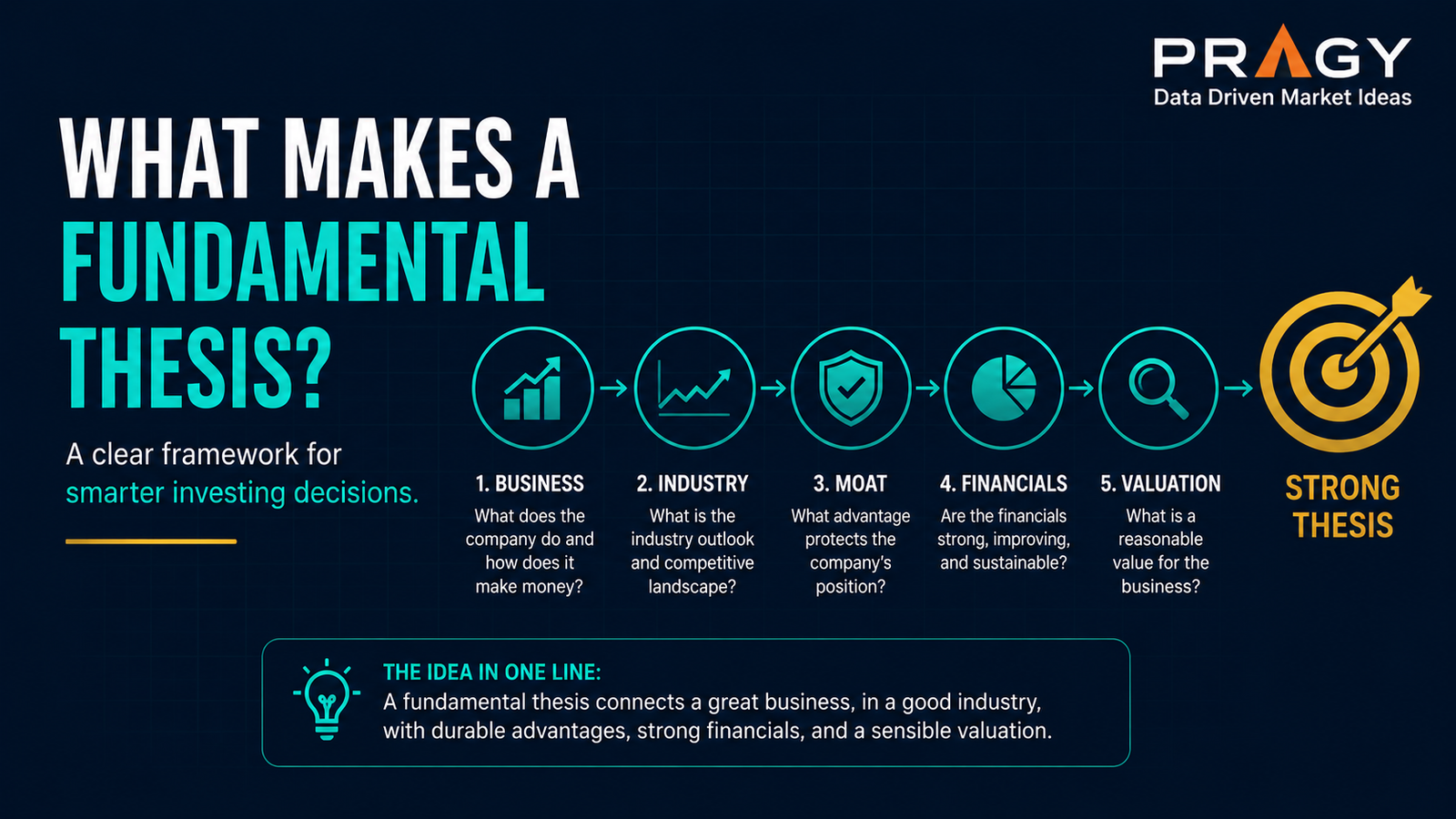
The five building blocks of a useful thesis
A strong fundamental thesis usually has five parts.
1. The business model
Start with the simplest question: How does this company make money?
Not “what does it do?” That is too shallow.
You want to understand the money engine. Does the company sell products, subscriptions, services, advertising, software, financing, marketplace access, or something else? Are revenues recurring or one-time? Are customers sticky or quick to leave?
A strong thesis explains the business model in plain English.
Green flag: you can explain the business in two sentences without using buzzwords.
Red flag: the thesis falls apart unless you use words like “disruption,” “ecosystem,” “AI-powered,” or “next-generation” every seven seconds.
2. The financial engine
The business story needs to show up in the numbers.
Useful questions include:
- Is revenue growing, flat, or shrinking?
- Are gross margins stable?
- Are operating margins improving?
- Is the company producing free cash flow?
- Is debt manageable?
- Are returns on invested capital attractive?
Free cash flow means the cash left after a business pays for operating needs and necessary capital spending. It matters because accounting profits can look clean while actual cash generation tells a different story.
Do not overcomplicate it. If a company keeps reporting growth but never turns that growth into cash, the thesis needs a very clear explanation.
3. The competitive advantage
A competitive advantage is what helps a company defend its profits against competitors.
That might come from brand strength, switching costs, scale, patents, network effects, cost leadership, distribution, data, regulatory position, or operational execution.
The key word is defend.
A company can grow quickly for a while without having a durable advantage. But if competitors can copy the product, undercut the pricing, and steal customers easily, the thesis needs to account for that.
A useful thesis explains why the company may keep winning, not just why it has won before.
4. The valuation
Valuation is where the story meets the price tag.
A company can be high quality and still not offer an attractive research setup if the stock already reflects aggressive expectations.
Common valuation tools include:
- Price-to-earnings ratio, often called P/E, which compares stock price to earnings.
- Price-to-sales ratio, often called P/S, which compares market value to revenue.
- Enterprise value to EBITDA, often called EV/EBITDA, which compares total company value to operating earnings before certain expenses.
- Discounted cash flow, often called DCF, which estimates value based on future cash flows.
The exact tool matters less than the assumptions behind it.
The better question is: What is the market already expecting?
If the stock requires perfect growth, perfect margins, and perfect execution to make sense, that is not automatically wrong. But it is a thinner margin for error.
5. The risk and invalidation
A good thesis includes the conditions that would weaken or break it.
Invalidation means the evidence that shows your original idea may no longer be valid. In fundamental research, invalidation could be slower revenue growth, margin pressure, rising debt, customer losses, failed product launches, weak cash flow, or valuation assumptions that no longer make sense.
This is not negative thinking. It is professional thinking.
A thesis without invalidation is hard to manage because every new data point becomes something to rationalize.
A practical thesis framework
Use this simple structure when building a fundamental thesis:
The one-paragraph thesis
Write the full idea in one paragraph:
This company may be mispriced because [core business reason]. The key drivers are [growth, margins, cash flow, or balance sheet factor]. The market may update its view if [catalyst]. The main risks are [risk factors]. The thesis would weaken if [invalidation evidence].
That paragraph forces clarity.
If you cannot fill it out cleanly, the idea may not be ready.
The assumption table
Every thesis has assumptions. The honest investor writes them down.
| Thesis component | Question to answer | Example research angle |
|---|---|---|
| Business model | How does the company make money? | Revenue sources and customer behavior |
| Growth | What drives future revenue? | Market size, pricing power, unit volume |
| Margins | Can profitability improve? | Cost structure and operating leverage |
| Cash flow | Does profit convert into cash? | Free cash flow trend |
| Valuation | What expectations are priced in? | Multiples, peer comparison, DCF assumptions |
| Catalyst | What may change market perception? | Earnings, guidance, debt reduction, product cycle |
| Risk | What could break the thesis? | Competition, regulation, demand weakness, execution |
The goal is not to predict the future perfectly. The goal is to know what you are actually betting your research view on.
Example: turning a vague idea into a real thesis
Weak version:
“Company A is a great business and the stock could do well.”
That tells you almost nothing.
Better version:
“Company A may deserve a closer research look because recurring revenue is growing, margins are expanding, and free cash flow has started to improve after several years of investment. The key question is whether revenue growth can stay above industry averages while management keeps costs controlled. The thesis would weaken if customer retention drops, margins reverse, or free cash flow fails to scale.”
Now you have something testable.
You can track revenue. You can track margins. You can track customer metrics. You can track free cash flow. You can watch whether management’s commentary matches the numbers.
That is the difference between a stock opinion and a research thesis.
Common mistakes beginners make
Mistake 1: Starting with the stock price
Price matters, but it should not be the whole thesis.
A stock being down 40% does not automatically make it attractive. It may be cheaper, or it may be correctly reflecting a weaker business.
The question is not “how far has it fallen?”
The question is “what has changed in the business, and what is the market pricing in now?”
Mistake 2: Ignoring valuation
Beginners often fall in love with quality and forget price.
A strong business can still carry weak future return potential if expectations are too aggressive. Valuation does not need to be perfect, but it needs to be considered.
Red flag: the thesis says the company is amazing but never explains what would make the current price reasonable.
Mistake 3: Treating growth as automatically good
Growth is only useful if it creates value.
A company can grow revenue while burning cash, diluting shareholders, or chasing low-margin business. That does not mean growth is bad. It means growth needs context.
Look for the quality of growth, not just the speed.
Mistake 4: No invalidation point
A thesis should tell you what would make you rethink.
Without invalidation, every bad quarter becomes “temporary,” every miss becomes “noise,” and every warning sign becomes something to ignore.
That is how research turns into attachment.
Mistake 5: Copying someone else’s thesis
Reading other research can be useful. Blindly adopting it is not.
A thesis only helps if you understand the assumptions. If you cannot explain what would prove it wrong, it is not your thesis yet.
Action checklist
Before putting a stock on a research watchlist, ask:
- Can I explain the business model simply?
- Do I understand the main revenue and profit drivers?
- Is the company producing or moving toward durable free cash flow?
- What gives the business a competitive advantage?
- What expectations are already reflected in valuation?
- What catalyst could make the market reassess the stock?
- What risks could damage the thesis?
- What evidence would make me change my view?
- Am I separating the company’s quality from the stock’s current price?
- Is this an educational research idea, not an emotional attachment?
Final takeaway
A fundamental thesis is not a fancy opinion.
It is a clear, testable explanation of why a stock may be mispriced based on business reality.
The best theses are simple enough to explain, specific enough to track, and honest enough to include the risks. They do not rely on hype. They do not require perfect certainty. They give you a framework for learning, testing, and updating your view as new information arrives.
The clean version: build the thesis before you build conviction.
Disclaimer
Educational content only. Not financial advice, not a recommendation to buy, sell, or hold any security. Investing and trading involve risk, including possible loss of capital.